

Level 2 – Case 28
186
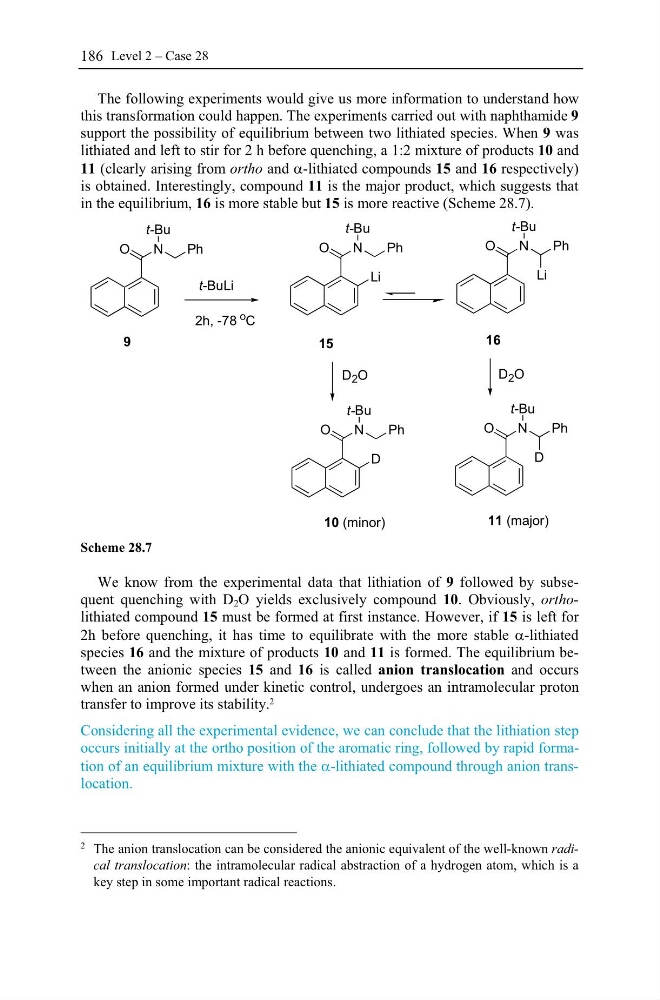
The following experiments would give us more information to understand how
this transformation could happen. The experiments carried out with naphthamide 9
support the possibility of equilibrium between two lithiated species. When 9 was
lithiated and left to stir for 2 h before quenching, a 1:2 mixture of products 10 and
11 (clearly arising from ortho and D-lithiated compounds 15 and 16 respectively)
is obtained. Interestingly, compound 11 is the major product, which suggests that
in the equilibrium, 16 is more stable but 15 is more reactive (Scheme 28.7).
O
N
Ph
t-Bu
O
N
Ph
t-Bu
Li
O
N
Ph
t-Bu
D
D 2 O
O
N
Ph
t-Bu
D
O
N
Ph
t-Bu
Li
D 2 O
9
t-BuLi
2h, -78 o C
10 (minor)
11 (major)
15
16
Scheme 28.7
We know from the experimental data that lithiation of 9 followed by subsequent quenching with D 2 O yields exclusively compound 10. Obviously, ortholithiated compound 15 must be formed at first instance. However, if 15 is left for
2h before quenching, it has time to equilibrate with the more stable D-lithiated
species 16 and the mixture of products 10 and 11 is formed. The equilibrium between the anionic species 15 and 16 is called anion translocation and occurs
when an anion formed under kinetic control, undergoes an intramolecular proton
transfer to improve its stability.
2
Considering all the experimental evidence, we can conclude that the lithiation step
occurs initially at the ortho position of the aromatic ring, followed by rapid formation of an equilibrium mixture with the D-lithiated compound through anion translocation.
2 The anion translocation can be considered the anionic equivalent of the well-known radical translocation: the intramolecular radical abstraction of a hydrogen atom, which is a
key step in some important radical reactions.
186
The following experiments would give us more information to understand how
this transformation could happen. The experiments carried out with naphthamide 9
support the possibility of equilibrium between two lithiated species. When 9 was
lithiated and left to stir for 2 h before quenching, a 1:2 mixture of products 10 and
11 (clearly arising from ortho and D-lithiated compounds 15 and 16 respectively)
is obtained. Interestingly, compound 11 is the major product, which suggests that
in the equilibrium, 16 is more stable but 15 is more reactive (Scheme 28.7).
O
N
Ph
t-Bu
O
N
Ph
t-Bu
Li
O
N
Ph
t-Bu
D
D 2 O
O
N
Ph
t-Bu
D
O
N
Ph
t-Bu
Li
D 2 O
9
t-BuLi
2h, -78 o C
10 (minor)
11 (major)
15
16
Scheme 28.7
We know from the experimental data that lithiation of 9 followed by subsequent quenching with D 2 O yields exclusively compound 10. Obviously, ortholithiated compound 15 must be formed at first instance. However, if 15 is left for
2h before quenching, it has time to equilibrate with the more stable D-lithiated
species 16 and the mixture of products 10 and 11 is formed. The equilibrium between the anionic species 15 and 16 is called anion translocation and occurs
when an anion formed under kinetic control, undergoes an intramolecular proton
transfer to improve its stability.
2
Considering all the experimental evidence, we can conclude that the lithiation step
occurs initially at the ortho position of the aromatic ring, followed by rapid formation of an equilibrium mixture with the D-lithiated compound through anion translocation.
2 The anion translocation can be considered the anionic equivalent of the well-known radical translocation: the intramolecular radical abstraction of a hydrogen atom, which is a
key step in some important radical reactions.