

A Dearomatizing Disrotatory Electrocyclic Ring Closure
r r
185
O
N
Ph
t-Bu
2) D 2 O
O
N
Ph
t-Bu
D
O
N
Ph
t-Bu
D
9
1) t-BuLi
10
11
Scheme 28.4
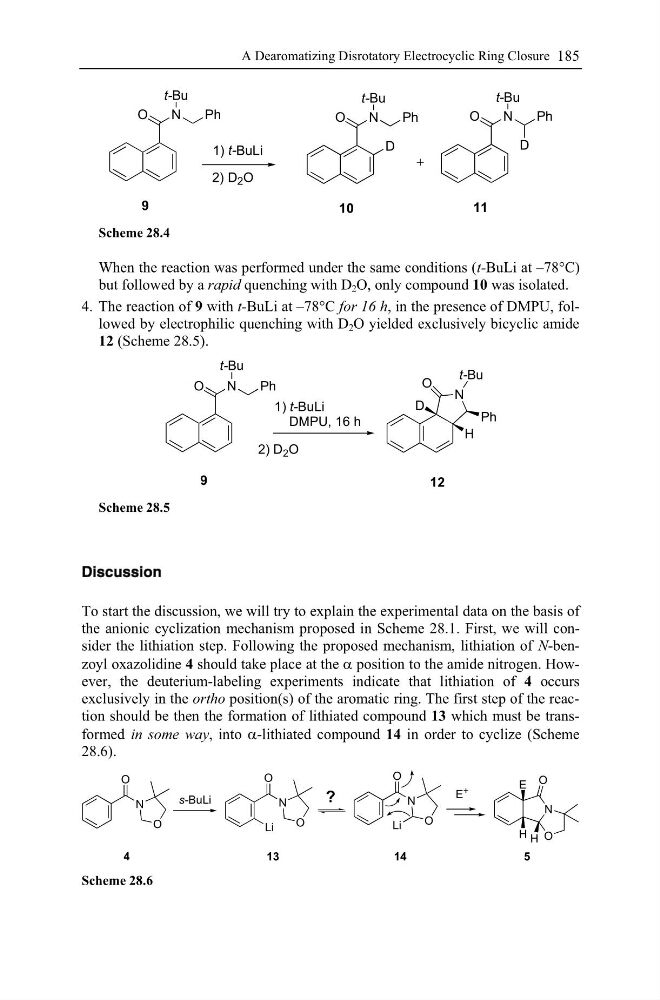
When the reaction was performed under the same conditions (t-BuLi at –78°C)
but followed by a rapid quenching with D
d
2 O, only compound 10 was isolated.
4. The reaction of 9 with t-BuLi at –78°C for 16 h, in the presence of DMPU, followed by electrophilic quenching with D 2 O yielded exclusively bicyclic amide
12 (Scheme 28.5).
O
N
Ph
t-Bu
2) D 2 O
N
O
t-Bu
H
D
Ph
9
1) t-BuLi
DMPU, 16 h
12
Scheme 28.5
D Di is sc cu us ss si io on n
To start the discussion, we will try to explain the experimental data on the basis of
the anionic cyclization mechanism proposed in Scheme 28.1. First, we will consider the lithiation step. Following the proposed mechanism, lithiation of N
f -benN N
zoyl oxazolidine 4 should take place at the D position to the amide nitrogen. However, the deuterium-labeling experiments indicate that lithiation of 4 occurs
exclusively in the ortho position(s) of the aromatic ring. The first step of the reaction should be then the formation of lithiated compound 13 which must be transformed in some way, into D-lithiated compound 14 in order to cyclize (Scheme
28.6).
N
O
O
N
O
O
Li
14
13
N
O
O
H H
E
5
?
E +
s-BuLi
N
O
O
Scheme 28.6
r r
185
O
N
Ph
t-Bu
2) D 2 O
O
N
Ph
t-Bu
D
O
N
Ph
t-Bu
D
9
1) t-BuLi
10
11
Scheme 28.4
When the reaction was performed under the same conditions (t-BuLi at –78°C)
but followed by a rapid quenching with D
d
2 O, only compound 10 was isolated.
4. The reaction of 9 with t-BuLi at –78°C for 16 h, in the presence of DMPU, followed by electrophilic quenching with D 2 O yielded exclusively bicyclic amide
12 (Scheme 28.5).
O
N
Ph
t-Bu
2) D 2 O
N
O
t-Bu
H
D
Ph
9
1) t-BuLi
DMPU, 16 h
12
Scheme 28.5
D Di is sc cu us ss si io on n
To start the discussion, we will try to explain the experimental data on the basis of
the anionic cyclization mechanism proposed in Scheme 28.1. First, we will consider the lithiation step. Following the proposed mechanism, lithiation of N
f -benN N
zoyl oxazolidine 4 should take place at the D position to the amide nitrogen. However, the deuterium-labeling experiments indicate that lithiation of 4 occurs
exclusively in the ortho position(s) of the aromatic ring. The first step of the reaction should be then the formation of lithiated compound 13 which must be transformed in some way, into D-lithiated compound 14 in order to cyclize (Scheme
28.6).
N
O
O
N
O
O
Li
14
13
N
O
O
H H
E
5
?
E +
s-BuLi
N
O
O
Scheme 28.6