

Level 2 – Case 28
188
It is worth noting that DMPU is added in all cases to obtain the cyclization
products. DMPU (like HMPA) is a good cation-solvating solvent. In this case it is
believed that DMPU forces ortho organolithium 13 to undergo anion translocation
to give the D-lithiated intermediate 14 and favors the electrocyclic ring closure
step. The effect of the removal of the counterion to accelerate a pericyclic reaction
has been also observed in anionic oxy-Cope rearrangements.
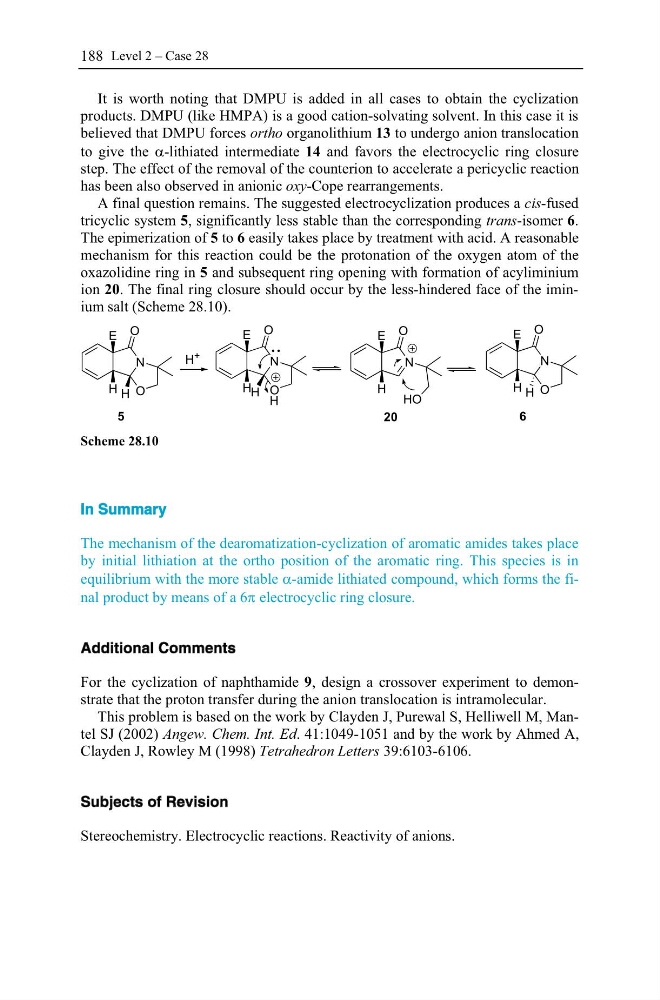
A final question remains. The suggested electrocyclization produces a cis-fused
tricyclic system 5, significantly less stable than the corresponding trans-isomer 6.
The epimerization of 5 to 6 easily takes place by treatment with acid. A reasonable
mechanism for this reaction could be the protonation of the oxygen atom of the
oxazolidine ring in 5 and subsequent ring opening with formation of acyliminium
ion 20. The final ring closure should occur by the less-hindered face of the iminium salt (Scheme 28.10).
N
O
O
E
H H
H +
N
O
H
O
E
H H
N
O
E
H
HO
N
O
O
E
H H
5
20
6
Scheme 28.10
In Summary
The mechanism of the dearomatization-cyclization of aromatic amides takes place
by initial lithiation at the ortho position of the aromatic ring. This species is in
equilibrium with the more stable D-amide lithiated compound, which forms the final product by means of a 6S electrocyclic ring closure.
Ad dd di it ti io on na al l C Co om mm me en nt ts s
For the cyclization of naphthamide 9, design a crossover experiment to demonstrate that the proton transfer during the anion translocation is intramolecular.
This problem is based on the work by Clayden J, Purewal S, Helliwell M, Mantel SJ (2002) Angew. Chem. Int. Ed. 41:1049-1051 and by the work by Ahmed A,
Clayden J, Rowley M (1998) Tetrahedron Letters 39:6103-6106.
S Su ub bj je ec ct ts s o of f R Re ev vi is si io on n
Stereochemistry. Electrocyclic reactions. Reactivity of anions.
188
It is worth noting that DMPU is added in all cases to obtain the cyclization
products. DMPU (like HMPA) is a good cation-solvating solvent. In this case it is
believed that DMPU forces ortho organolithium 13 to undergo anion translocation
to give the D-lithiated intermediate 14 and favors the electrocyclic ring closure
step. The effect of the removal of the counterion to accelerate a pericyclic reaction
has been also observed in anionic oxy-Cope rearrangements.
A final question remains. The suggested electrocyclization produces a cis-fused
tricyclic system 5, significantly less stable than the corresponding trans-isomer 6.
The epimerization of 5 to 6 easily takes place by treatment with acid. A reasonable
mechanism for this reaction could be the protonation of the oxygen atom of the
oxazolidine ring in 5 and subsequent ring opening with formation of acyliminium
ion 20. The final ring closure should occur by the less-hindered face of the iminium salt (Scheme 28.10).
N
O
O
E
H H
H +
N
O
H
O
E
H H
N
O
E
H
HO
N
O
O
E
H H
5
20
6
Scheme 28.10
In Summary
The mechanism of the dearomatization-cyclization of aromatic amides takes place
by initial lithiation at the ortho position of the aromatic ring. This species is in
equilibrium with the more stable D-amide lithiated compound, which forms the final product by means of a 6S electrocyclic ring closure.
Ad dd di it ti io on na al l C Co om mm me en nt ts s
For the cyclization of naphthamide 9, design a crossover experiment to demonstrate that the proton transfer during the anion translocation is intramolecular.
This problem is based on the work by Clayden J, Purewal S, Helliwell M, Mantel SJ (2002) Angew. Chem. Int. Ed. 41:1049-1051 and by the work by Ahmed A,
Clayden J, Rowley M (1998) Tetrahedron Letters 39:6103-6106.
S Su ub bj je ec ct ts s o of f R Re ev vi is si io on n
Stereochemistry. Electrocyclic reactions. Reactivity of anions.