

Level 2 – Case 27
180
v = 1/2 v isom
(27.1)
m
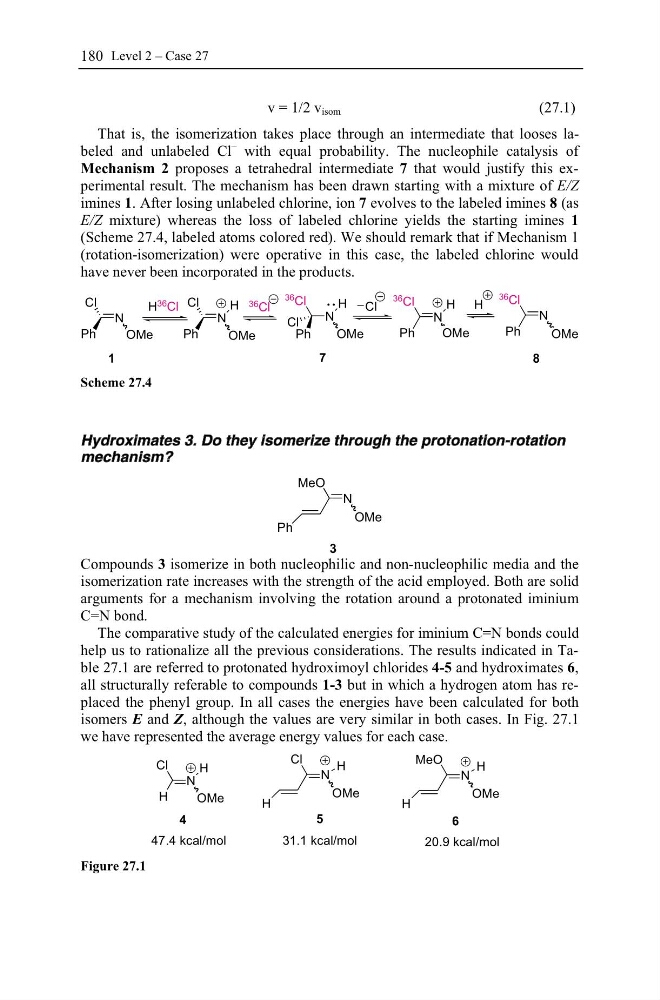
That is, the isomerization takes place through an intermediate that looses labeled and unlabeled Cl
– with equal probability. The nucleophile catalysis of
–
Mechanism 2 proposes a tetrahedral intermediate 7 that would justify this experimental result. The mechanism has been drawn starting with a mixture of E/Z
imines 1. After losing unlabeled chlorine, ion 7 evolves to the labeled imines 8 (as
E/Z mixture) whereas the loss of labeled
Z
chlorine yields the starting imines 1
(Scheme 27.4, labeled atoms colored red). We should remark that if Mechanism 1
(rotation-isomerization) were operative in this case, the labeled chlorine would
have never been incorporated in the products.
Ph
N
Cl
OMe
H 36 Cl
Ph
N
Cl
OMe
H 36 Cl
7
OMe
H
Cl
Ph
N
36 Cl
Cl
Ph
N
36 Cl
OMe
H H
Ph
N
36 Cl
OMe
1
Scheme 27.4
H Hy H Hy yd yd y yd yd y yd y ydr d dr d d dr d d o
ro r ro ro ro ro
r rox ox ox ox o o i
xi xi x xi xi x xim i im im
im i i a at te te t te te te te t tes s 3 3. 3. D Do o t th t th th th th t t e ey y y y i is is i is is is i i o om me er ri ri ri r ri ri r riz i iz i i iz i i e
ze ze ze ze z ze t th t th th th th t t r ro ro r ro ro ro ro r rou ug ug ug gh h h
gh t th t th th th th t t e e p pr ro ro r ro ro ro ro r rot to to to to to t ton na at ti ti ti t ti ti t tio io io io i ion n- -r ro ro r ro ro ro ro r rot ta ta t ta ta ta ta t tat ti ti ti t ti ti t tio io io io i ion n
m me ec ch ha an ni is is i is is is i i m m? ?
N
MeO
OMe
Ph
3
Compounds 3 isomerize in both nucleophilic and non-nucleophilic media and the
isomerization rate increases with the strength of the acid employed. Both are solid
arguments for a mechanism involving the rotation around a protonated iminium
C=N bond.
The comparative study of the calculated energies for iminium C=N bonds could
help us to rationalize all the previous considerations. The results indicated in Table 27.1 are referred to protonated hydroximoyl chlorides 4-5 and hydroximates 6,
all structurally referable to compounds 1-3 but in which a hydrogen atom has replaced the phenyl group. In all cases the energies have been calculated for both
isomers E and
E
Z, although the values are very similar in both cases. In Fig. 27.1
Z Z
we have represented the average energy values for each case.
N
MeO
OMe
H
H
N
Cl
OMe
H
H
H
N
Cl
OMe
H
4
5
6
47.4 kcal/mol
31.1 kcal/mol
20.9 kcal/mol
Figure 27.1
180
v = 1/2 v isom
(27.1)
m
That is, the isomerization takes place through an intermediate that looses labeled and unlabeled Cl
– with equal probability. The nucleophile catalysis of
–
Mechanism 2 proposes a tetrahedral intermediate 7 that would justify this experimental result. The mechanism has been drawn starting with a mixture of E/Z
imines 1. After losing unlabeled chlorine, ion 7 evolves to the labeled imines 8 (as
E/Z mixture) whereas the loss of labeled
Z
chlorine yields the starting imines 1
(Scheme 27.4, labeled atoms colored red). We should remark that if Mechanism 1
(rotation-isomerization) were operative in this case, the labeled chlorine would
have never been incorporated in the products.
Ph
N
Cl
OMe
H 36 Cl
Ph
N
Cl
OMe
H 36 Cl
7
OMe
H
Cl
Ph
N
36 Cl
Cl
Ph
N
36 Cl
OMe
H H
Ph
N
36 Cl
OMe
1
Scheme 27.4
H Hy H Hy yd yd y yd yd y yd y ydr d dr d d dr d d o
ro r ro ro ro ro
r rox ox ox ox o o i
xi xi x xi xi x xim i im im
im i i a at te te t te te te te t tes s 3 3. 3. D Do o t th t th th th th t t e ey y y y i is is i is is is i i o om me er ri ri ri r ri ri r riz i iz i i iz i i e
ze ze ze ze z ze t th t th th th th t t r ro ro r ro ro ro ro r rou ug ug ug gh h h
gh t th t th th th th t t e e p pr ro ro r ro ro ro ro r rot to to to to to t ton na at ti ti ti t ti ti t tio io io io i ion n- -r ro ro r ro ro ro ro r rot ta ta t ta ta ta ta t tat ti ti ti t ti ti t tio io io io i ion n
m me ec ch ha an ni is is i is is is i i m m? ?
N
MeO
OMe
Ph
3
Compounds 3 isomerize in both nucleophilic and non-nucleophilic media and the
isomerization rate increases with the strength of the acid employed. Both are solid
arguments for a mechanism involving the rotation around a protonated iminium
C=N bond.
The comparative study of the calculated energies for iminium C=N bonds could
help us to rationalize all the previous considerations. The results indicated in Table 27.1 are referred to protonated hydroximoyl chlorides 4-5 and hydroximates 6,
all structurally referable to compounds 1-3 but in which a hydrogen atom has replaced the phenyl group. In all cases the energies have been calculated for both
isomers E and
E
Z, although the values are very similar in both cases. In Fig. 27.1
Z Z
we have represented the average energy values for each case.
N
MeO
OMe
H
H
N
Cl
OMe
H
H
H
N
Cl
OMe
H
4
5
6
47.4 kcal/mol
31.1 kcal/mol
20.9 kcal/mol
Figure 27.1