

Acid-Catalyzed Isomerization of Imines 181
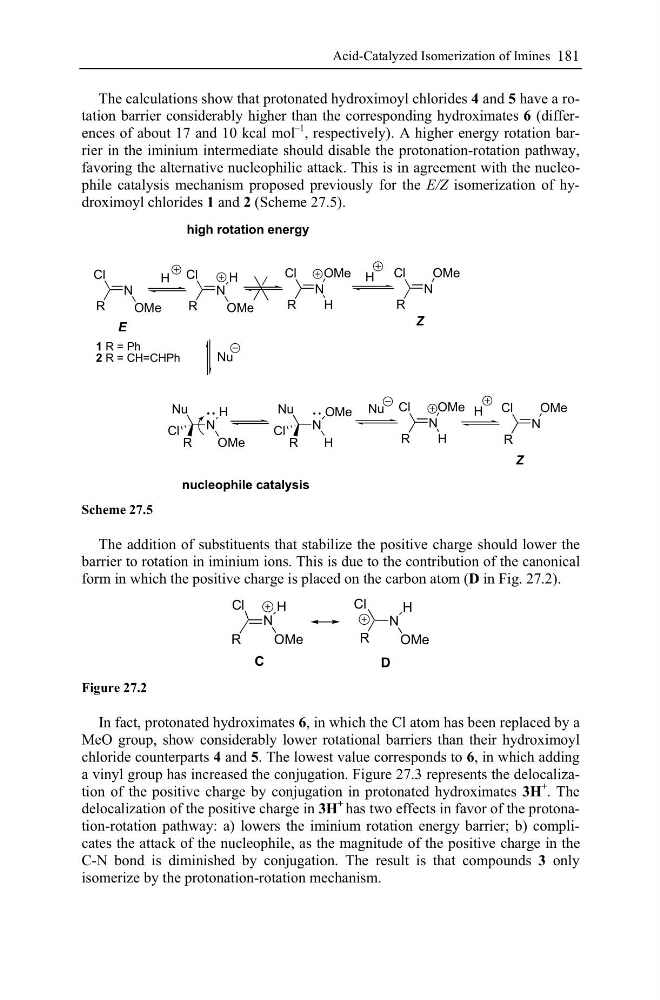
The calculations show that protonated hydroximoyl chlorides 4 and 5 have a rotation barrier considerably higher than the corresponding hydroximates 6 (differences of about 17 and 10 kcal mol
–1
, respectively). A higher energy rotation barrier in the iminium intermediate should disable the protonation-rotation pathway,
favoring the alternative nucleophilic attack. This is in agreement with the nucleophile catalysis mechanism proposed previously for the E/Z isomerization of hyZ
droximoyl chlorides 1 and 2 (Scheme 27.5).
R
N
Cl
OMe
H
R
N
Cl
OMe
H
R
N
Nu
OMe
H
Cl
R
N
Nu
H
OMe
Cl
N
Cl
OMe H
R
H
N
Cl
OMe
R
N
Cl
OMe
H
R
N
Cl
OMe
Nu
Nu
E
Z
high rotation energy
1 R = Ph
2 R = CH=CHPh
nucleophile catalysis
Z
Scheme 27.5
The addition of substituents that stabilize the positive charge should lower the
barrier to rotation in iminium ions. This is due to the contribution of the canonical
form in which the positive charge is placed on the carbon atom (D in Fig. 27.2).
R
N
Cl
OMe
H
C
D
R
N
Cl
OMe
H
Figure 27.2
In fact, protonated hydroximates 6, in which the Cl atom has been replaced by a
MeO group, show considerably lower rotational barriers than their hydroximoyl
chloride counterparts 4 and 5. The lowest value corresponds to 6, in which adding
a vinyl group has increased the conjugation. Figure 27.3 represents the delocalization of the positive charge by conjugation in protonated hydroximates 3H
+
. The
delocalization of the positive charge in 3H
+ has two effects in favor of the protonation-rotation pathway: a) lowers the iminium rotation energy barrier; b) complicates the attack of the nucleophile, as the magnitude of the positive charge in the
C-N bond is diminished by conjugation. The result is that compounds 3 only
isomerize by the protonation-rotation mechanism.
The calculations show that protonated hydroximoyl chlorides 4 and 5 have a rotation barrier considerably higher than the corresponding hydroximates 6 (differences of about 17 and 10 kcal mol
–1
, respectively). A higher energy rotation barrier in the iminium intermediate should disable the protonation-rotation pathway,
favoring the alternative nucleophilic attack. This is in agreement with the nucleophile catalysis mechanism proposed previously for the E/Z isomerization of hyZ
droximoyl chlorides 1 and 2 (Scheme 27.5).
R
N
Cl
OMe
H
R
N
Cl
OMe
H
R
N
Nu
OMe
H
Cl
R
N
Nu
H
OMe
Cl
N
Cl
OMe H
R
H
N
Cl
OMe
R
N
Cl
OMe
H
R
N
Cl
OMe
Nu
Nu
E
Z
high rotation energy
1 R = Ph
2 R = CH=CHPh
nucleophile catalysis
Z
Scheme 27.5
The addition of substituents that stabilize the positive charge should lower the
barrier to rotation in iminium ions. This is due to the contribution of the canonical
form in which the positive charge is placed on the carbon atom (D in Fig. 27.2).
R
N
Cl
OMe
H
C
D
R
N
Cl
OMe
H
Figure 27.2
In fact, protonated hydroximates 6, in which the Cl atom has been replaced by a
MeO group, show considerably lower rotational barriers than their hydroximoyl
chloride counterparts 4 and 5. The lowest value corresponds to 6, in which adding
a vinyl group has increased the conjugation. Figure 27.3 represents the delocalization of the positive charge by conjugation in protonated hydroximates 3H
+
. The
delocalization of the positive charge in 3H
+ has two effects in favor of the protonation-rotation pathway: a) lowers the iminium rotation energy barrier; b) complicates the attack of the nucleophile, as the magnitude of the positive charge in the
C-N bond is diminished by conjugation. The result is that compounds 3 only
isomerize by the protonation-rotation mechanism.