

Acid-Catalyzed Isomerization of Imines 179
Table 27. 1
kcal/mol
H
N
Cl
OMe
H
4
N
Cl
OMe
H
H
5
N
MeO
OMe
H
H
6
Z-isomer
47.2
30.3
20.4
Z Z
E-isomer
47.6
31.9
21.5
3. The rates of isomerization for 3 followed the order of acidity of the three acids
(triflic acid > HCl > HBF 4 ).
4. The rates of E/Z isomerization of 1 were compared to the rate of incorporation
of radioactive chloride ion (
36
Cl
–
) into the product during the isomerization. It
was found that
36
Cl was incorporated into the hydroxymoyl chloride at a rate
equal to one half the rate of isomerization.
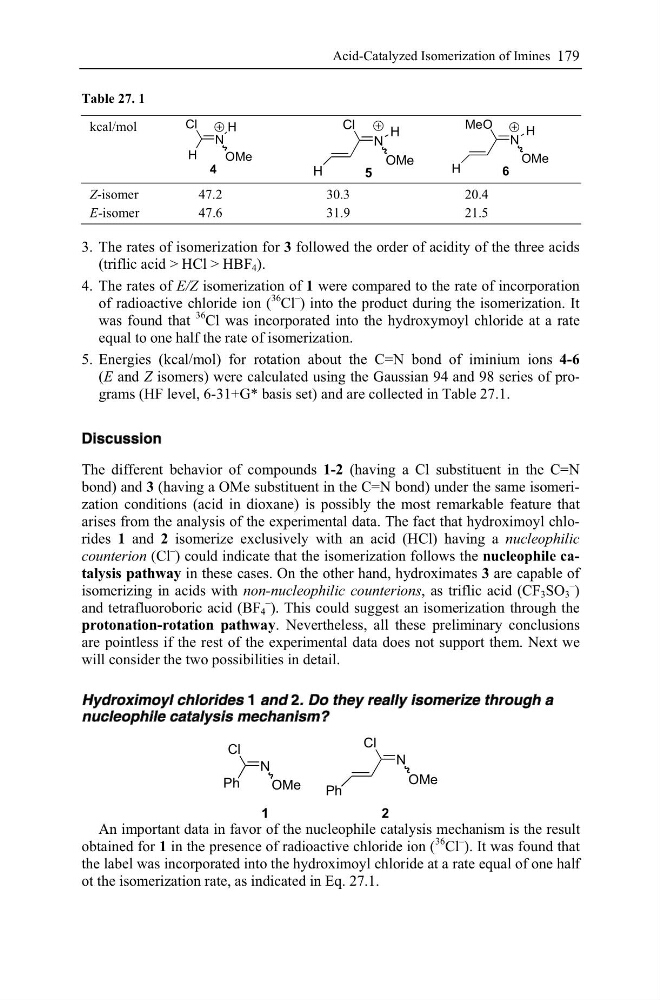
5. Energies (kcal/mol) for rotation about the C=N bond of iminium ions 4-6
(E and Z isomers) were calculated using the Gaussian 94 and 98 series of proZ
grams (HF level, 6-31+G* basis set) and are collected in Table 27.1.
D Di is sc cu us ss si io on n
The different behavior of compounds 1-2 (having a Cl substituent in the C=N
bond) and 3 (having a OMe substituent in the C=N bond) under the same isomerization conditions (acid in dioxane) is possibly the most remarkable feature that
arises from the analysis of the experimental data. The fact that hydroximoyl chlorides 1 and 2 isomerize exclusively with an acid (HCl) having a nucleophilic
counterion (Cl
– ) could indicate that the isomerization follows the nucleophile catalysis pathway in these cases. On the other hand, hydroximates 3 are capable of
isomerizing in acids with non-nucleophilic counterions, as triflic acid (CF 3 SO 3
–
)
and tetrafluoroboric acid (BF 4
– ). This could suggest an isomerization through the
protonation-rotation pathway. Nevertheless, all these preliminary conclusions
are pointless if the rest of the experimental data does not support them. Next we
will consider the two possibilities in detail.
H Hy H Hy yd yd y yd yd y yd y ydr d dr d d dr
d d o
ro r ro ro ro ro
r rox ox ox ox o o i
xi xi x xi xi x xim i im im im i i o oy y y yl y yl yl y yl y y c ch hl lo lo lo lo l lor ri ri ri r ri ri r rid id id i id i ide de d de de de d des s 1 1 a an nd d 2 2. . D Do o t th t th th th th t t e ey y y y r re re r re re re re r rea al ll ll l ll l l y
l ly y i is is i is is is i i o om me er ri ri ri r ri ri r riz i iz i i iz i i e
ze z ze ze ze ze z ze t th t th th th th t t r ro ro r ro ro ro ro r rou ug ug ug gh h h
gh a a
n nu uc cl le le l le le le l leo op op op ph hi il i il il i il
i i e
le l le le le l le c ca a a
cat ta ta t ta ta ta ta t tal ly l ly ys ys y ys ys ys ys y y i is is i is is is i i m me ec ch ha an ni is is i is is is i i m m? ?
Ph
N
Cl
OMe
N
Cl
OMe
Ph
1
2
An important data in favor of the nucleophile catalysis mechanism is the result
obtained for 1 in the presence of radioactive chloride ion (
36 Cl
– ). It was found that
the label was incorporated into the hydroximoyl chloride at a rate equal of one half
ot the isomerization rate, as indicated in Eq. 27.1.
Table 27. 1
kcal/mol
H
N
Cl
OMe
H
4
N
Cl
OMe
H
H
5
N
MeO
OMe
H
H
6
Z-isomer
47.2
30.3
20.4
Z Z
E-isomer
47.6
31.9
21.5
3. The rates of isomerization for 3 followed the order of acidity of the three acids
(triflic acid > HCl > HBF 4 ).
4. The rates of E/Z isomerization of 1 were compared to the rate of incorporation
of radioactive chloride ion (
36
Cl
–
) into the product during the isomerization. It
was found that
36
Cl was incorporated into the hydroxymoyl chloride at a rate
equal to one half the rate of isomerization.
5. Energies (kcal/mol) for rotation about the C=N bond of iminium ions 4-6
(E and Z isomers) were calculated using the Gaussian 94 and 98 series of proZ
grams (HF level, 6-31+G* basis set) and are collected in Table 27.1.
D Di is sc cu us ss si io on n
The different behavior of compounds 1-2 (having a Cl substituent in the C=N
bond) and 3 (having a OMe substituent in the C=N bond) under the same isomerization conditions (acid in dioxane) is possibly the most remarkable feature that
arises from the analysis of the experimental data. The fact that hydroximoyl chlorides 1 and 2 isomerize exclusively with an acid (HCl) having a nucleophilic
counterion (Cl
– ) could indicate that the isomerization follows the nucleophile catalysis pathway in these cases. On the other hand, hydroximates 3 are capable of
isomerizing in acids with non-nucleophilic counterions, as triflic acid (CF 3 SO 3
–
)
and tetrafluoroboric acid (BF 4
– ). This could suggest an isomerization through the
protonation-rotation pathway. Nevertheless, all these preliminary conclusions
are pointless if the rest of the experimental data does not support them. Next we
will consider the two possibilities in detail.
H Hy H Hy yd yd y yd yd y yd y ydr d dr d d dr
d d o
ro r ro ro ro ro
r rox ox ox ox o o i
xi xi x xi xi x xim i im im im i i o oy y y yl y yl yl y yl y y c ch hl lo lo lo lo l lor ri ri ri r ri ri r rid id id i id i ide de d de de de d des s 1 1 a an nd d 2 2. . D Do o t th t th th th th t t e ey y y y r re re r re re re re r rea al ll ll l ll l l y
l ly y i is is i is is is i i o om me er ri ri ri r ri ri r riz i iz i i iz i i e
ze z ze ze ze ze z ze t th t th th th th t t r ro ro r ro ro ro ro r rou ug ug ug gh h h
gh a a
n nu uc cl le le l le le le l leo op op op ph hi il i il il i il
i i e
le l le le le l le c ca a a
cat ta ta t ta ta ta ta t tal ly l ly ys ys y ys ys ys ys y y i is is i is is is i i m me ec ch ha an ni is is i is is is i i m m? ?
Ph
N
Cl
OMe
N
Cl
OMe
Ph
1
2
An important data in favor of the nucleophile catalysis mechanism is the result
obtained for 1 in the presence of radioactive chloride ion (
36 Cl
– ). It was found that
the label was incorporated into the hydroximoyl chloride at a rate equal of one half
ot the isomerization rate, as indicated in Eq. 27.1.