

Level 2 – Case 27
178
R
Y
N
X
H
R
Y
N
X
H
R
N
X
H
Y
R
H
N
X
Y -H
R
N
X
Y
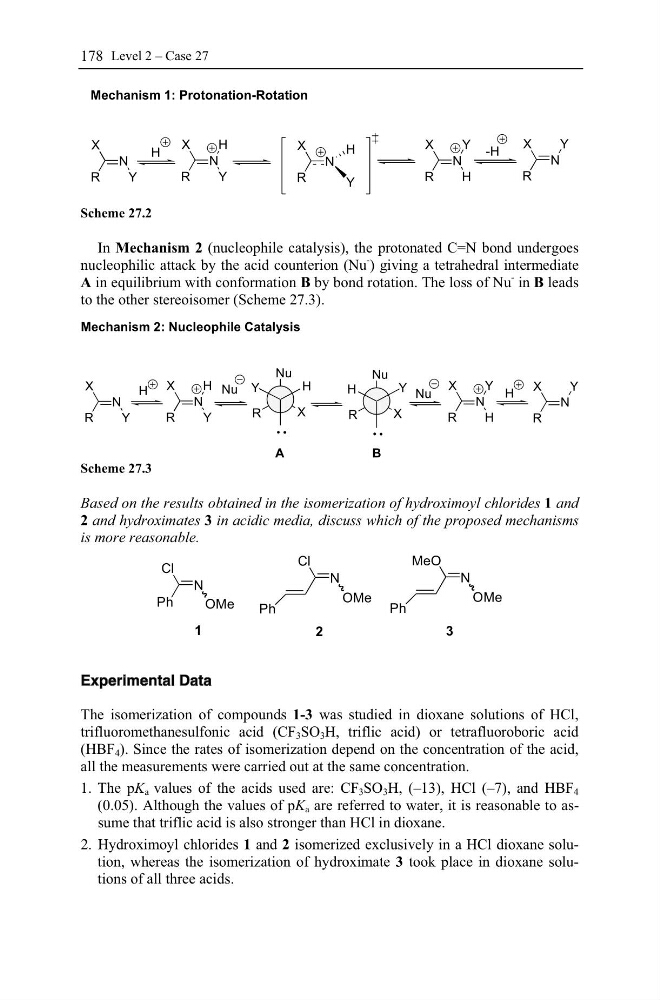
Mechanism 1: Protonation-Rotation
Scheme 27.2
In Mechanism 2 (nucleophile catalysis), the protonated C=N bond undergoes
nucleophilic attack by the acid counterion (Nu
-
) giving a tetrahedral intermediate
A in equilibrium with conformation B by bond rotation. The loss of Nu
- in B leads
to the other stereoisomer (Scheme 27.3).
B
R
H
N
X
Y H
N
Y
R
X
Y
H
R
Y
N
X
H
R
Y
N
X
H
A
R
X
Nu
R
X
Nu
Y
H
Mechanism 2: Nucleophile Catalysis
Nu
Nu
Scheme 27.3
Based on the results obtained in the isomerization of hydroximoyl chlorides 1 and
2 and hydroximates 3 in acidic media, discuss which of the proposed mechanisms
is more reasonable.
Ph
N
Cl
OMe
N
Cl
OMe
Ph
N
MeO
OMe
Ph
1
2
3
E Ex xp pe er ri im me en nt ta al l D Da at ta a
The isomerization of compounds 1-3 was studied in dioxane solutions of HCl,
trifluoromethanesulfonic acid (CF 3 SO 3 H, triflic acid) or tetrafluoroboric acid
(HBF 4 ). Since the rates of isomerization depend on the concentration of the acid,
all the measurements were carried out at the same concentration.
1. The pK a
K K values of the acids used are: CF 3 SO 3 H, (–13), HCl (–7), and HBF 4
(0.05). Although the values of pK a
K K are referred to water, it is reasonable to assume that triflic acid is also stronger than HCl in dioxane.
2. Hydroximoyl chlorides 1 and 2 isomerized exclusively in a HCl dioxane solution, whereas the isomerization of hydroximate 3 took place in dioxane solutions of all three acids.
178
R
Y
N
X
H
R
Y
N
X
H
R
N
X
H
Y
R
H
N
X
Y -H
R
N
X
Y
Mechanism 1: Protonation-Rotation
Scheme 27.2
In Mechanism 2 (nucleophile catalysis), the protonated C=N bond undergoes
nucleophilic attack by the acid counterion (Nu
-
) giving a tetrahedral intermediate
A in equilibrium with conformation B by bond rotation. The loss of Nu
- in B leads
to the other stereoisomer (Scheme 27.3).
B
R
H
N
X
Y H
N
Y
R
X
Y
H
R
Y
N
X
H
R
Y
N
X
H
A
R
X
Nu
R
X
Nu
Y
H
Mechanism 2: Nucleophile Catalysis
Nu
Nu
Scheme 27.3
Based on the results obtained in the isomerization of hydroximoyl chlorides 1 and
2 and hydroximates 3 in acidic media, discuss which of the proposed mechanisms
is more reasonable.
Ph
N
Cl
OMe
N
Cl
OMe
Ph
N
MeO
OMe
Ph
1
2
3
E Ex xp pe er ri im me en nt ta al l D Da at ta a
The isomerization of compounds 1-3 was studied in dioxane solutions of HCl,
trifluoromethanesulfonic acid (CF 3 SO 3 H, triflic acid) or tetrafluoroboric acid
(HBF 4 ). Since the rates of isomerization depend on the concentration of the acid,
all the measurements were carried out at the same concentration.
1. The pK a
K K values of the acids used are: CF 3 SO 3 H, (–13), HCl (–7), and HBF 4
(0.05). Although the values of pK a
K K are referred to water, it is reasonable to assume that triflic acid is also stronger than HCl in dioxane.
2. Hydroximoyl chlorides 1 and 2 isomerized exclusively in a HCl dioxane solution, whereas the isomerization of hydroximate 3 took place in dioxane solutions of all three acids.