

L Le ev ve el l 2 2 C Ca as se e 2 27 7
A Ac ci id d- -C Ca at ta al ly yz ze ed d I Is so om me er ri iz za at ti io on n o of f I Im mi in ne es s
K Ke ey y p po oi in nt t: : N Nu uc cl le le l le le le l leo op op op ph hi il i il il i il i i e
le l le le le l le c ca at ta ta t ta ta ta ta t tal ly l ly ys ys y ys ys ys ys y y i is is i is is is i i v ve ve v ve ve ve ve v ver rs rs r rs rs rs rs r r u us s b bo on nd d r ro ro r ro ro ro ro r rot ta ta t ta ta ta ta t tat ti ti ti t ti ti t tio io io io i ion n
Y
N
X
R
H
R
Y
N
X
H
R
Y
N
X
H
R
Y
N
X
H
R
H
N
X
Y
R
H
N
X
Y -H
-H
R
N
X
Y
N
X
Y
R
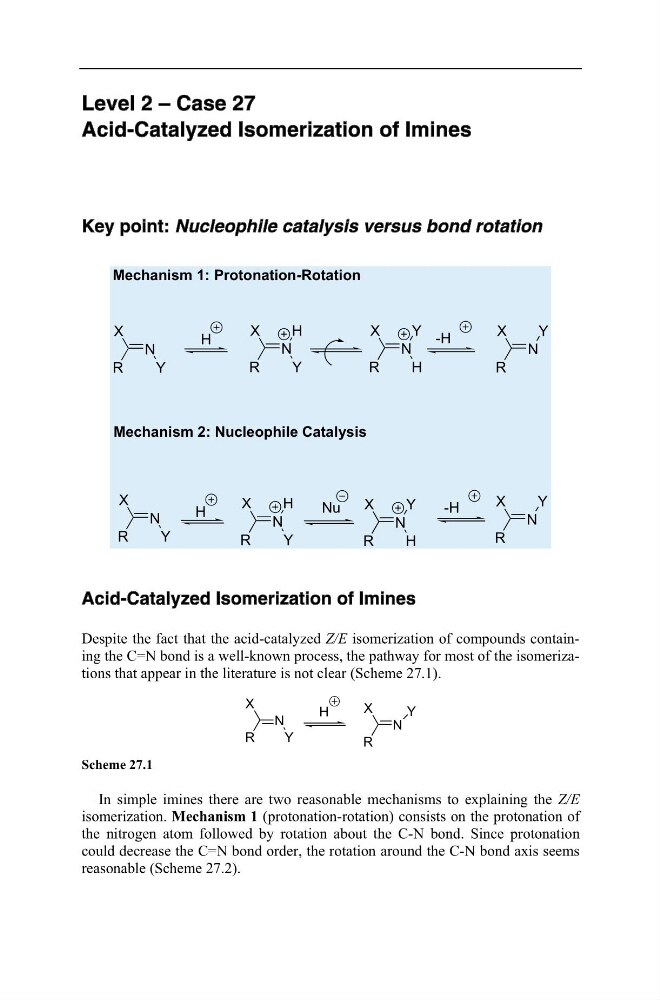
Mechanism 1: Protonation-Rotation
Mechanism 2: Nucleophile Catalysis
Nu
A Ac ci id d- -C Ca at ta al ly yz ze ed d I Is so om me er ri iz za at ti io on n o of f I Im mi in ne es s
Despite the fact that the acid-catalyzed Z/E isomerization of compounds containE
ing the C=N bond is a well-known process, the pathway for most of the isomerizations that appear in the literature is not clear (Scheme 27.1).
R
N
X
Y
R
N
X
Y
H
Scheme 27.1
In simple imines there are two reasonable mechanisms to explaining the Z/E
isomerization. Mechanism 1 (protonation-rotation) consists on the protonation of
the nitrogen atom followed by rotation about the C-N bond. Since protonation
could decrease the C=N bond order, the rotation around the C-N bond axis seems
reasonable (Scheme 27.2).
A Ac ci id d- -C Ca at ta al ly yz ze ed d I Is so om me er ri iz za at ti io on n o of f I Im mi in ne es s
K Ke ey y p po oi in nt t: : N Nu uc cl le le l le le le l leo op op op ph hi il i il il i il i i e
le l le le le l le c ca at ta ta t ta ta ta ta t tal ly l ly ys ys y ys ys ys ys y y i is is i is is is i i v ve ve v ve ve ve ve v ver rs rs r rs rs rs rs r r u us s b bo on nd d r ro ro r ro ro ro ro r rot ta ta t ta ta ta ta t tat ti ti ti t ti ti t tio io io io i ion n
Y
N
X
R
H
R
Y
N
X
H
R
Y
N
X
H
R
Y
N
X
H
R
H
N
X
Y
R
H
N
X
Y -H
-H
R
N
X
Y
N
X
Y
R
Mechanism 1: Protonation-Rotation
Mechanism 2: Nucleophile Catalysis
Nu
A Ac ci id d- -C Ca at ta al ly yz ze ed d I Is so om me er ri iz za at ti io on n o of f I Im mi in ne es s
Despite the fact that the acid-catalyzed Z/E isomerization of compounds containE
ing the C=N bond is a well-known process, the pathway for most of the isomerizations that appear in the literature is not clear (Scheme 27.1).
R
N
X
Y
R
N
X
Y
H
Scheme 27.1
In simple imines there are two reasonable mechanisms to explaining the Z/E
isomerization. Mechanism 1 (protonation-rotation) consists on the protonation of
the nitrogen atom followed by rotation about the C-N bond. Since protonation
could decrease the C=N bond order, the rotation around the C-N bond axis seems
reasonable (Scheme 27.2).