

2-Chloro-1,3,5-triazines as Activating Groups of Carboxylic Acids 175
conc [M]
time [s]
a
b
c
1
0.2
0.4
0.6
0.8
0
0
2000
4000
6000
8000
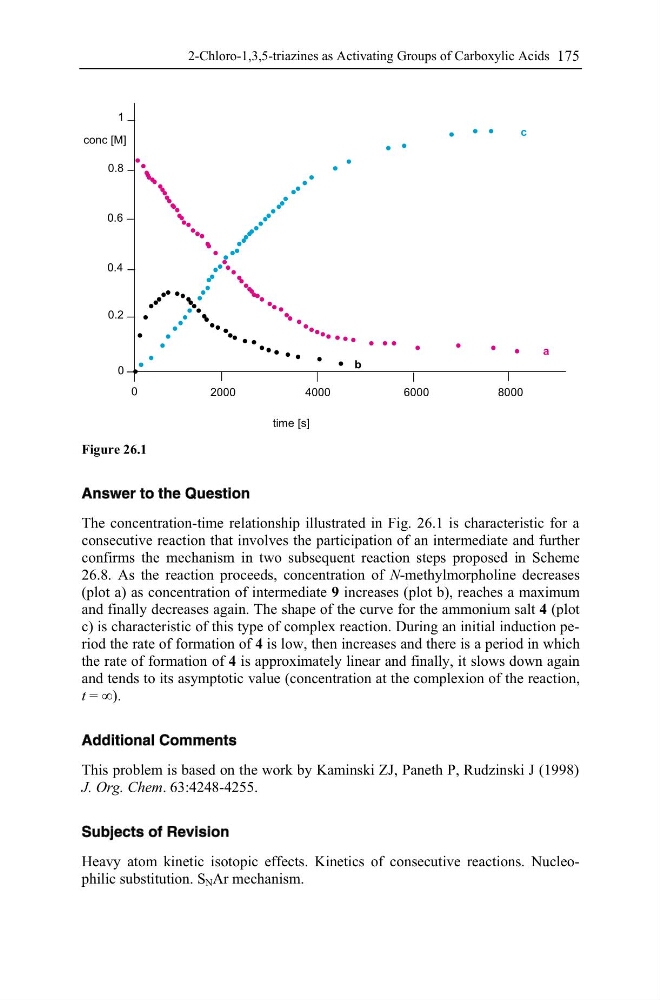
Figure 26.1
A An ns sw we er r t to o t th he e Q Qu ue es st ti io on n
The concentration-time relationship illustrated in Fig. 26.1 is characteristic for a
consecutive reaction that involves the participation of an intermediate and further
confirms the mechanism in two subsequent reaction steps proposed in Scheme
26.8. As the reaction proceeds, concentration of N-methylmorpholine decreases
N N
(plot a) as concentration of intermediate 9 increases (plot b), reaches a maximum
and finally decreases again. The shape of the curve for the ammonium salt 4 (plot
c) is characteristic of this type of complex reaction. During an initial induction period the rate of formation of 4 is low, then increases and there is a period in which
the rate of formation of 4 is approximately linear and finally, it slows down again
and tends to its asymptotic value (concentration at the complexion of the reaction,
t =
t ).
A Ad dd di it ti io on na al l C Co om mm me en nt ts s
This problem is based on the work by Kaminski ZJ, Paneth P, Rudzinski J (1998)
J. Org. Chem. 63:4248-4255.
S Su ub bj je ec ct ts s o of f R Re ev vi is si io on n
Heavy atom kinetic isotopic effects. Kinetics of consecutive reactions. Nucleophilic substitution. S N Ar mechanism.
conc [M]
time [s]
a
b
c
1
0.2
0.4
0.6
0.8
0
0
2000
4000
6000
8000
Figure 26.1
A An ns sw we er r t to o t th he e Q Qu ue es st ti io on n
The concentration-time relationship illustrated in Fig. 26.1 is characteristic for a
consecutive reaction that involves the participation of an intermediate and further
confirms the mechanism in two subsequent reaction steps proposed in Scheme
26.8. As the reaction proceeds, concentration of N-methylmorpholine decreases
N N
(plot a) as concentration of intermediate 9 increases (plot b), reaches a maximum
and finally decreases again. The shape of the curve for the ammonium salt 4 (plot
c) is characteristic of this type of complex reaction. During an initial induction period the rate of formation of 4 is low, then increases and there is a period in which
the rate of formation of 4 is approximately linear and finally, it slows down again
and tends to its asymptotic value (concentration at the complexion of the reaction,
t =
t ).
A Ad dd di it ti io on na al l C Co om mm me en nt ts s
This problem is based on the work by Kaminski ZJ, Paneth P, Rudzinski J (1998)
J. Org. Chem. 63:4248-4255.
S Su ub bj je ec ct ts s o of f R Re ev vi is si io on n
Heavy atom kinetic isotopic effects. Kinetics of consecutive reactions. Nucleophilic substitution. S N Ar mechanism.