

Level 2 – Case 26
174
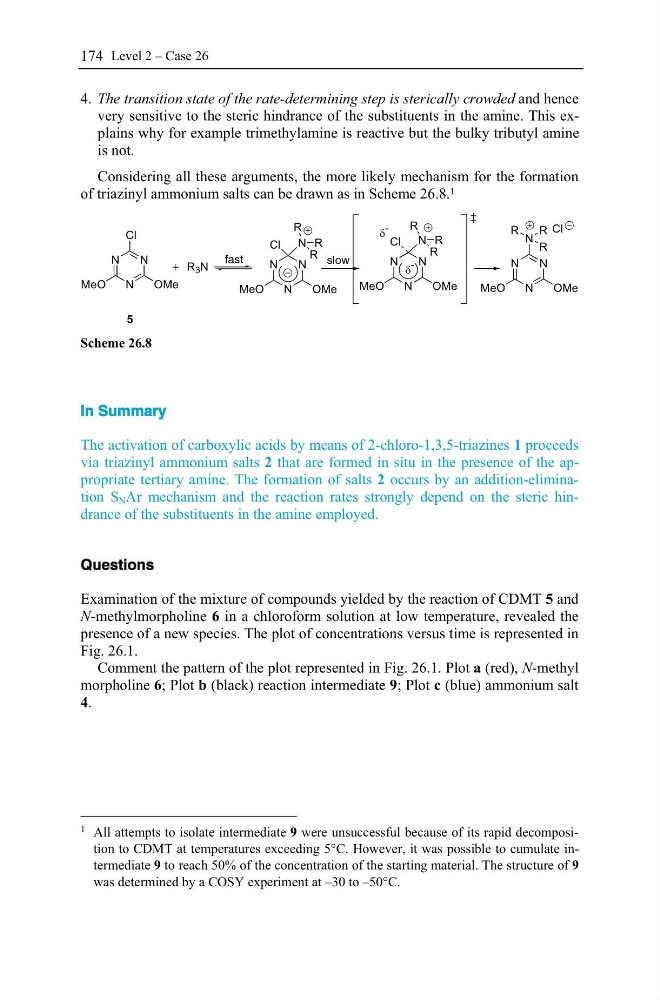
4. The transition state of the rate-determining step is sterically crowded and hence
d
very sensitive to the steric hindrance of the substituents in the amine. This explains why for example trimethylamine is reactive but the bulky tributyl amine
is not.
Considering all these arguments, the more likely mechanism for the formation
of triazinyl ammonium salts can be drawn as in Scheme 26.8.
1
N
N
N
Cl
OMe
MeO
N
N
N
OMe
MeO
N
Cl
R
R
N
N
N
OMe
MeO
N
Cl
R
R
R
N
N
N
N
OMe
MeO
R
R
R
Cl
5
fast
slow
G
-
G
-
R 3 N
R
Scheme 26.8
In Summary
The activation of carboxylic acids by means of 2-chloro-1,3,5-triazines 1 proceeds
via triazinyl ammonium salts 2 that are formed in situ in the presence of the appropriate tertiary amine. The formation of salts 2 occurs by an addition-elimination S N Ar mechanism and the reaction rates strongly depend on the steric hindrance of the substituents in the amine employed.
Q Qu ue es st ti io on ns s
Examination of the mixture of compounds yielded by the reaction of CDMT 5 and
N-methylmorpholine N N
6 in a chloroform solution at low temperature, revealed the
presence of a new species. The plot of concentrations versus time is represented in
Fig. 26.1.
Comment the pattern of the plot represented in Fig. 26.1. Plot a (red), N-methyl N N
morpholine 6; Plot b (black) reaction intermediate 9; Plot c (blue) ammonium salt
4.
1 All attempts to isolate intermediate 9 were unsuccessful because of its rapid decomposition to CDMT at temperatures exceeding 5°C. However, it was possible to cumulate intermediate 9 to reach 50% of the concentration of the starting material. The structure of 9
was determined by a COSY experiment at –30 to –50°C.
174
4. The transition state of the rate-determining step is sterically crowded and hence
d
very sensitive to the steric hindrance of the substituents in the amine. This explains why for example trimethylamine is reactive but the bulky tributyl amine
is not.
Considering all these arguments, the more likely mechanism for the formation
of triazinyl ammonium salts can be drawn as in Scheme 26.8.
1
N
N
N
Cl
OMe
MeO
N
N
N
OMe
MeO
N
Cl
R
R
N
N
N
OMe
MeO
N
Cl
R
R
R
N
N
N
N
OMe
MeO
R
R
R
Cl
5
fast
slow
G
-
G
-
R 3 N
R
Scheme 26.8
In Summary
The activation of carboxylic acids by means of 2-chloro-1,3,5-triazines 1 proceeds
via triazinyl ammonium salts 2 that are formed in situ in the presence of the appropriate tertiary amine. The formation of salts 2 occurs by an addition-elimination S N Ar mechanism and the reaction rates strongly depend on the steric hindrance of the substituents in the amine employed.
Q Qu ue es st ti io on ns s
Examination of the mixture of compounds yielded by the reaction of CDMT 5 and
N-methylmorpholine N N
6 in a chloroform solution at low temperature, revealed the
presence of a new species. The plot of concentrations versus time is represented in
Fig. 26.1.
Comment the pattern of the plot represented in Fig. 26.1. Plot a (red), N-methyl N N
morpholine 6; Plot b (black) reaction intermediate 9; Plot c (blue) ammonium salt
4.
1 All attempts to isolate intermediate 9 were unsuccessful because of its rapid decomposition to CDMT at temperatures exceeding 5°C. However, it was possible to cumulate intermediate 9 to reach 50% of the concentration of the starting material. The structure of 9
was determined by a COSY experiment at –30 to –50°C.