

2-Chloro-1,3,5-triazines as Activating Groups of Carboxylic Acids 173
N
N
N
OMe
Me
MeO
N
Cl
O
N
N
N
OMe
MeO
N
Cl
O
Me
N
N
N
OMe
MeO
N
Cl
O
Me
5
4
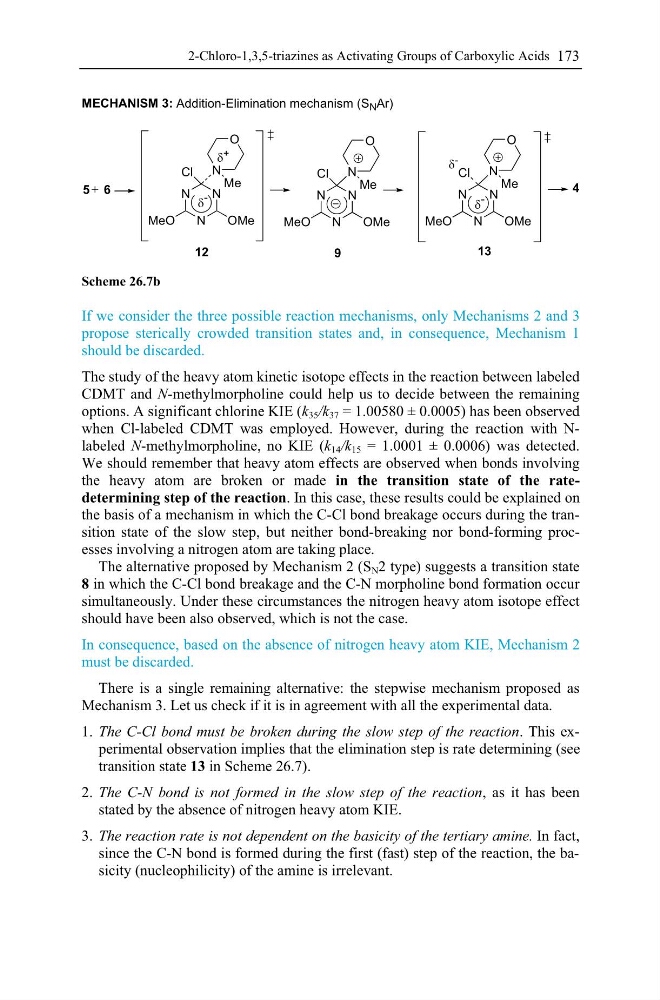
MECHANISM 3: Addition-Elimination mechanism (S N Ar)
9
6
G
-
G +
12
G
-
G -
13
If we consider the three possible reaction mechanisms, only Mechanisms 2 and 3
propose sterically crowded transition states and, in consequence, Mechanism 1
should be discarded.
The study of the heavy atom kinetic isotope effects in the reaction between labeled
CDMT and N-methylmorpholine could help us to decide between the remaining
N N
options. A significant chlorine KIE (k 35
k k /k / / 37
k k = 1.00580 ± 0.0005) has been observ r r ed
when Cl-labeled CDMT was employed. However, during the reaction with Nlabeled N-methylmorpholine, no KIE (
N N
k 14 /k
4 4 15 = 1.0001 ± 0.0006) was detected.
We should remember that heavy atom effects are observed when bonds involving
the heavy atom are broken or made in the transition state of the ratedetermining step of the reaction. In this case, these results could be explained on
the basis of a mechanism in which the C-Cl bond breakage occurs during the transition state of the slow step, but neither bond-breaking nor bond-forming processes involving a nitrogen atom are taking place.
The alternative proposed by Mechanism 2 (S N 2 type) suggests a transition state
8 in which the C-Cl bond breakage and the C-N morpholine bond formation occur
simultaneously. Under these circumstances the nitrogen heavy atom isotope effect
should have been also observ r r ed, which is not the case.
In consequence, based on the absence of nitrogen heavy atom KIE, Mechanism 2
must be discarded.
There is a single remaining alternative: the stepwise mechanism proposed as
Mechanism 3. Let us check if it is in agreement with all the experimental data.
1. The C-Cl bond must be broken during the slow step of the reaction. This experimental observation implies that the elimination step is rate determining (see
transition state 13 in Scheme 26.7).
2. The C-N bond is not formed in the slow step of the reaction, as it has been
stated by the absence of nitrogen heavy atom KIE.
3. The reaction rate is not dependent on the basicity of the tertiary amine. In fact,
since the C-N bond is formed during the first (fast) step of the reaction, the basicity (nucleophilicity) of the amine is irrelevant.
N
N
N
OMe
Me
MeO
N
Cl
O
N
N
N
OMe
MeO
N
Cl
O
Me
N
N
N
OMe
MeO
N
Cl
O
Me
5
4
MECHANISM 3: Addition-Elimination mechanism (S N Ar)
9
6
G
-
G +
12
G
-
G -
13
If we consider the three possible reaction mechanisms, only Mechanisms 2 and 3
propose sterically crowded transition states and, in consequence, Mechanism 1
should be discarded.
The study of the heavy atom kinetic isotope effects in the reaction between labeled
CDMT and N-methylmorpholine could help us to decide between the remaining
N N
options. A significant chlorine KIE (k 35
k k /k / / 37
k k = 1.00580 ± 0.0005) has been observ r r ed
when Cl-labeled CDMT was employed. However, during the reaction with Nlabeled N-methylmorpholine, no KIE (
N N
k 14 /k
4 4 15 = 1.0001 ± 0.0006) was detected.
We should remember that heavy atom effects are observed when bonds involving
the heavy atom are broken or made in the transition state of the ratedetermining step of the reaction. In this case, these results could be explained on
the basis of a mechanism in which the C-Cl bond breakage occurs during the transition state of the slow step, but neither bond-breaking nor bond-forming processes involving a nitrogen atom are taking place.
The alternative proposed by Mechanism 2 (S N 2 type) suggests a transition state
8 in which the C-Cl bond breakage and the C-N morpholine bond formation occur
simultaneously. Under these circumstances the nitrogen heavy atom isotope effect
should have been also observ r r ed, which is not the case.
In consequence, based on the absence of nitrogen heavy atom KIE, Mechanism 2
must be discarded.
There is a single remaining alternative: the stepwise mechanism proposed as
Mechanism 3. Let us check if it is in agreement with all the experimental data.
1. The C-Cl bond must be broken during the slow step of the reaction. This experimental observation implies that the elimination step is rate determining (see
transition state 13 in Scheme 26.7).
2. The C-N bond is not formed in the slow step of the reaction, as it has been
stated by the absence of nitrogen heavy atom KIE.
3. The reaction rate is not dependent on the basicity of the tertiary amine. In fact,
since the C-N bond is formed during the first (fast) step of the reaction, the basicity (nucleophilicity) of the amine is irrelevant.