

Level 2 – Case 26
172
Apart from other considerations, the most striking feature in the formation of
triazinyl ammonium salts 2 is the strong dependence of the reaction rate on the
f
steric hindrance of the tertiary amine employed. In fact, two important conclusions
could be deduced from this data: First, the tertiary amine has to be necessarily involved in the slow step of the reaction. Second, the sensitivity to the steric hindrance suggests a sterically crowded transition state.
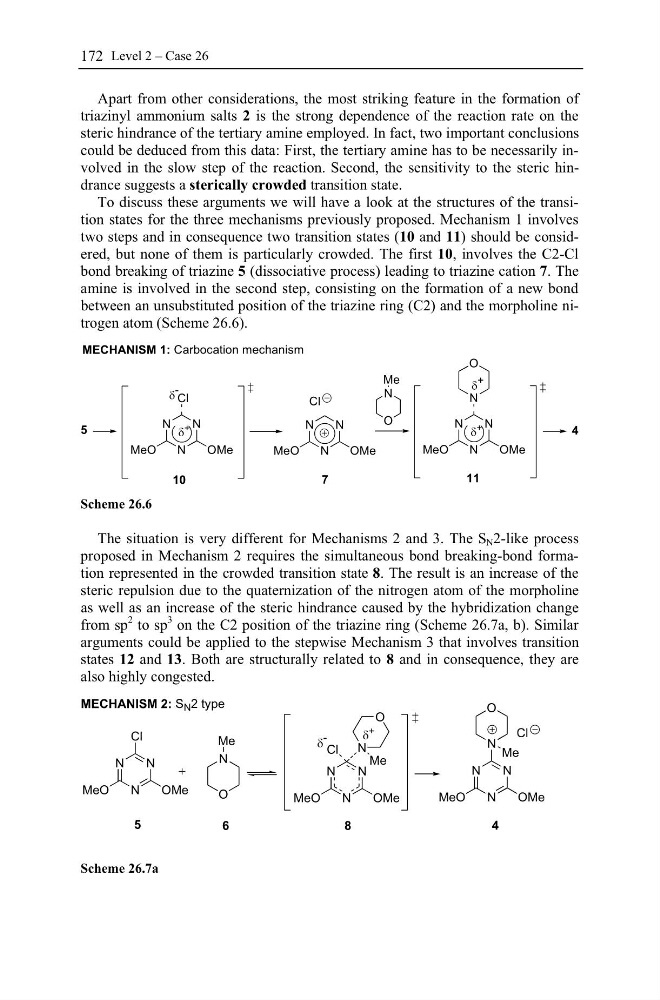
To discuss these arguments we will have a look at the structures of the transition states for the three mechanisms previously proposed. Mechanism 1 involves
two steps and in consequence two transition states (10 and 11) should be considered, but none of them is particularly crowded. The first 10, involves the C2-Cl
bond breaking of triazine 5 (dissociative process) leading to triazine cation 7. The
amine is involved in the second step, consisting on the formation of a new bond
between an unsubstituted position of the triazine ring (C2) and the morpholine nitrogen atom (Scheme 26.6).
N
N
N
OMe
MeO
Cl
Cl
N
N
N
OMe
MeO
O
N
Me
N
N
N
OMe
MeO
N
O
G
-
G +
MECHANISM 1: Carbocation mechanism
7
10
G
+
G +
11
4
5
Scheme 26.6
The situation is very different for Mechanisms 2 and 3. The S N 2-like process
proposed in Mechanism 2 requires the simultaneous bond breaking-bond formation represented in the crowded transition state 8. The result is an increase of the
steric repulsion due to the quaternization of the nitrogen atom of the morpholine
as well as an increase of the steric hindrance caused by the hybridization change
from sp
2 to sp
3 on the C2 position of the triazine ring (Scheme 26.7a, b). Similar
arguments could be applied to the stepwise Mechanism 3 that involves transition
states 12 and 13. Both are structurally related to 8 and in consequence, they are
also highly congested.
OMe
N
N
N
MeO
N
Cl
O
Me
-
G +
N
N
N
Cl
OMe
MeO
O
N
Me
N
N
N
N
OMe
MeO
O
Me
5
6
MECHANISM 2: S N 2 type
4
8
Scheme 26.7a
172
Apart from other considerations, the most striking feature in the formation of
triazinyl ammonium salts 2 is the strong dependence of the reaction rate on the
f
steric hindrance of the tertiary amine employed. In fact, two important conclusions
could be deduced from this data: First, the tertiary amine has to be necessarily involved in the slow step of the reaction. Second, the sensitivity to the steric hindrance suggests a sterically crowded transition state.
To discuss these arguments we will have a look at the structures of the transition states for the three mechanisms previously proposed. Mechanism 1 involves
two steps and in consequence two transition states (10 and 11) should be considered, but none of them is particularly crowded. The first 10, involves the C2-Cl
bond breaking of triazine 5 (dissociative process) leading to triazine cation 7. The
amine is involved in the second step, consisting on the formation of a new bond
between an unsubstituted position of the triazine ring (C2) and the morpholine nitrogen atom (Scheme 26.6).
N
N
N
OMe
MeO
Cl
Cl
N
N
N
OMe
MeO
O
N
Me
N
N
N
OMe
MeO
N
O
G
-
G +
MECHANISM 1: Carbocation mechanism
7
10
G
+
G +
11
4
5
Scheme 26.6
The situation is very different for Mechanisms 2 and 3. The S N 2-like process
proposed in Mechanism 2 requires the simultaneous bond breaking-bond formation represented in the crowded transition state 8. The result is an increase of the
steric repulsion due to the quaternization of the nitrogen atom of the morpholine
as well as an increase of the steric hindrance caused by the hybridization change
from sp
2 to sp
3 on the C2 position of the triazine ring (Scheme 26.7a, b). Similar
arguments could be applied to the stepwise Mechanism 3 that involves transition
states 12 and 13. Both are structurally related to 8 and in consequence, they are
also highly congested.
OMe
N
N
N
MeO
N
Cl
O
Me
-
G +
N
N
N
Cl
OMe
MeO
O
N
Me
N
N
N
N
OMe
MeO
O
Me
5
6
MECHANISM 2: S N 2 type
4
8
Scheme 26.7a