

2-Chloro-1,3,5-triazines as Activating Groups of Carboxylic Acids 171
N
N
N
Cl
OMe
MeO
O
N
Me
Cl
N
N
N
OMe
MeO
O
N
Me
N
N
N
N
OMe
MeO
O
Me
4
5
6
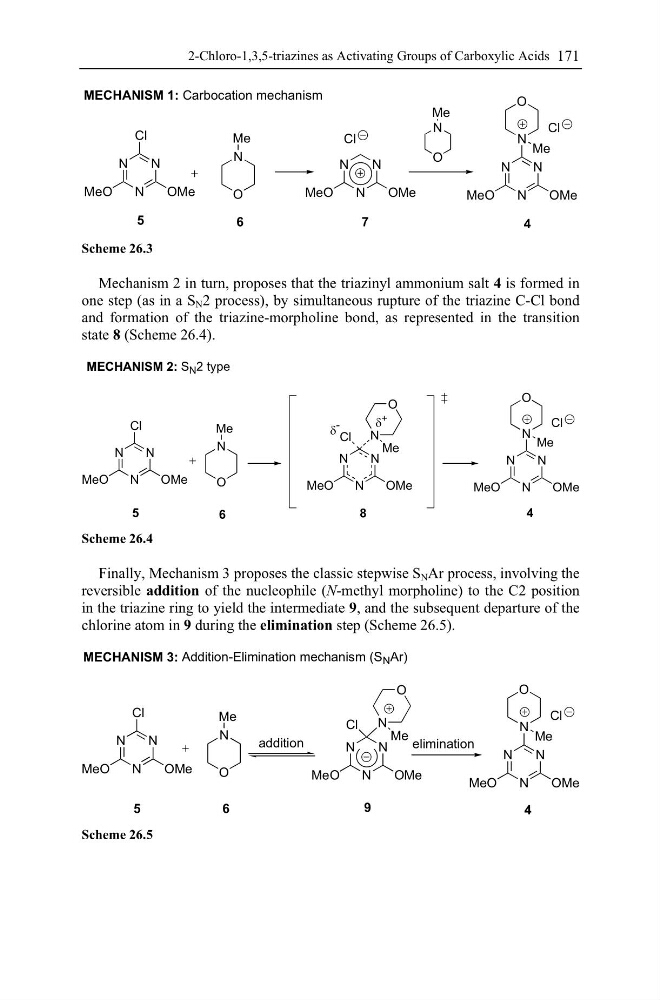
MECHANISM 1: Carbocation mechanism
7
Scheme 26.3
Mechanism 2 in turn, proposes that the triazinyl ammonium salt 4 is formed in
one step (as in a S N 2 process), by simultaneous rupture of the triazine C-Cl bond
and formation of the triazine-morpholine bond, as represented in the transition
state 8 (Scheme 26.4).
O
N
Me
OMe
N
N
N
MeO
N
Cl
O
Me
Cl
OMe
MeO
N
N
N
N
N
N
OMe
MeO
O
Me
5
G
-
G +
8
6
MECHANISM 2: S N 2 type
4
Scheme 26.4
Finally, Mechanism 3 proposes the classic stepwise S N Ar process, involving the
reversible addition of the nucleophile (N
( ( -methyl morpholine) to the C2 position
N N
in the triazine ring to yield the intermediate 9, and the subsequent departure of the
chlorine atom in 9 during the elimination step (Scheme 26.5).
N
N
N
Cl
OMe
MeO
O
N
Me
N
N
N
OMe
MeO
N
Cl
O
Me
N
N
N
N
OMe
MeO
O
Me
5
6
addition
elimination
4
MECHANISM 3: Addition-Elimination mechanism (S N Ar)
9
Scheme 26.5
N
N
N
Cl
OMe
MeO
O
N
Me
Cl
N
N
N
OMe
MeO
O
N
Me
N
N
N
N
OMe
MeO
O
Me
4
5
6
MECHANISM 1: Carbocation mechanism
7
Scheme 26.3
Mechanism 2 in turn, proposes that the triazinyl ammonium salt 4 is formed in
one step (as in a S N 2 process), by simultaneous rupture of the triazine C-Cl bond
and formation of the triazine-morpholine bond, as represented in the transition
state 8 (Scheme 26.4).
O
N
Me
OMe
N
N
N
MeO
N
Cl
O
Me
Cl
OMe
MeO
N
N
N
N
N
N
OMe
MeO
O
Me
5
G
-
G +
8
6
MECHANISM 2: S N 2 type
4
Scheme 26.4
Finally, Mechanism 3 proposes the classic stepwise S N Ar process, involving the
reversible addition of the nucleophile (N
( ( -methyl morpholine) to the C2 position
N N
in the triazine ring to yield the intermediate 9, and the subsequent departure of the
chlorine atom in 9 during the elimination step (Scheme 26.5).
N
N
N
Cl
OMe
MeO
O
N
Me
N
N
N
OMe
MeO
N
Cl
O
Me
N
N
N
N
OMe
MeO
O
Me
5
6
addition
elimination
4
MECHANISM 3: Addition-Elimination mechanism (S N Ar)
9
Scheme 26.5