

Level 2 – Case 26
170
N
N
N
N
OMe
MeO
O
Me
N
N
Cl
OMe
MeO
O
N
Me
4
5
6
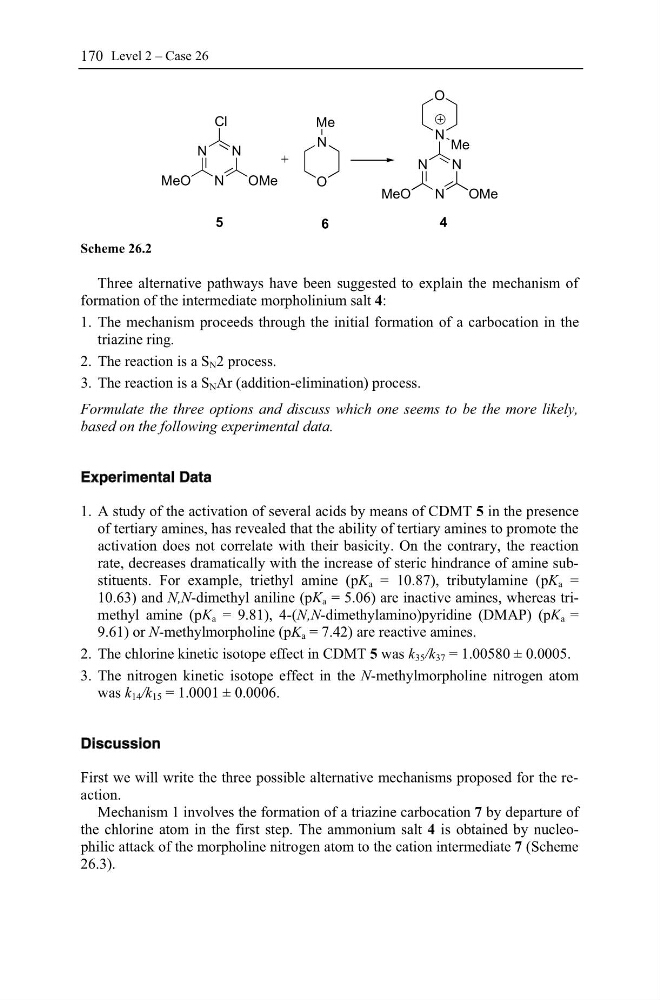
Scheme 26.2
Three alternative pathways have been suggested to explain the mechanism of
formation of the intermediate morpholinium salt 4:
1. The mechanism proceeds through the initial formation of a carbocation in the
triazine ring.
2. The reaction is a S N 2 process.
3. The reaction is a S N Ar (addition-elimination) process.
Formulate the three options and discuss which one seems to be the more likely,
based on the following experimental data.
E Ex xp pe er ri im me en nt ta al l D Da at ta a
1. A study of the activation of several acids by means of CDMT 5 in the presence
of tertiary amines, has revealed that the ability of tertiary amines to promote the
activation does not correlate with their basicity. On the contrary, the reaction
rate, decreases dramatically with the increase of steric hindrance of amine substituents. For example, triethyl amine (pK a
K K = 10.87), tributylamine (pK a
K K =
10.63) and N,N-dimethyl aniline (p
N N
K a
K K = 5.06) are inactive amines, whereas trimethyl amine (pK a
K K = 9.81), 4-(N,N ( (
-dimethylamino)pyridine (DMAP) (p
N N
K a
K K =
9.61) or N-methylmorpholine (p
N N
K a
K K = 7.42) are reactive amines.
2. The chlorine kinetic isotope effect in CDMT 5 was k 35
k k /k 37
k k = 1.00580 ± 0.0005.
3. The nitrogen kinetic isotope effect in the N-methylmorpholine nitrogen atom
N N
was k 14 /k
4 4 15 = 1.0001 ± 0.0006.
D Di is sc cu us ss si io on n
First we will write the three possible alternative mechanisms proposed for the reaction.
Mechanism 1 involves the formation of a triazine carbocation 7 by departure of
the chlorine atom in the first step. The ammonium salt 4 is obtained by nucleophilic attack of the morpholine nitrogen atom to the cation intermediate 7 (Scheme
26.3).
170
N
N
N
N
OMe
MeO
O
Me
N
N
Cl
OMe
MeO
O
N
Me
4
5
6
Scheme 26.2
Three alternative pathways have been suggested to explain the mechanism of
formation of the intermediate morpholinium salt 4:
1. The mechanism proceeds through the initial formation of a carbocation in the
triazine ring.
2. The reaction is a S N 2 process.
3. The reaction is a S N Ar (addition-elimination) process.
Formulate the three options and discuss which one seems to be the more likely,
based on the following experimental data.
E Ex xp pe er ri im me en nt ta al l D Da at ta a
1. A study of the activation of several acids by means of CDMT 5 in the presence
of tertiary amines, has revealed that the ability of tertiary amines to promote the
activation does not correlate with their basicity. On the contrary, the reaction
rate, decreases dramatically with the increase of steric hindrance of amine substituents. For example, triethyl amine (pK a
K K = 10.87), tributylamine (pK a
K K =
10.63) and N,N-dimethyl aniline (p
N N
K a
K K = 5.06) are inactive amines, whereas trimethyl amine (pK a
K K = 9.81), 4-(N,N ( (
-dimethylamino)pyridine (DMAP) (p
N N
K a
K K =
9.61) or N-methylmorpholine (p
N N
K a
K K = 7.42) are reactive amines.
2. The chlorine kinetic isotope effect in CDMT 5 was k 35
k k /k 37
k k = 1.00580 ± 0.0005.
3. The nitrogen kinetic isotope effect in the N-methylmorpholine nitrogen atom
N N
was k 14 /k
4 4 15 = 1.0001 ± 0.0006.
D Di is sc cu us ss si io on n
First we will write the three possible alternative mechanisms proposed for the reaction.
Mechanism 1 involves the formation of a triazine carbocation 7 by departure of
the chlorine atom in the first step. The ammonium salt 4 is obtained by nucleophilic attack of the morpholine nitrogen atom to the cation intermediate 7 (Scheme
26.3).