

Level 2 – Case 25
166
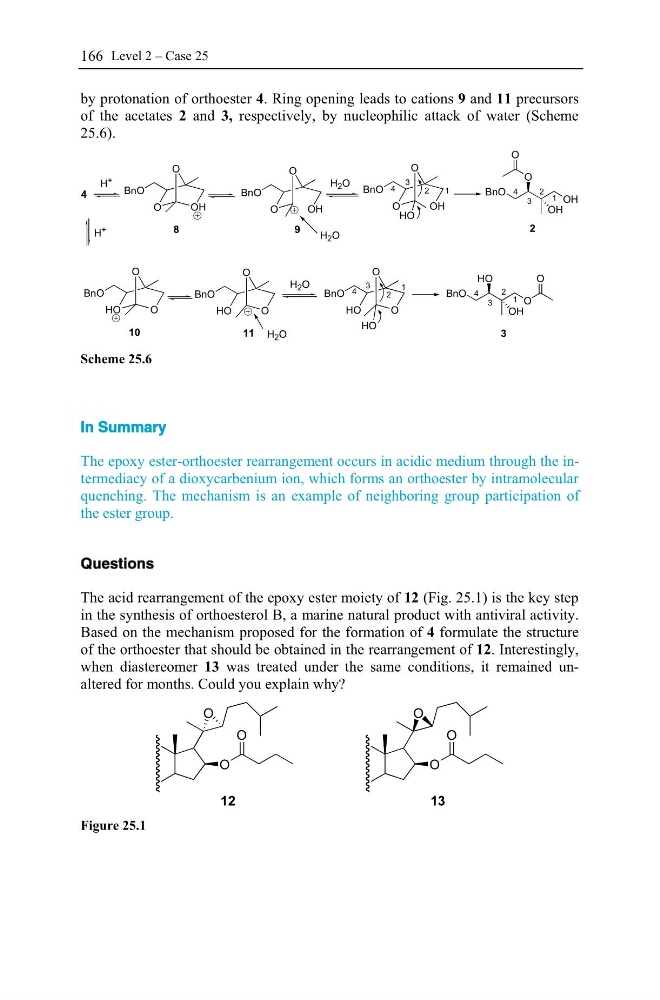
by protonation of orthoester 4. Ring opening leads to cations 9 and 11 precursors
of the acetates 2 and 3, respectively, by nucleophilic attack of water (Scheme
25.6).
H +
O
HO
BnO
O
HO
BnO
H 2 O
O
HO
BnO
HO
H +
OH
O
BnO
OH
O
BnO
OH
O
BnO
HO
BnO
O
HO
OH
O
BnO
OH
O
OH
O
4
3
1
4
4
3
2
1
3
3
1
4
2
2
4
3
2
1
2
8
9
10
11
O
O
O
O
O
O
H 2 O
H 2 O
H 2 O
Scheme 25.6
In Summary
The epoxy ester-orthoester rearrangement occurs in acidic medium through the intermediacy of a dioxycarbenium ion, which forms an orthoester by intramolecular
quenching. The mechanism is an example of neighboring group participation of
the ester group.
Q Qu ue es st ti io on ns s
The acid rearrangement of the epoxy ester moiety of 12 (Fig. 25.1) is the key step
in the synthesis of orthoesterol B, a marine natural product with antiviral activity.
Based on the mechanism proposed for the formation of 4 formulate the structure
of the orthoester that should be obtained in the rearrangement of 12. Interestingly,
when diastereomer 13 was treated under the same conditions, it remained unaltered for months. Could you explain why?
O
O
O
12
O
O
O
13
Figure 25.1
166
by protonation of orthoester 4. Ring opening leads to cations 9 and 11 precursors
of the acetates 2 and 3, respectively, by nucleophilic attack of water (Scheme
25.6).
H +
O
HO
BnO
O
HO
BnO
H 2 O
O
HO
BnO
HO
H +
OH
O
BnO
OH
O
BnO
OH
O
BnO
HO
BnO
O
HO
OH
O
BnO
OH
O
OH
O
4
3
1
4
4
3
2
1
3
3
1
4
2
2
4
3
2
1
2
8
9
10
11
O
O
O
O
O
O
H 2 O
H 2 O
H 2 O
Scheme 25.6
In Summary
The epoxy ester-orthoester rearrangement occurs in acidic medium through the intermediacy of a dioxycarbenium ion, which forms an orthoester by intramolecular
quenching. The mechanism is an example of neighboring group participation of
the ester group.
Q Qu ue es st ti io on ns s
The acid rearrangement of the epoxy ester moiety of 12 (Fig. 25.1) is the key step
in the synthesis of orthoesterol B, a marine natural product with antiviral activity.
Based on the mechanism proposed for the formation of 4 formulate the structure
of the orthoester that should be obtained in the rearrangement of 12. Interestingly,
when diastereomer 13 was treated under the same conditions, it remained unaltered for months. Could you explain why?
O
O
O
12
O
O
O
13
Figure 25.1