

Epoxi Ester-Orthoester Rearrangement 167
A An ns sw we er r t to o t th he e Q Qu ue es st ti io on n
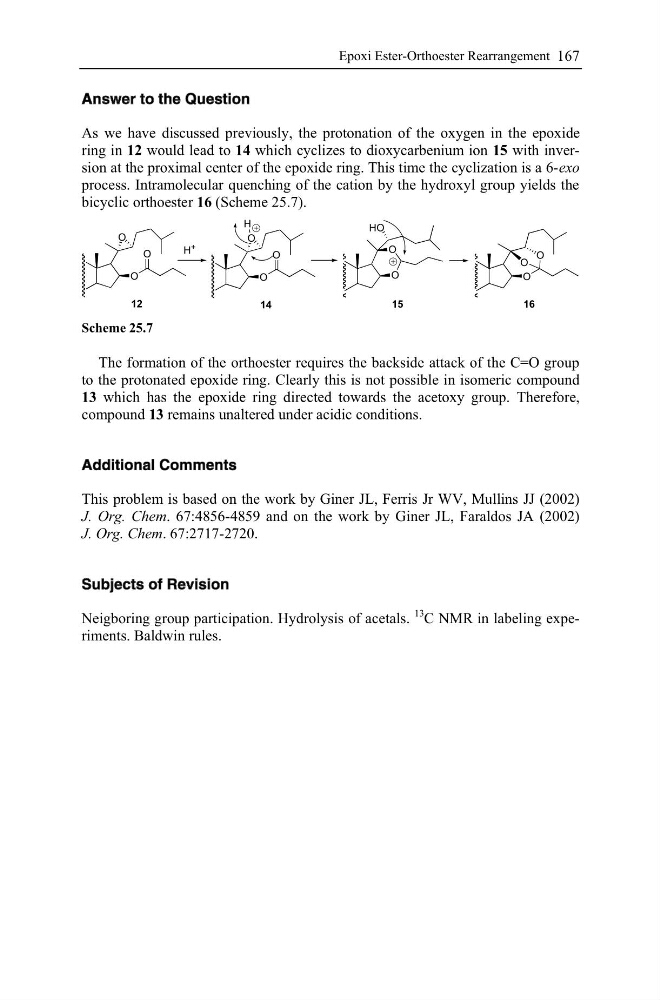
As we have discussed previously, the protonation of the oxygen in the epoxide
ring in 12 would lead to 14 which cyclizes to dioxycarbenium ion 15 with inversion at the proximal center of the epoxide ring. This time the cyclization is a 6-exo
process. Intramolecular quenching of the cation by the hydroxyl group yields the
bicyclic orthoester 16 (Scheme 25.7).
O
O
O
H +
O
O
O
H
O
O
HO
O
O
O
12
14
15
1 6
Scheme 25.7
The formation of the orthoester requires the backside attack of the C=O group
to the protonated epoxide ring. Clearly this is not possible in isomeric compound
13 which has the epoxide ring directed towards the acetoxy group. Therefore,
compound 13 remains unaltered under acidic conditions.
A Ad dd di it ti io on na al l C Co om mm me en nt ts s
This problem is based on the work by Giner JL, Ferris Jr WV, Mullins JJ (2002)
J. Org. Chem. 67:4856-4859 and on the work by Giner JL, Faraldos JA (2002)
J. Org. Chem. 67:2717-2720.
S Su ub bj je ec ct ts s o of f R Re ev vi is si io on n
Neigboring group participation. Hydrolysis of acetals.
13
C NMR in labeling experiments. Baldwin rules.
A An ns sw we er r t to o t th he e Q Qu ue es st ti io on n
As we have discussed previously, the protonation of the oxygen in the epoxide
ring in 12 would lead to 14 which cyclizes to dioxycarbenium ion 15 with inversion at the proximal center of the epoxide ring. This time the cyclization is a 6-exo
process. Intramolecular quenching of the cation by the hydroxyl group yields the
bicyclic orthoester 16 (Scheme 25.7).
O
O
O
H +
O
O
O
H
O
O
HO
O
O
O
12
14
15
1 6
Scheme 25.7
The formation of the orthoester requires the backside attack of the C=O group
to the protonated epoxide ring. Clearly this is not possible in isomeric compound
13 which has the epoxide ring directed towards the acetoxy group. Therefore,
compound 13 remains unaltered under acidic conditions.
A Ad dd di it ti io on na al l C Co om mm me en nt ts s
This problem is based on the work by Giner JL, Ferris Jr WV, Mullins JJ (2002)
J. Org. Chem. 67:4856-4859 and on the work by Giner JL, Faraldos JA (2002)
J. Org. Chem. 67:2717-2720.
S Su ub bj je ec ct ts s o of f R Re ev vi is si io on n
Neigboring group participation. Hydrolysis of acetals.
13
C NMR in labeling experiments. Baldwin rules.