

Epoxi Ester-Orthoester Rearrangement 165
and at C-2 indicate that these are the positions placed next to the heavy atom and
hence, their NMR signals should be more shielded than in the unlabeled compound. This is in agreement with the experimental observations.
BnO
O
O
O
1- 18 O
H + BnO
O
O
H
O
O
O
BnO
HO
O
O
O
BnO
4- 18 O
1
2
3
4
4
3 2
1
4
3
2
1
O = 18 O
3
2
1
5
5-exo cyclization
Scheme 25.4
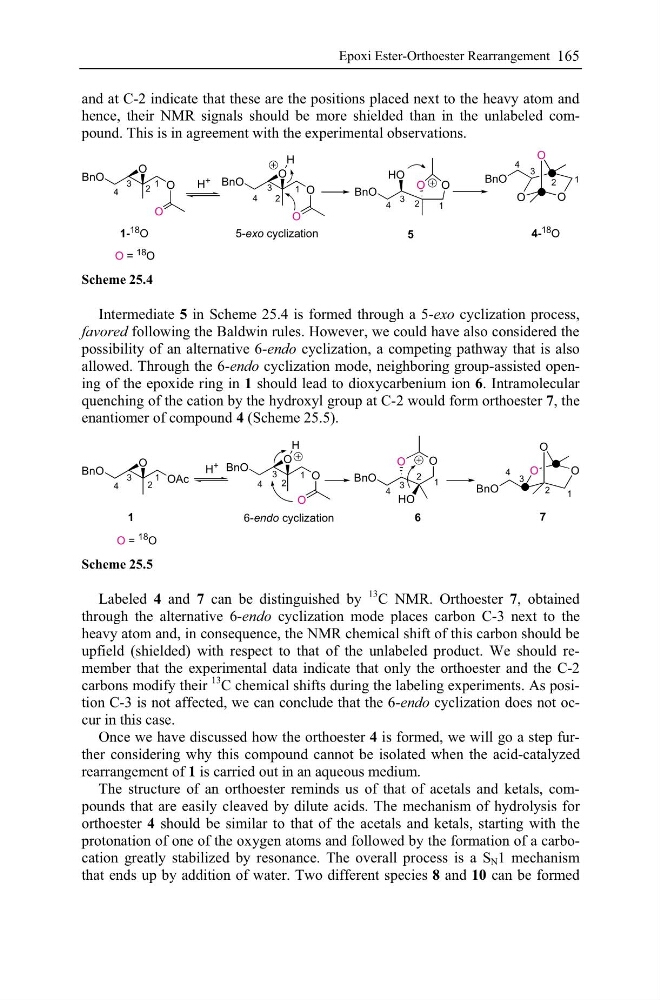
Intermediate 5 in Scheme 25.4 is formed through a 5-exo cyclization process,
favored following the Baldwin rules. However, we could have also considered the
d
possibility of an alternative 6-endo cyclization, a competing pathway that is also
allowed. Through the 6-endo cyclization mode, neighboring group-assisted opening of the epoxide ring in 1 should lead to dioxycarbenium ion 6. Intramolecular
quenching of the cation by the hydroxyl group at C-2 would form orthoester 7, the
enantiomer of compound 4 (Scheme 25.5).
BnO
OAc
O
H + BnO
O
O
H
O
BnO
O
O
HO
O
O
O
BnO
1
6
1
2
3
4
4
3
2
6-endo cyclization
1
2
1
7
O =
18
O
3
4
3
2
1
4
Scheme 25.5
Labeled 4 and 7 can be distinguished by
13
C NMR. Orthoester 7, obtained
through the alternative 6-endo cyclization mode places carbon C-3 next to the
heavy atom and, in consequence, the NMR chemical shift of this carbon should be
upfield (shielded) with respect to that of the unlabeled product. We should remember that the experimental data indicate that only the orthoester and the C-2
carbons modify their
13
C chemical shifts during the labeling experiments. As position C-3 is not affected, we can conclude that the 6-endo cyclization does not occur in this case.
Once we have discussed how the orthoester 4 is formed, we will go a step further considering why this compound cannot be isolated when the acid-catalyzed
rearrangement of 1 is carried out in an aqueous medium.
The structure of an orthoester reminds us of that of acetals and ketals, compounds that are easily cleaved by dilute acids. The mechanism of hydrolysis for
orthoester 4 should be similar to that of the acetals and ketals, starting with the
protonation of one of the oxygen atoms and followed by the formation of a carbocation greatly stabilized by resonance. The overall process is a S N 1 mechanism
that ends up by addition of water. Two different species 8 and 10 can be formed
and at C-2 indicate that these are the positions placed next to the heavy atom and
hence, their NMR signals should be more shielded than in the unlabeled compound. This is in agreement with the experimental observations.
BnO
O
O
O
1- 18 O
H + BnO
O
O
H
O
O
O
BnO
HO
O
O
O
BnO
4- 18 O
1
2
3
4
4
3 2
1
4
3
2
1
O = 18 O
3
2
1
5
5-exo cyclization
Scheme 25.4
Intermediate 5 in Scheme 25.4 is formed through a 5-exo cyclization process,
favored following the Baldwin rules. However, we could have also considered the
d
possibility of an alternative 6-endo cyclization, a competing pathway that is also
allowed. Through the 6-endo cyclization mode, neighboring group-assisted opening of the epoxide ring in 1 should lead to dioxycarbenium ion 6. Intramolecular
quenching of the cation by the hydroxyl group at C-2 would form orthoester 7, the
enantiomer of compound 4 (Scheme 25.5).
BnO
OAc
O
H + BnO
O
O
H
O
BnO
O
O
HO
O
O
O
BnO
1
6
1
2
3
4
4
3
2
6-endo cyclization
1
2
1
7
O =
18
O
3
4
3
2
1
4
Scheme 25.5
Labeled 4 and 7 can be distinguished by
13
C NMR. Orthoester 7, obtained
through the alternative 6-endo cyclization mode places carbon C-3 next to the
heavy atom and, in consequence, the NMR chemical shift of this carbon should be
upfield (shielded) with respect to that of the unlabeled product. We should remember that the experimental data indicate that only the orthoester and the C-2
carbons modify their
13
C chemical shifts during the labeling experiments. As position C-3 is not affected, we can conclude that the 6-endo cyclization does not occur in this case.
Once we have discussed how the orthoester 4 is formed, we will go a step further considering why this compound cannot be isolated when the acid-catalyzed
rearrangement of 1 is carried out in an aqueous medium.
The structure of an orthoester reminds us of that of acetals and ketals, compounds that are easily cleaved by dilute acids. The mechanism of hydrolysis for
orthoester 4 should be similar to that of the acetals and ketals, starting with the
protonation of one of the oxygen atoms and followed by the formation of a carbocation greatly stabilized by resonance. The overall process is a S N 1 mechanism
that ends up by addition of water. Two different species 8 and 10 can be formed