

Level 2 – Case 25
164
E Ex xp pe er ri im me en nt ta al l D Da at ta a
Orthoester 4 has been characterized by NMR upon treatment of 1 with 0.5%
trifluoroacetic acid (TFA)/CDCl 3 for 1 h. The study of the reaction mechanism
f
was carried out in TFA/CDCl 3 starting from epoxy ester 1 labeled with
18 O in the
carbonyl oxygen. The location of the label in the orthoester intermediate was determined by
13
C-NMR spectrometry, through the characteristic upfield shifts of the
carbon signals when bonded to the heavy isotope. The
13 C NMR of labeled orthoester 4 showed upfield shifts of the signals corresponding to the orthoester carbon (120.5 ppm, 'G = 25 ppb) and the C-2 position (85.5 ppm, 'G = 34 ppb).
D Di is sc cu us ss si io on n
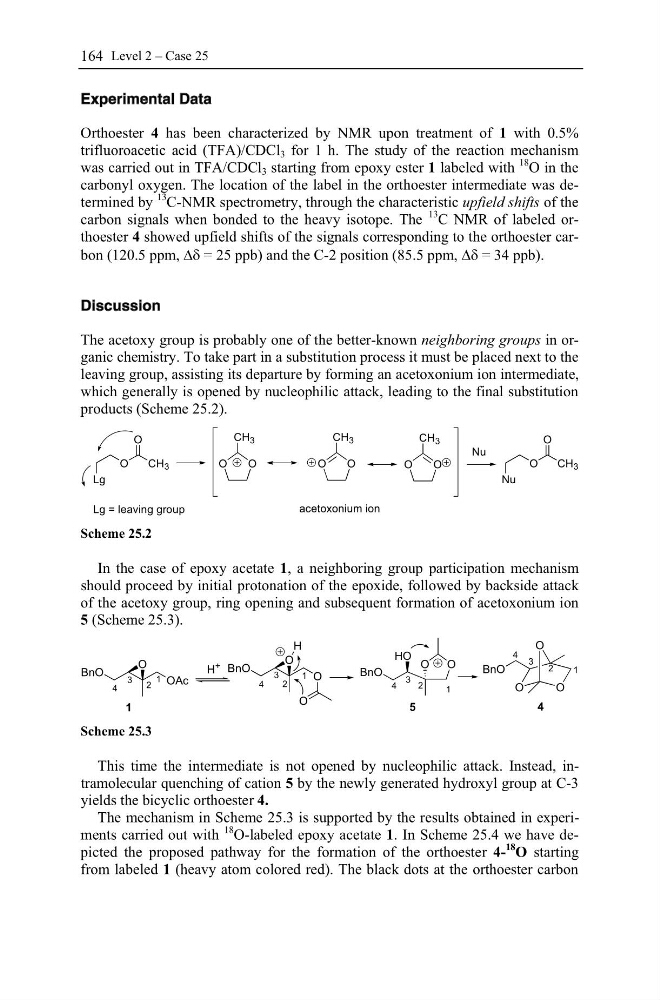
The acetoxy group is probably one of the better-known neighboring groups in organic chemistry. To take part in a substitution process it must be placed next to the
leaving group, assisting its departure by forming an acetoxonium ion intermediate,
which generally is opened by nucleophilic attack, leading to the final substitution
products (Scheme 25.2).
O
O
CH 3
Lg
O
O
CH 3
O
O
CH 3
O
O
CH 3
O
O
CH 3
Nu
Lg = leaving group
acetoxonium ion
Nu
Scheme 25.2
In the case of epoxy acetate 1, a neighboring group participation mechanism
should proceed by initial protonation of the epoxide, followed by backside attack
of the acetoxy group, ring opening and subsequent formation of acetoxonium ion
u
5 (Scheme 25.3).
BnO
OAc
O
H + BnO
O
O
H
O
O
O
BnO
HO
O
O
O
BnO
1
5
4
1
2
3
4
4
3 2
1
4
3
2
1
4
3
2
1
Scheme 25.3
This time the intermediate is not opened by nucleophilic attack. Instead, intramolecular quenching of cation 5 by the newly generated hydroxyl group at C-3
yields the bicyclic orthoester 4.
The mechanism in Scheme 25.3 is supported by the results obtained in experiments carried out with
18
O-labeled epoxy acetate 1. In Scheme 25.4 we have depicted the proposed pathway for the formation of the orthoester 418
O starting
from labeled 1 (heavy atom colored red). The black dots at the orthoester carbon
164
E Ex xp pe er ri im me en nt ta al l D Da at ta a
Orthoester 4 has been characterized by NMR upon treatment of 1 with 0.5%
trifluoroacetic acid (TFA)/CDCl 3 for 1 h. The study of the reaction mechanism
f
was carried out in TFA/CDCl 3 starting from epoxy ester 1 labeled with
18 O in the
carbonyl oxygen. The location of the label in the orthoester intermediate was determined by
13
C-NMR spectrometry, through the characteristic upfield shifts of the
carbon signals when bonded to the heavy isotope. The
13 C NMR of labeled orthoester 4 showed upfield shifts of the signals corresponding to the orthoester carbon (120.5 ppm, 'G = 25 ppb) and the C-2 position (85.5 ppm, 'G = 34 ppb).
D Di is sc cu us ss si io on n
The acetoxy group is probably one of the better-known neighboring groups in organic chemistry. To take part in a substitution process it must be placed next to the
leaving group, assisting its departure by forming an acetoxonium ion intermediate,
which generally is opened by nucleophilic attack, leading to the final substitution
products (Scheme 25.2).
O
O
CH 3
Lg
O
O
CH 3
O
O
CH 3
O
O
CH 3
O
O
CH 3
Nu
Lg = leaving group
acetoxonium ion
Nu
Scheme 25.2
In the case of epoxy acetate 1, a neighboring group participation mechanism
should proceed by initial protonation of the epoxide, followed by backside attack
of the acetoxy group, ring opening and subsequent formation of acetoxonium ion
u
5 (Scheme 25.3).
BnO
OAc
O
H + BnO
O
O
H
O
O
O
BnO
HO
O
O
O
BnO
1
5
4
1
2
3
4
4
3 2
1
4
3
2
1
4
3
2
1
Scheme 25.3
This time the intermediate is not opened by nucleophilic attack. Instead, intramolecular quenching of cation 5 by the newly generated hydroxyl group at C-3
yields the bicyclic orthoester 4.
The mechanism in Scheme 25.3 is supported by the results obtained in experiments carried out with
18
O-labeled epoxy acetate 1. In Scheme 25.4 we have depicted the proposed pathway for the formation of the orthoester 418
O starting
from labeled 1 (heavy atom colored red). The black dots at the orthoester carbon