

L Le ev ve el l 2 2 C Ca as se e 2 25 5
E Ep po ox xi i E Es st te er r- -O Or rt th ho oe es st te er r R Re ea ar rr ra an ng ge em me en nt t
K Ke ey y p po oi in nt t: : I Is Is I Is Is Is I I o ot to to to to to t top op op pe e l la la l la l la la l lab be el li li li l li li l lin i in in in i i g g. g.
N Ne Ne N Ne Ne Ne N Nei ig i ig g
igh h h
ghb bo or ri ri ri r ri ri r rin i in in in i i g g g gr r
gro ro r ro ro ro ro r rou up up up p p pa ar rt t t
r rti ti ti t ti ti t tic ic ic ic i i i ip i ip i ip p
i ipa at ti ti ti t ti
ti t tio io io io i ion n
BnO
OAc
O
H 3 O +
BnO
OH
OAc
OH
BnO
OAc
OH
OH
E Ep po ox xi i E Es st te er r- -O Or rt th ho oe es st te er r R Re ea ar rr ra an ng ge em me en nt t
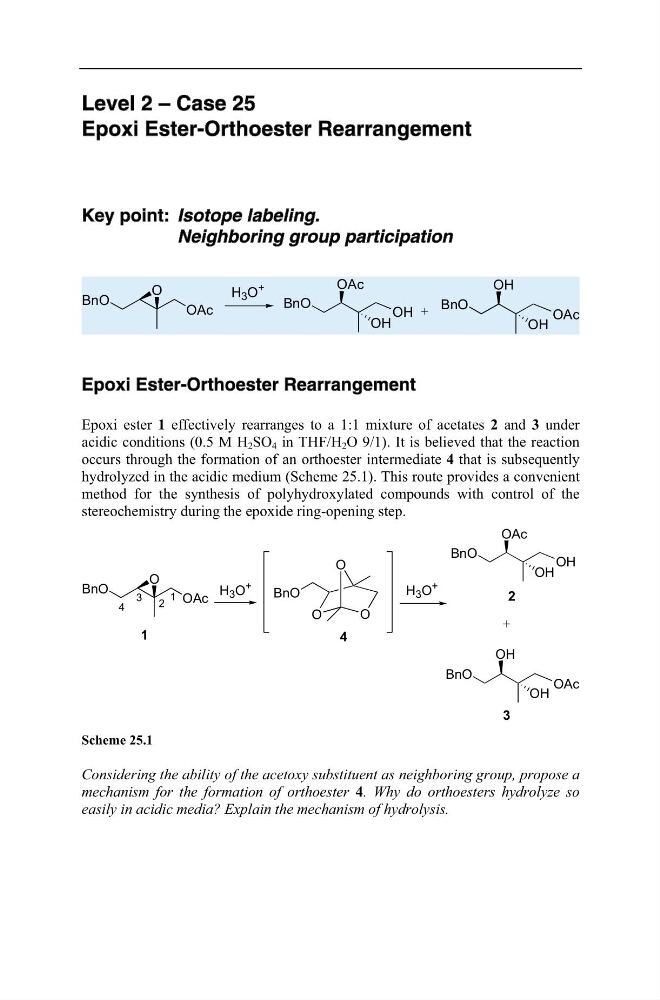
Epoxi ester 1 effectively rearranges to a 1:1 mixture of acetates 2 and 3 under
acidic conditions (0.5 M H 2 SO 4 in THF/H 2 O 9/1). It is believed that the reaction
occurs through the formation of an orthoester intermediate 4 that is subsequently
hydrolyzed in the acidic medium (Scheme 25.1). This route provides a convenient
method for the synthesis of polyhydroxylated compounds with control of the
stereochemistry during the epoxide ring-opening step.
H 3 O
+
O
O
O
BnO
H 3 O
+
BnO
OH
OAc
OH
BnO
OAc
OH
OH
4
3
2
BnO
OAc
O
1
4
3
2
1
Scheme 25.1
Considering the ability of the acetoxy substituent as neighboring group, propose a
mechanism for the formation of orthoester 4. Why do orthoesters hydrolyze so
easily in acidic media? Explain the mechanism of hydrolysis.
E Ep po ox xi i E Es st te er r- -O Or rt th ho oe es st te er r R Re ea ar rr ra an ng ge em me en nt t
K Ke ey y p po oi in nt t: : I Is Is I Is Is Is I I o ot to to to to to t top op op pe e l la la l la l la la l lab be el li li li l li li l lin i in in in i i g g. g.
N Ne Ne N Ne Ne Ne N Nei ig i ig g
igh h h
ghb bo or ri ri ri r ri ri r rin i in in in i i g g g gr r
gro ro r ro ro ro ro r rou up up up p p pa ar rt t t
r rti ti ti t ti ti t tic ic ic ic i i i ip i ip i ip p
i ipa at ti ti ti t ti
ti t tio io io io i ion n
BnO
OAc
O
H 3 O +
BnO
OH
OAc
OH
BnO
OAc
OH
OH
E Ep po ox xi i E Es st te er r- -O Or rt th ho oe es st te er r R Re ea ar rr ra an ng ge em me en nt t
Epoxi ester 1 effectively rearranges to a 1:1 mixture of acetates 2 and 3 under
acidic conditions (0.5 M H 2 SO 4 in THF/H 2 O 9/1). It is believed that the reaction
occurs through the formation of an orthoester intermediate 4 that is subsequently
hydrolyzed in the acidic medium (Scheme 25.1). This route provides a convenient
method for the synthesis of polyhydroxylated compounds with control of the
stereochemistry during the epoxide ring-opening step.
H 3 O
+
O
O
O
BnO
H 3 O
+
BnO
OH
OAc
OH
BnO
OAc
OH
OH
4
3
2
BnO
OAc
O
1
4
3
2
1
Scheme 25.1
Considering the ability of the acetoxy substituent as neighboring group, propose a
mechanism for the formation of orthoester 4. Why do orthoesters hydrolyze so
easily in acidic media? Explain the mechanism of hydrolysis.