

Hydrolysis of 2-Aminobenzoate Esters 155
R 1
O
OR 2
R 1
O
OH 2
OR 2
R 1
OH
OH
OR 2
H 2 O
- R 2 O
R 1
OH
OH
- H
R 1
O
OH
addition
elimination
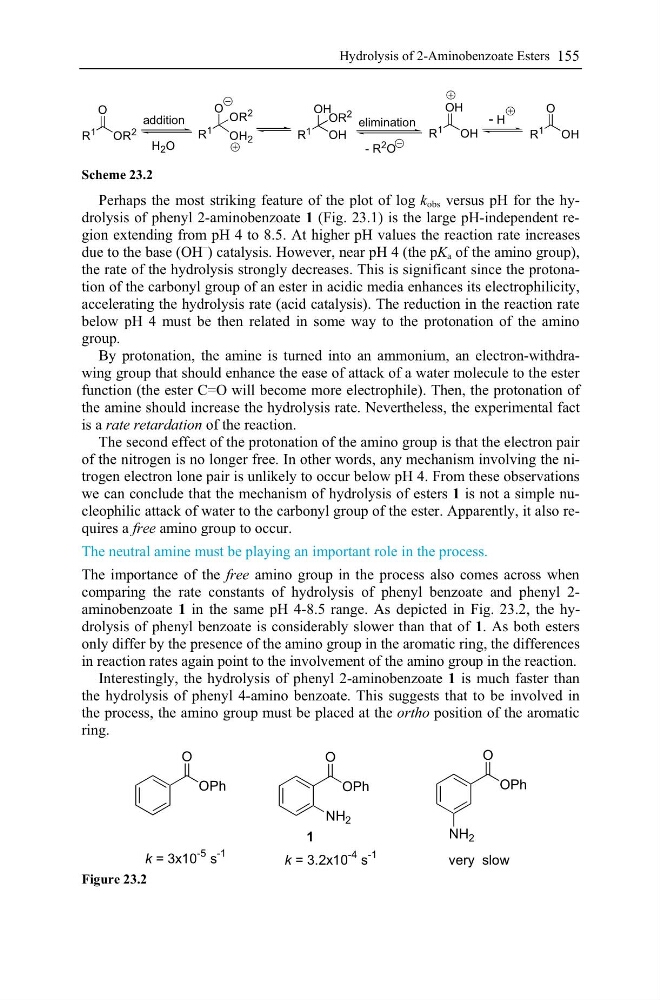
Scheme 23.2
Perhaps the most striking feature of the plot of log k obs
k k versus pH for the hydrolysis of phenyl 2-aminobenzoate 1 (Fig. 23.1) is the large pH-independent region extending from pH 4 to 8.5. At higher pH values the reaction rate increases
due to the base (OH
–
) catalysis. However, near pH 4 (the pK
p p a
K K of the amino group),
the rate of the hydrolysis strongly decreases. This is significant since the protonation of the carbonyl group of an ester in acidic media enhances its electrophilicity,
accelerating the hydrolysis rate (acid catalysis). The reduction in the reaction rate
below pH 4 must be then related in some way to the protonation of the amino
group.
By protonation, the amine is turned into an ammonium, an electron-withdrawing group that should enhance the ease of attack of a water molecule to the ester
function (the ester C=O will become more electrophile). Then, the protonation of
the amine should increase the hydrolysis rate. Nevertheless, the experimental fact
t
is a rate retardation of the reaction.
The second effect of the protonation of the amino group is that the electron pair
of the nitrogen is no longer free. In other words, any mechanism involving the nitrogen electron lone pair is unlikely to occur below pH 4. From these observations
we can conclude that the mechanism of hydrolysis of esters 1 is not a simple nucleophilic attack of water to the carbonyl group of the ester. Apparently, it also requires a free amino group to occur.
The neutral amine must be playing an important role in the process.
The importance of the free amino group in the process also comes across when
comparing the rate constants of hydrolysis of phenyl benzoate and phenyl 2aminobenzoate 1 in the same pH 4-8.5 range. As depicted in Fig. 23.2, the hydrolysis of phenyl benzoate is considerably slower than that of 1. As both esters
only differ by the presence of the amino group in the aromatic ring, the differences
in reaction rates again point to the involvement of the amino group in the reaction.
Interestingly, the hydrolysis of phenyl 2-aminobenzoate 1 is much faster than
the hydrolysis of phenyl 4-amino benzoate. This suggests that to be involved in
the process, the amino group must be placed at the
u
ortho position of the aromatic
ring.
OPh
NH 2
O
OPh
O
OPh
NH 2
k = 3x10
k
-5 s
-1
k = 3.2x10
k
-4 s
-1
1
very slow
Figure 23.2
R 1
O
OR 2
R 1
O
OH 2
OR 2
R 1
OH
OH
OR 2
H 2 O
- R 2 O
R 1
OH
OH
- H
R 1
O
OH
addition
elimination
Scheme 23.2
Perhaps the most striking feature of the plot of log k obs
k k versus pH for the hydrolysis of phenyl 2-aminobenzoate 1 (Fig. 23.1) is the large pH-independent region extending from pH 4 to 8.5. At higher pH values the reaction rate increases
due to the base (OH
–
) catalysis. However, near pH 4 (the pK
p p a
K K of the amino group),
the rate of the hydrolysis strongly decreases. This is significant since the protonation of the carbonyl group of an ester in acidic media enhances its electrophilicity,
accelerating the hydrolysis rate (acid catalysis). The reduction in the reaction rate
below pH 4 must be then related in some way to the protonation of the amino
group.
By protonation, the amine is turned into an ammonium, an electron-withdrawing group that should enhance the ease of attack of a water molecule to the ester
function (the ester C=O will become more electrophile). Then, the protonation of
the amine should increase the hydrolysis rate. Nevertheless, the experimental fact
t
is a rate retardation of the reaction.
The second effect of the protonation of the amino group is that the electron pair
of the nitrogen is no longer free. In other words, any mechanism involving the nitrogen electron lone pair is unlikely to occur below pH 4. From these observations
we can conclude that the mechanism of hydrolysis of esters 1 is not a simple nucleophilic attack of water to the carbonyl group of the ester. Apparently, it also requires a free amino group to occur.
The neutral amine must be playing an important role in the process.
The importance of the free amino group in the process also comes across when
comparing the rate constants of hydrolysis of phenyl benzoate and phenyl 2aminobenzoate 1 in the same pH 4-8.5 range. As depicted in Fig. 23.2, the hydrolysis of phenyl benzoate is considerably slower than that of 1. As both esters
only differ by the presence of the amino group in the aromatic ring, the differences
in reaction rates again point to the involvement of the amino group in the reaction.
Interestingly, the hydrolysis of phenyl 2-aminobenzoate 1 is much faster than
the hydrolysis of phenyl 4-amino benzoate. This suggests that to be involved in
the process, the amino group must be placed at the
u
ortho position of the aromatic
ring.
OPh
NH 2
O
OPh
O
OPh
NH 2
k = 3x10
k
-5 s
-1
k = 3.2x10
k
-4 s
-1
1
very slow
Figure 23.2