

Level 2 – Case 23
156
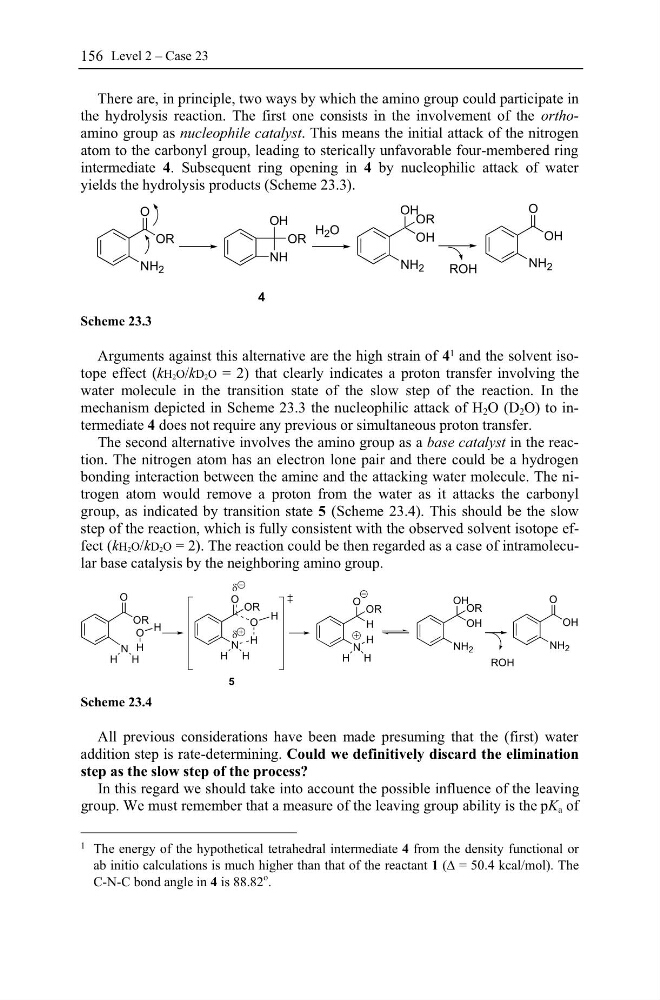
There are, in principle, two ways by which the amino group could participate in
the hydrolysis reaction. The first one consists in the involvement of the orthoamino group as nucleophile catalyst. This means the initial attack of the nitrogen
atom to the carbonyl group, leading to sterically unfavorable four-membered ring
intermediate 4. Subsequent ring opening in 4 by nucleophilic attack of water
yields the hydrolysis products (Scheme 23.3).
NH 2
O
OR
H 2 O
NH 2
OH
OH
OR
H
NH 2
O
OH
ROH
4
NH
OH
OR
Scheme 23.3
Arguments against this alternative are the high strain of 4
1 and the solvent isotope effect (kH k k 2 O/kD k k 2 O = 2) that clearly indicates a proton transfer involving the
water molecule in the transition state of the slow step of the reaction. In the
mechanism depicted in Scheme 23.3 the nucleophilic attack of H 2 O (D 2 O) to intermediate 4 does not require any previous or simultaneous proton transfer.
The second alternative involves the amino group as a base catalyst in the react
tion. The nitrogen atom has an electron lone pair and there could be a hydrogen
bonding interaction between the amine and the attacking water molecule. The nitrogen atom would remove a proton from the water as it attacks the carbonyl
m
group, as indicated by transition state 5 (Scheme 23.4). This should be the slow
step of the reaction, which is fully consistent with the observed solvent isotope effect (kH k k 2 O/kD k k 2 O = 2). The reaction could be then regarded as a case of intramolecular base catalysis by the neighboring amino group.
N
O
H H
OR
O
H
H
N
O
O
H
H H
H
OR
N
O
H H
OR
H
H
ROH
NH 2
O
OH
NH 2
OH
OH
OR
G
G
5
All previous considerations have been made presuming that the (first) water
addition step is rate-determining. Could we definitively discard the elimination
step as the slow step of the process?
In this regard we should take into account the possible influence of the leaving
group. We must remember that a measure of the leaving group ability is the pK a
K K of
1 The energy of the hypothetical tetrahedral intermediate 4 from the density functional or
ab initio calculations is much higher than that of the reactant 1 (' = 50.4 kcal/mol). The
C-N-C bond angle in 4 is 88.82
o .
156
There are, in principle, two ways by which the amino group could participate in
the hydrolysis reaction. The first one consists in the involvement of the orthoamino group as nucleophile catalyst. This means the initial attack of the nitrogen
atom to the carbonyl group, leading to sterically unfavorable four-membered ring
intermediate 4. Subsequent ring opening in 4 by nucleophilic attack of water
yields the hydrolysis products (Scheme 23.3).
NH 2
O
OR
H 2 O
NH 2
OH
OH
OR
H
NH 2
O
OH
ROH
4
NH
OH
OR
Scheme 23.3
Arguments against this alternative are the high strain of 4
1 and the solvent isotope effect (kH k k 2 O/kD k k 2 O = 2) that clearly indicates a proton transfer involving the
water molecule in the transition state of the slow step of the reaction. In the
mechanism depicted in Scheme 23.3 the nucleophilic attack of H 2 O (D 2 O) to intermediate 4 does not require any previous or simultaneous proton transfer.
The second alternative involves the amino group as a base catalyst in the react
tion. The nitrogen atom has an electron lone pair and there could be a hydrogen
bonding interaction between the amine and the attacking water molecule. The nitrogen atom would remove a proton from the water as it attacks the carbonyl
m
group, as indicated by transition state 5 (Scheme 23.4). This should be the slow
step of the reaction, which is fully consistent with the observed solvent isotope effect (kH k k 2 O/kD k k 2 O = 2). The reaction could be then regarded as a case of intramolecular base catalysis by the neighboring amino group.
N
O
H H
OR
O
H
H
N
O
O
H
H H
H
OR
N
O
H H
OR
H
H
ROH
NH 2
O
OH
NH 2
OH
OH
OR
G
G
5
All previous considerations have been made presuming that the (first) water
addition step is rate-determining. Could we definitively discard the elimination
step as the slow step of the process?
In this regard we should take into account the possible influence of the leaving
group. We must remember that a measure of the leaving group ability is the pK a
K K of
1 The energy of the hypothetical tetrahedral intermediate 4 from the density functional or
ab initio calculations is much higher than that of the reactant 1 (' = 50.4 kcal/mol). The
C-N-C bond angle in 4 is 88.82
o .