

Level 2 – Case 23
154
and these reactions are approximately two-fold slower in D 2 O than in H 2 O
(kH k k 2 O/kD k k 2 O = 2).
NH 2
O
OR
NH 2
O
OH
ROH
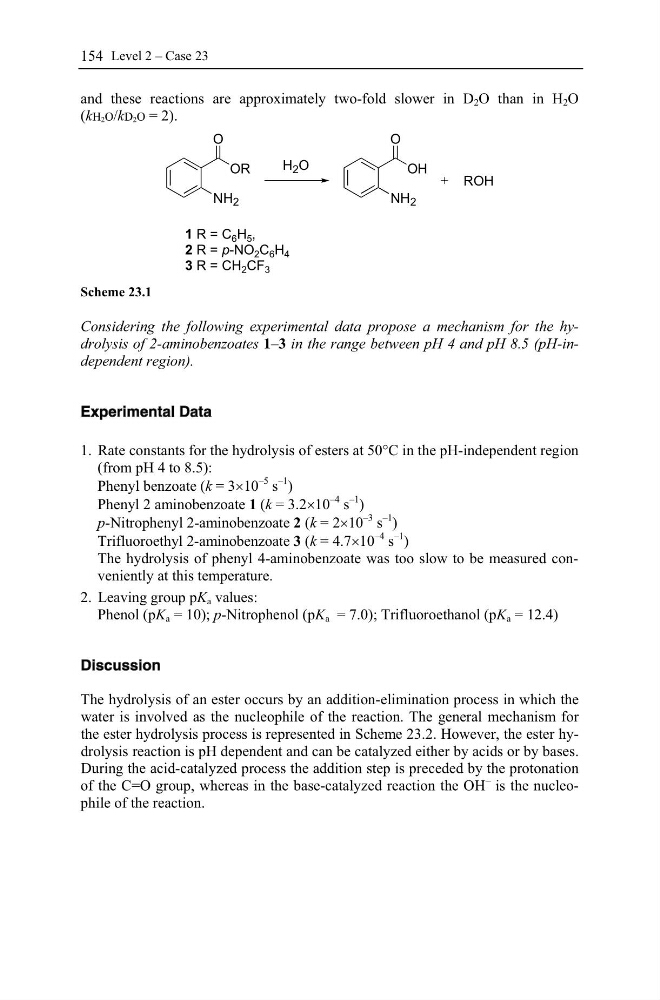
1 R = C 6 H 5 ,
2 R = p-NO 2 C 6 H 4
3 R = CH 2 CF 3
H 2 O
Scheme 23.1
Considering the following experimental data propose a mechanism for the hydrolysis of 2-aminobenzoates 1–3 in the range between pH 4 and pH 8.5 (pH-independent region).
E Ex xp pe er ri im me en nt ta al l D Da at ta a
1. Rate constants for the hydrolysis of esters at 50°C in the pH-independent region
(from pH 4 to 8.5):
Phenyl benzoate (k = 3
k
u10
–5 s
–1 )
Phenyl 2 aminobenzoate 1 (k = 3.2
k
u10
–4 s
–1
)
p-Nitrophenyl 2-aminobenzoate 2 (k = 2
k
u10
–3 s
–1 )
Trifluoroethyl 2-aminobenzoate 3 (k = 4.7
k
u10
–4 s
–1
)
The hydrolysis of phenyl 4-aminobenzoate was too slow to be measured conveniently at this temperature.
2. Leaving group pK a
K K values:
Phenol (pK a
K K = 10); p-Nitrophenol (pK a
K K = 7.0); Trifluoroethanol (pK a
K K = 12.4)
D Di is sc cu us ss si io on n
The hydrolysis of an ester occurs by an addition-elimination process in which the
water is involved as the nucleophile of the reaction. The general mechanism for
the ester hydrolysis process is represented in Scheme 23.2. However, the ester hydrolysis reaction is pH dependent and can be catalyzed either by acids or by bases.
During the acid-catalyzed process the addition step is preceded by the protonation
of the C=O group, whereas in the base-catalyzed reaction the OH
– is the nucleo–
phile of the reaction.
154
and these reactions are approximately two-fold slower in D 2 O than in H 2 O
(kH k k 2 O/kD k k 2 O = 2).
NH 2
O
OR
NH 2
O
OH
ROH
1 R = C 6 H 5 ,
2 R = p-NO 2 C 6 H 4
3 R = CH 2 CF 3
H 2 O
Scheme 23.1
Considering the following experimental data propose a mechanism for the hydrolysis of 2-aminobenzoates 1–3 in the range between pH 4 and pH 8.5 (pH-independent region).
E Ex xp pe er ri im me en nt ta al l D Da at ta a
1. Rate constants for the hydrolysis of esters at 50°C in the pH-independent region
(from pH 4 to 8.5):
Phenyl benzoate (k = 3
k
u10
–5 s
–1 )
Phenyl 2 aminobenzoate 1 (k = 3.2
k
u10
–4 s
–1
)
p-Nitrophenyl 2-aminobenzoate 2 (k = 2
k
u10
–3 s
–1 )
Trifluoroethyl 2-aminobenzoate 3 (k = 4.7
k
u10
–4 s
–1
)
The hydrolysis of phenyl 4-aminobenzoate was too slow to be measured conveniently at this temperature.
2. Leaving group pK a
K K values:
Phenol (pK a
K K = 10); p-Nitrophenol (pK a
K K = 7.0); Trifluoroethanol (pK a
K K = 12.4)
D Di is sc cu us ss si io on n
The hydrolysis of an ester occurs by an addition-elimination process in which the
water is involved as the nucleophile of the reaction. The general mechanism for
the ester hydrolysis process is represented in Scheme 23.2. However, the ester hydrolysis reaction is pH dependent and can be catalyzed either by acids or by bases.
During the acid-catalyzed process the addition step is preceded by the protonation
of the C=O group, whereas in the base-catalyzed reaction the OH
– is the nucleo–
phile of the reaction.