

Tandem Cycloadditions with Nitronates 149
Me
CO 2 Et
N
O
O
Me
Me
Me
Me
SnCl 4
N
O
Me
Me
Me
Me
Me
O
H
EtO 2 C
H
7
8
13
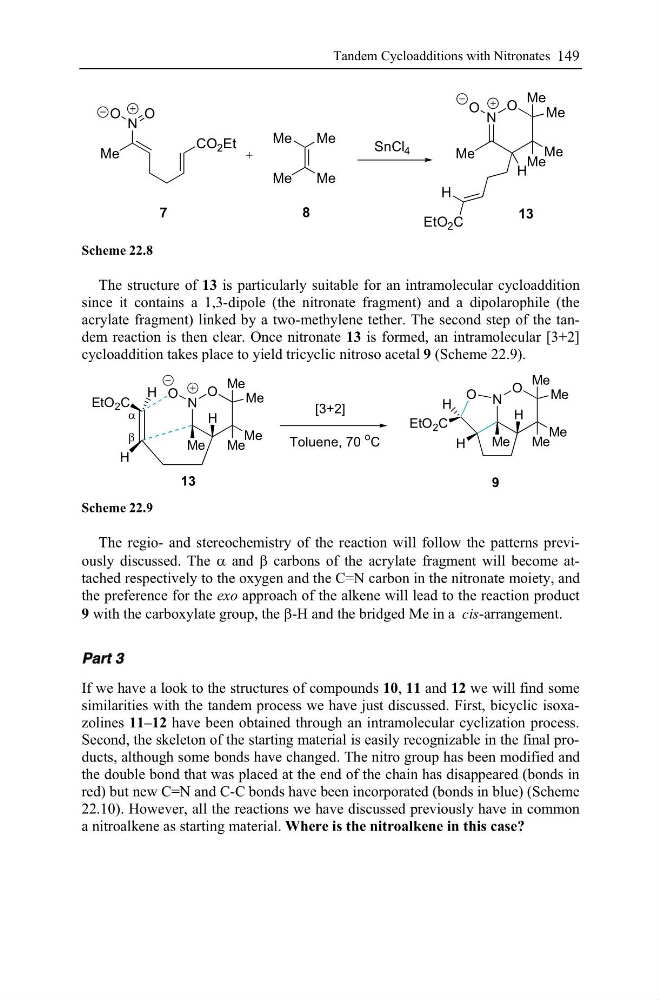
Scheme 22.8
The structure of 13 is particularly suitable for an intramolecular cycloaddition
since it contains a 1,3-dipole (the nitronate fragment) and a dipolarophile (the
acrylate fragment) linked by a two-methylene tether. The second step of the tandem reaction is then clear. Once nitronate 13 is formed, an intramolecular [3+2]
cycloaddition takes place to yield tricyclic nitroso acetal 9 (Scheme 22.9).
N
O
Me
Me
Me
Me
Me
H
EtO 2 C
H O
H
Me
H
O
Me
Me
Me
Me
H
N
O
EtO 2 C
H
Toluene, 70
o C
9
[3+2]
13
D
E
Scheme 22.9
The regio- and stereochemistry of the reaction will follow the patterns previously discussed. The D and E carbons of the acrylate fragment will become attached respectively to the oxygen and the C=N carbon in the nitronate moiety, and
the preference for the exo approach of the alkene will lead to the reaction product
9 with the carboxylate group, the E-H and the bridged Me in a cis-arrangement.
P Pa Pa P Pa Pa Pa Pa P Par rt rt rt t
rt r rt r rt r 3 3
If we have a look to the structures of compounds 10, 11 and 12 we will find some
similarities with the tandem process we have just discussed. First, bicyclic isoxazolines 11–12 have been obtained through an intramolecular cyclization process.
Second, the skeleton of the starting material is easily recognizable in the final products, although some bonds have changed. The nitro group has been modified and
the double bond that was placed at the end of the chain has disappeared (bonds in
red) but new C=N and C-C bonds have been incorporated (bonds in blue) (Scheme
22.10). However, all the reactions we have discussed previously have in common
a nitroalkene as starting material. Where is the nitroalkene in this case?
Me
CO 2 Et
N
O
O
Me
Me
Me
Me
SnCl 4
N
O
Me
Me
Me
Me
Me
O
H
EtO 2 C
H
7
8
13
Scheme 22.8
The structure of 13 is particularly suitable for an intramolecular cycloaddition
since it contains a 1,3-dipole (the nitronate fragment) and a dipolarophile (the
acrylate fragment) linked by a two-methylene tether. The second step of the tandem reaction is then clear. Once nitronate 13 is formed, an intramolecular [3+2]
cycloaddition takes place to yield tricyclic nitroso acetal 9 (Scheme 22.9).
N
O
Me
Me
Me
Me
Me
H
EtO 2 C
H O
H
Me
H
O
Me
Me
Me
Me
H
N
O
EtO 2 C
H
Toluene, 70
o C
9
[3+2]
13
D
E
Scheme 22.9
The regio- and stereochemistry of the reaction will follow the patterns previously discussed. The D and E carbons of the acrylate fragment will become attached respectively to the oxygen and the C=N carbon in the nitronate moiety, and
the preference for the exo approach of the alkene will lead to the reaction product
9 with the carboxylate group, the E-H and the bridged Me in a cis-arrangement.
P Pa Pa P Pa Pa Pa Pa P Par rt rt rt t
rt r rt r rt r 3 3
If we have a look to the structures of compounds 10, 11 and 12 we will find some
similarities with the tandem process we have just discussed. First, bicyclic isoxazolines 11–12 have been obtained through an intramolecular cyclization process.
Second, the skeleton of the starting material is easily recognizable in the final products, although some bonds have changed. The nitro group has been modified and
the double bond that was placed at the end of the chain has disappeared (bonds in
red) but new C=N and C-C bonds have been incorporated (bonds in blue) (Scheme
22.10). However, all the reactions we have discussed previously have in common
a nitroalkene as starting material. Where is the nitroalkene in this case?