

Level 2 – Case 22
148
O
Me
MeO
H
O
N
CH 2
MeO 2 C
N
O
OMe
O
MeO 2 C
Me
H
6
exo approach
Scheme 22.6
P Pa Pa P Pa Pa Pa Pa P Par rt rt rt t
rt
r rt r rt r 2 2
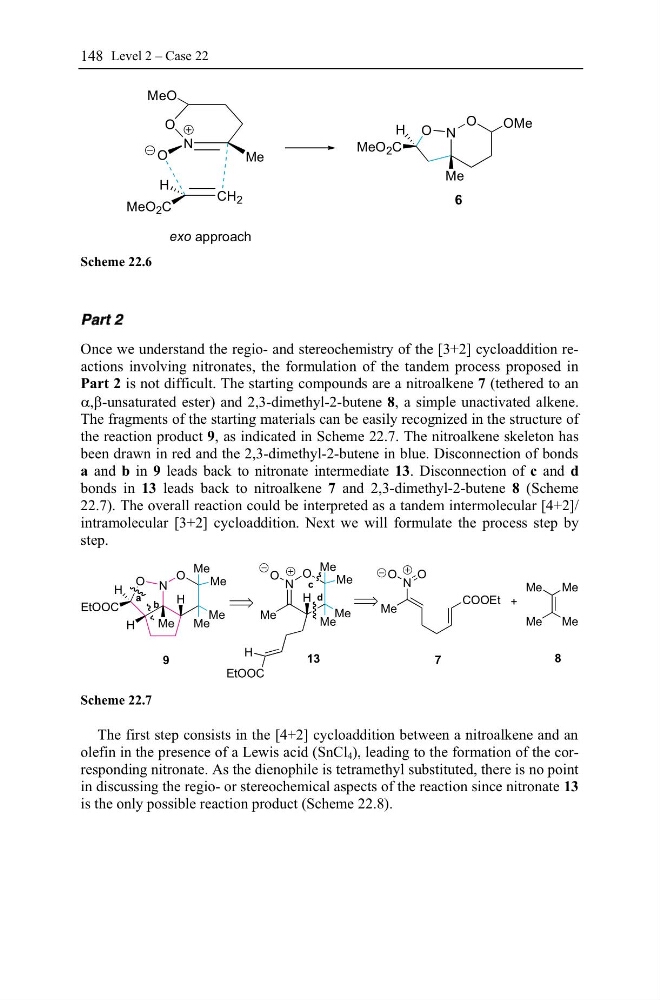
Once we understand the regio- and stereochemistry of the [3+2] cycloaddition reactions involving nitronates, the formulation of the tandem process proposed in
Part 2 is not difficult. The starting compounds are a nitroalkene 7 (tethered to an
DE-unsaturated ester) and 2,3-dimethyl-2-butene 8, a simple unactivated alkene.
The fragments of the starting materials can be easily recognized in the structure of
the reaction product 9
t , as indicated in Scheme 22.7. The nitroalkene skeleton has
been drawn in red and the 2,3-dimethyl-2-butene in blue. Disconnection of bonds
a and b in 9 leads back to nitronate intermediate 13. Disconnection of c and d
bonds in 13 leads back to nitroalkene 7 and 2,3-dimethyl-2-butene 8 (Scheme
22.7). The overall reaction could be interpreted as a tandem intermolecular [4+2]/
intramolecular [3+2] cycloaddition. Next we will formulate the process step by
step.
N
O
Me
Me
Me
Me
Me
M
H
O
EtOOC
H
Me
Me
Me
Me
N
O
O
Me
Me
Me
Me
H
Me
EtOOC
H
H
Me
COOEt
O
N
O
8
13
a b b
c
d
7
9
+
Scheme 22.7
The first step consists in the [4+2] cycloaddition between a nitroalkene and an
olefin in the presence of a Lewis acid (SnCl 4 ), leading to the formation of the corresponding nitronate. As the dienophile is tetramethyl substituted, there is no point
in discussing the regio- or stereochemical aspects of the reaction since nitronate 13
is the only possible reaction product (Scheme 22.8).
148
O
Me
MeO
H
O
N
CH 2
MeO 2 C
N
O
OMe
O
MeO 2 C
Me
H
6
exo approach
Scheme 22.6
P Pa Pa P Pa Pa Pa Pa P Par rt rt rt t
rt
r rt r rt r 2 2
Once we understand the regio- and stereochemistry of the [3+2] cycloaddition reactions involving nitronates, the formulation of the tandem process proposed in
Part 2 is not difficult. The starting compounds are a nitroalkene 7 (tethered to an
DE-unsaturated ester) and 2,3-dimethyl-2-butene 8, a simple unactivated alkene.
The fragments of the starting materials can be easily recognized in the structure of
the reaction product 9
t , as indicated in Scheme 22.7. The nitroalkene skeleton has
been drawn in red and the 2,3-dimethyl-2-butene in blue. Disconnection of bonds
a and b in 9 leads back to nitronate intermediate 13. Disconnection of c and d
bonds in 13 leads back to nitroalkene 7 and 2,3-dimethyl-2-butene 8 (Scheme
22.7). The overall reaction could be interpreted as a tandem intermolecular [4+2]/
intramolecular [3+2] cycloaddition. Next we will formulate the process step by
step.
N
O
Me
Me
Me
Me
Me
M
H
O
EtOOC
H
Me
Me
Me
Me
N
O
O
Me
Me
Me
Me
H
Me
EtOOC
H
H
Me
COOEt
O
N
O
8
13
a b b
c
d
7
9
+
Scheme 22.7
The first step consists in the [4+2] cycloaddition between a nitroalkene and an
olefin in the presence of a Lewis acid (SnCl 4 ), leading to the formation of the corresponding nitronate. As the dienophile is tetramethyl substituted, there is no point
in discussing the regio- or stereochemical aspects of the reaction since nitronate 13
is the only possible reaction product (Scheme 22.8).