

Tandem Cycloadditions with Nitronates 147
P Pa ar rt t 3 3
Treatment of vinylsilane 10 with 2 equiv of trimethylsilyl chloride (TMSCl) and
Et 3 N, afforded bicyclic isoxazolines 11 and 12 as a 4.5:1 mixture of stereoisomers
(Scheme 22.4).
Propose a reasonable mechanism to account for the formation of compounds
11 and 12, justifying the diastereoselectivity of the reaction.
Me 2 Si
NO 2
n-Pr
2 eq. TMSCl, 2 eq. NEt 3
N
O
Me 2 Si
H
n-Pr
CH 2 Cl 2 , RT
10
11
N
O
Me 2 Si
H
n-Pr
12
diastereoselectivity 4.5:1
y
Scheme 22.4
D Di is sc cu us ss si io on n
P Pa Pa P Pa Pa Pa Pa P Par rt rt rt t
rt r rt r rt r 1 1
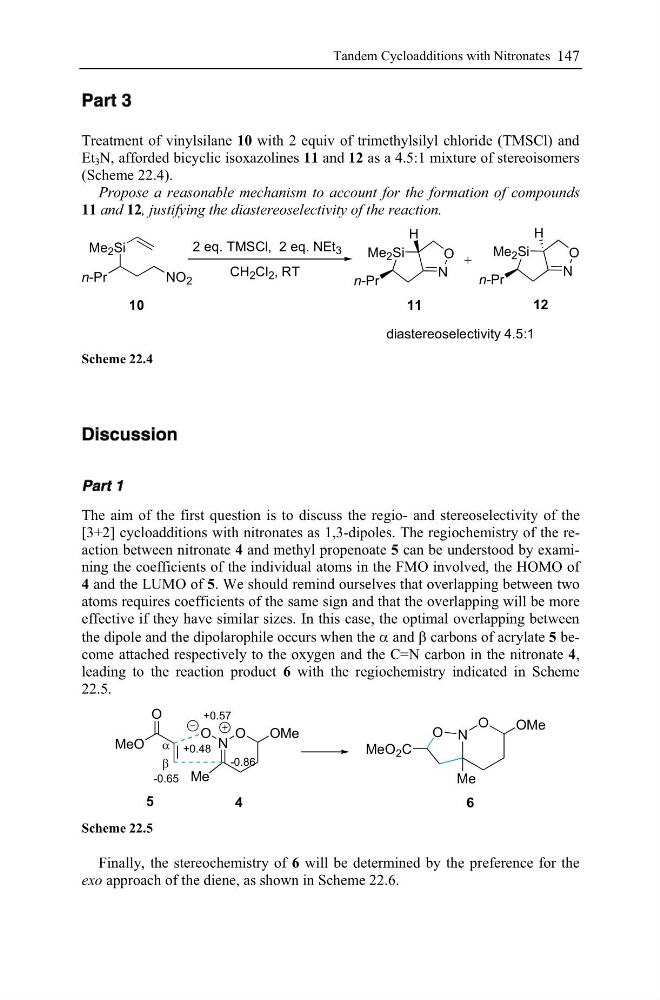
The aim of the first question is to discuss the regio- and stereoselectivity of the
[3+2] cycloadditions with nitronates as 1,3-dipoles. The regiochemistry of the reaction between nitronate 4 and methyl propenoate 5 can be understood by examining the coefficients of the individual atoms in the FMO involved, the HOMO of
4 and the LUMO of 5. We should remind ourselves that overlapping between two
atoms requires coefficients of the same sign and that the overlapping will be more
effective if they have similar sizes. In this case, the optimal overlapping between
the dipole and the dipolarophile occurs when the D and E carbons of acrylate 5 become attached respectively to the oxygen and the C=N carbon in the nitronate 4,
leading to the reaction product 6 with the regiochemistry indicated in Scheme
22.5.
O
O
Me
MeO
N
OMe
O
Me
N
O
O
OMe
MeO 2 C
6
5
+0.57
-0.86 6
4
+0.48
-0.65
D
E
Scheme 22.5
Finally, the stereochemistry of 6 will be determined by the preference for the
exo approach of the diene, as shown in Scheme 22.6.
P Pa ar rt t 3 3
Treatment of vinylsilane 10 with 2 equiv of trimethylsilyl chloride (TMSCl) and
Et 3 N, afforded bicyclic isoxazolines 11 and 12 as a 4.5:1 mixture of stereoisomers
(Scheme 22.4).
Propose a reasonable mechanism to account for the formation of compounds
11 and 12, justifying the diastereoselectivity of the reaction.
Me 2 Si
NO 2
n-Pr
2 eq. TMSCl, 2 eq. NEt 3
N
O
Me 2 Si
H
n-Pr
CH 2 Cl 2 , RT
10
11
N
O
Me 2 Si
H
n-Pr
12
diastereoselectivity 4.5:1
y
Scheme 22.4
D Di is sc cu us ss si io on n
P Pa Pa P Pa Pa Pa Pa P Par rt rt rt t
rt r rt r rt r 1 1
The aim of the first question is to discuss the regio- and stereoselectivity of the
[3+2] cycloadditions with nitronates as 1,3-dipoles. The regiochemistry of the reaction between nitronate 4 and methyl propenoate 5 can be understood by examining the coefficients of the individual atoms in the FMO involved, the HOMO of
4 and the LUMO of 5. We should remind ourselves that overlapping between two
atoms requires coefficients of the same sign and that the overlapping will be more
effective if they have similar sizes. In this case, the optimal overlapping between
the dipole and the dipolarophile occurs when the D and E carbons of acrylate 5 become attached respectively to the oxygen and the C=N carbon in the nitronate 4,
leading to the reaction product 6 with the regiochemistry indicated in Scheme
22.5.
O
O
Me
MeO
N
OMe
O
Me
N
O
O
OMe
MeO 2 C
6
5
+0.57
-0.86 6
4
+0.48
-0.65
D
E
Scheme 22.5
Finally, the stereochemistry of 6 will be determined by the preference for the
exo approach of the diene, as shown in Scheme 22.6.