

Level 2 – Case 22
146
Me
OMe
O
O
COOMe
N
O
O
OMe
MeO 2 C
Me
H
4
6
5
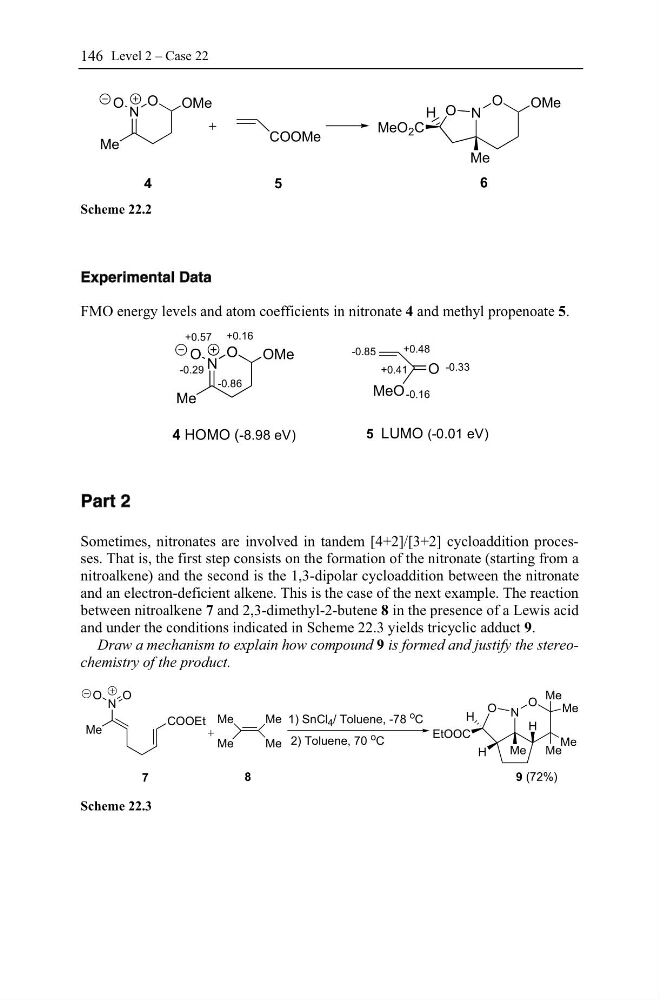
Scheme 22.2
E Ex xp pe er ri im me en nt ta al l D Da at ta a
FMO energy levels and atom coefficients in nitronate 4 and methyl propenoate 5.
4 HOMO (-8.98 eV)
O
MeO
N
O
Me
O
OMe
N
O
+0.16
+0.57
-0.86
-0.29
-0.33
5 LUMO (-0.01 eV)
+0.41
-0.16
+0.48
-0.85
P Pa ar rt t 2 2
Sometimes, nitronates are involved in tandem [4+2]/[3+2] cycloaddition processes. That is, the first step consists on the formation of the nitronate (starting from a
nitroalkene) and the second is the 1,3-dipolar cycloaddition between the nitronate
and an electron-deficient alkene. This is the case of the next example. The reaction
between nitroalkene 7 and 2,3-dimethyl-2-butene 8 in the presence of a Lewis acid
and under the conditions indicated in Scheme 22.3 yields tricyclic adduct 9.
Draw a mechanism to explain how compound 9 is formed and justify the stereochemistry of the product.
Me
COOEt
N
O
O
Me
Me
Me
Me
N
O
O
Me
Me
Me
Me
M
H
Me
EtOOC
H
H
8
1) SnCl 4 / Toluene, -78 o C
2) Toluene, 70 o C
9 (72%)
7
Scheme 22.3
146
Me
OMe
O
O
COOMe
N
O
O
OMe
MeO 2 C
Me
H
4
6
5
Scheme 22.2
E Ex xp pe er ri im me en nt ta al l D Da at ta a
FMO energy levels and atom coefficients in nitronate 4 and methyl propenoate 5.
4 HOMO (-8.98 eV)
O
MeO
N
O
Me
O
OMe
N
O
+0.16
+0.57
-0.86
-0.29
-0.33
5 LUMO (-0.01 eV)
+0.41
-0.16
+0.48
-0.85
P Pa ar rt t 2 2
Sometimes, nitronates are involved in tandem [4+2]/[3+2] cycloaddition processes. That is, the first step consists on the formation of the nitronate (starting from a
nitroalkene) and the second is the 1,3-dipolar cycloaddition between the nitronate
and an electron-deficient alkene. This is the case of the next example. The reaction
between nitroalkene 7 and 2,3-dimethyl-2-butene 8 in the presence of a Lewis acid
and under the conditions indicated in Scheme 22.3 yields tricyclic adduct 9.
Draw a mechanism to explain how compound 9 is formed and justify the stereochemistry of the product.
Me
COOEt
N
O
O
Me
Me
Me
Me
N
O
O
Me
Me
Me
Me
M
H
Me
EtOOC
H
H
8
1) SnCl 4 / Toluene, -78 o C
2) Toluene, 70 o C
9 (72%)
7
Scheme 22.3