

L Le ev ve el l 2 2 C Ca as se e 2 22 2
T Ta an nd de em m C Cy yc cl lo oa ad dd di it ti io on ns s w wi it th h N Ni it tr ro on na at te es s
K Ke ey y p
po oi in nt t: : C Cy Cy Cy yc yc y yc yc yc yc y y l lo lo lo lo l loa ad dd dd d dd dd d dd d ddi di di d di di d dit ti ti ti t ti ti t tio io io io i ion ns s
N
O
O
Me
COOEt
Me
Me
Me
Me
O
O
M e
O
Me
Me
M
Me
EtOOC
H
H
N
Me
H
2) Toluene, 70 o C
1) SnCl 4 /
Toluene, -78
o
C
T Ta an nd de em m C Cy yc cl lo oa ad dd di it ti io on ns s w wi it th h N Ni it tr ro on na at te es s
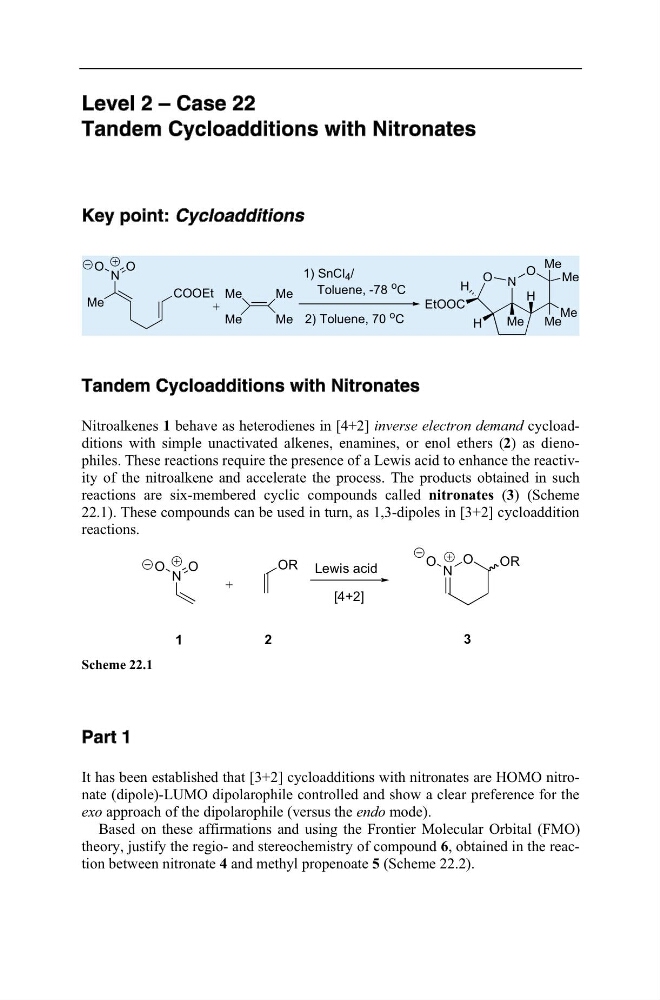
Nitroalkenes 1 behave as heterodienes in [4+2] inverse electron demand cycloadd
ditions with simple unactivated alkenes, enamines, or enol ethers (2) as dienophiles. These reactions require the presence of a Lewis acid to enhance the reactivity of the nitroalkene and accelerate the process. The products obtained in such
reactions are six-membered cyclic compounds called nitronates (3) (Scheme
22.1). These compounds can be used in turn, as 1,3-dipoles in [3+2] cycloaddition
reactions.
N
O
O
N
O
O
1
3
[4+2]
Lewis acid
2
OR
OR
Scheme 22.1
P Pa ar rt t 1 1
It has been established that [3+2] cycloadditions with nitronates are HOMO nitronate (dipole)-LUMO dipolarophile controlled and show a clear preference for the
exo approach of the dipolarophile (versus the endo mode).
Based on these affirmations and using the Frontier Molecular Orbital (FMO)
theory, justify the regio- and stereochemistry of compound 6, obtained in the reaction between nitronate 4 and methyl propenoate 5 (Scheme 22.2).
T Ta an nd de em m C Cy yc cl lo oa ad dd di it ti io on ns s w wi it th h N Ni it tr ro on na at te es s
K Ke ey y p
po oi in nt t: : C Cy Cy Cy yc yc y yc yc yc yc y y l lo lo lo lo l loa ad dd dd d dd dd d dd d ddi di di d di di d dit ti ti ti t ti ti t tio io io io i ion ns s
N
O
O
Me
COOEt
Me
Me
Me
Me
O
O
M e
O
Me
Me
M
Me
EtOOC
H
H
N
Me
H
2) Toluene, 70 o C
1) SnCl 4 /
Toluene, -78
o
C
T Ta an nd de em m C Cy yc cl lo oa ad dd di it ti io on ns s w wi it th h N Ni it tr ro on na at te es s
Nitroalkenes 1 behave as heterodienes in [4+2] inverse electron demand cycloadd
ditions with simple unactivated alkenes, enamines, or enol ethers (2) as dienophiles. These reactions require the presence of a Lewis acid to enhance the reactivity of the nitroalkene and accelerate the process. The products obtained in such
reactions are six-membered cyclic compounds called nitronates (3) (Scheme
22.1). These compounds can be used in turn, as 1,3-dipoles in [3+2] cycloaddition
reactions.
N
O
O
N
O
O
1
3
[4+2]
Lewis acid
2
OR
OR
Scheme 22.1
P Pa ar rt t 1 1
It has been established that [3+2] cycloadditions with nitronates are HOMO nitronate (dipole)-LUMO dipolarophile controlled and show a clear preference for the
exo approach of the dipolarophile (versus the endo mode).
Based on these affirmations and using the Frontier Molecular Orbital (FMO)
theory, justify the regio- and stereochemistry of compound 6, obtained in the reaction between nitronate 4 and methyl propenoate 5 (Scheme 22.2).