

Level 2 – Case 22
150
Me 2 Si
N
n-Pr
O
O
2 eq. TMSCl, 2 eq. NEt 3
N
O
Me 2 Si
H
n-Pr
CH 2 Cl 2 , RT
10
11
O
and 12
Scheme 22.10
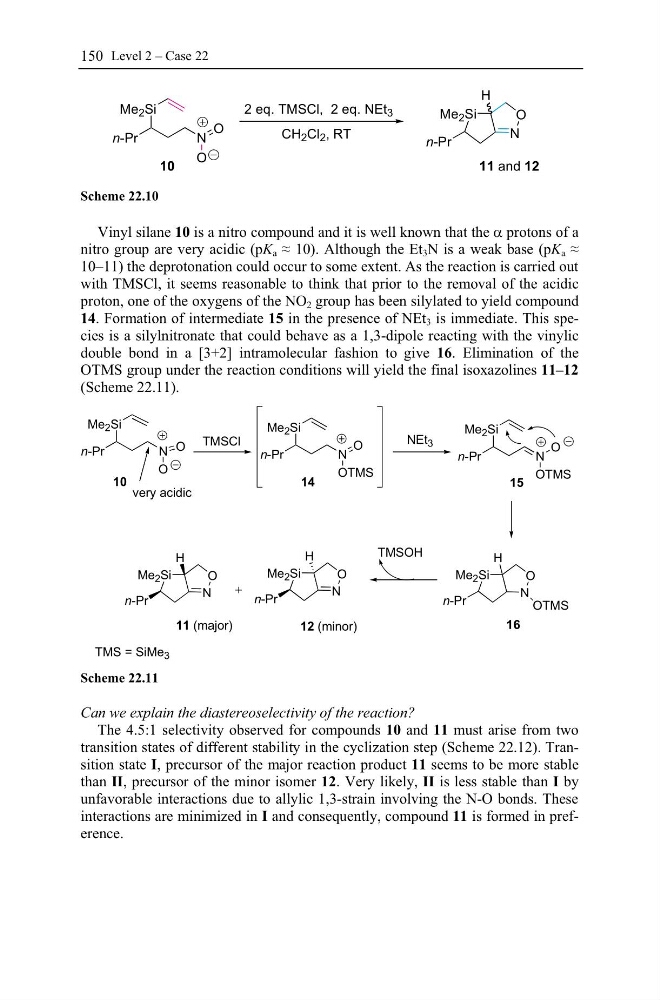
Vinyl silane 10 is a nitro compound and it is well known that the Dprotons of a
nitro group are very acidic (pK a
K K § 10). Although the Et 3 N is a weak base (pK a
K K §
10–11) the deprotonation could occur to some extent. As the reaction is carried out
with TMSCl, it seems reasonable to think that prior to the removal of the acidic
proton, one of the oxygens of the NO 2 group has been silylated to yield compound
14. Formation of intermediate 15 in the presence of NEt 3 is immediate. This species is a silylnitronate that could behave as a 1,3-dipole reacting with the vinylic
double bond in a [3+2] intramolecular fashion to give 16. Elimination of the
OTMS group under the reaction conditions will yield the final isoxazolines 11–12
(Scheme 22.11).
Me 2 Si
N
n-Pr
O
O
N
O
Me 2 Si
H
n-Pr
TMSCl
N
O
Me 2 Si
H
n-Pr
Me 2 Si
N
n-Pr
OTMS
O
TMSOH
NEt 3
N
O
Me 2 Si
H
n-Pr
OTMS
Me 2 Si
N
n-Pr
O
OTMS
very acidic
TMS = SiMe 3
12 (minor)
10
15
16
14
11 (major)
Scheme 22.11
Can we explain the diastereoselectivity of the reaction?
The 4.5:1 selectivity observed for compounds 10 and 11 must arise from two
transition states of different stability in the cyclization step (Scheme 22.12). Transition state I, precursor of the major reaction product 11 seems to be more stable
than II, precursor of the minor isomer 12. Very likely, II is less stable than I by
unfavorable interactions due to allylic 1,3-strain involving the N-O bonds. These
interactions are minimized in I and consequently, compound 11 is formed in preference.
150
Me 2 Si
N
n-Pr
O
O
2 eq. TMSCl, 2 eq. NEt 3
N
O
Me 2 Si
H
n-Pr
CH 2 Cl 2 , RT
10
11
O
and 12
Scheme 22.10
Vinyl silane 10 is a nitro compound and it is well known that the Dprotons of a
nitro group are very acidic (pK a
K K § 10). Although the Et 3 N is a weak base (pK a
K K §
10–11) the deprotonation could occur to some extent. As the reaction is carried out
with TMSCl, it seems reasonable to think that prior to the removal of the acidic
proton, one of the oxygens of the NO 2 group has been silylated to yield compound
14. Formation of intermediate 15 in the presence of NEt 3 is immediate. This species is a silylnitronate that could behave as a 1,3-dipole reacting with the vinylic
double bond in a [3+2] intramolecular fashion to give 16. Elimination of the
OTMS group under the reaction conditions will yield the final isoxazolines 11–12
(Scheme 22.11).
Me 2 Si
N
n-Pr
O
O
N
O
Me 2 Si
H
n-Pr
TMSCl
N
O
Me 2 Si
H
n-Pr
Me 2 Si
N
n-Pr
OTMS
O
TMSOH
NEt 3
N
O
Me 2 Si
H
n-Pr
OTMS
Me 2 Si
N
n-Pr
O
OTMS
very acidic
TMS = SiMe 3
12 (minor)
10
15
16
14
11 (major)
Scheme 22.11
Can we explain the diastereoselectivity of the reaction?
The 4.5:1 selectivity observed for compounds 10 and 11 must arise from two
transition states of different stability in the cyclization step (Scheme 22.12). Transition state I, precursor of the major reaction product 11 seems to be more stable
than II, precursor of the minor isomer 12. Very likely, II is less stable than I by
unfavorable interactions due to allylic 1,3-strain involving the N-O bonds. These
interactions are minimized in I and consequently, compound 11 is formed in preference.