

Level 2 – Case 21
140
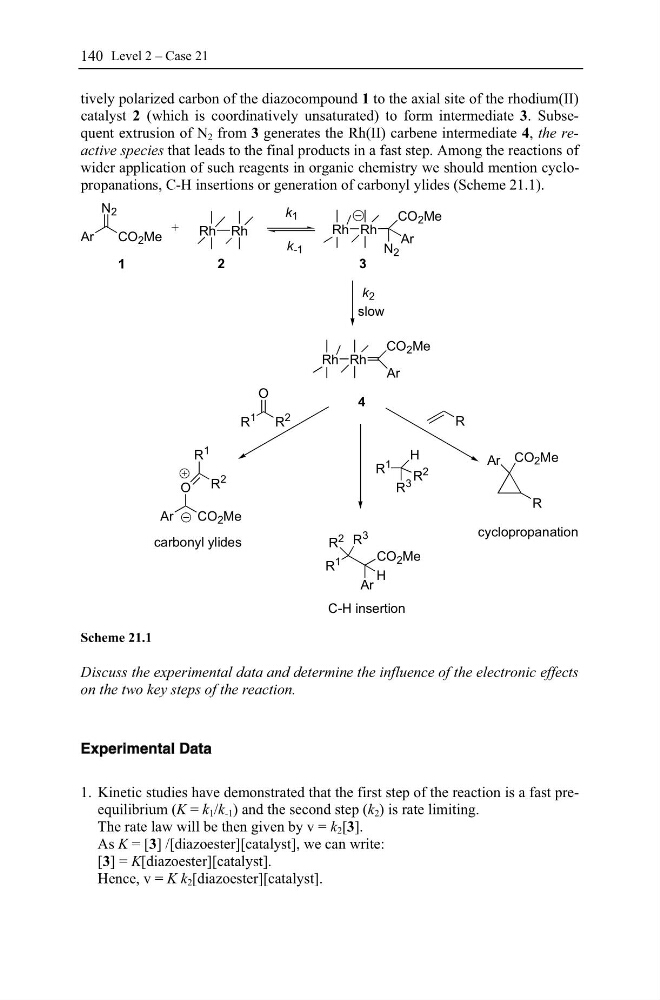
tively polarized carbon of the diazocompound 1 to the axial site of the rhodium(II)
catalyst 2 (which is coordinatively unsaturated) to form intermediate 3. Subsequent extrusion of N 2 from 3 generates the Rh(II) carbene intermediate 4, the reactive species that leads to the final products in a fast step. Among the reactions of
wider application of such reagents in organic chemistry we should mention cyclopropanations, C-H insertions or generation of carbonyl ylides (Scheme 21.1).
H
R 1
Ar
CO 2 Me
R 2 R 3
CO 2 Me
Ar
R
Ar
CO 2 Me
N 2
Rh Rh
2 Me
O
R
1
R
2
R
2
O
R
1
Rh Rh
CO 2 Me
N 2
Ar
Rh Rh
CO 2 Me
Ar
R 1
H
R 2
R 3
R
cyclopropanation
C-H insertion
carbonyl ylides
1
2
k 1
k -
k k 1
3
k 2
k k
4
slow
Discuss the experimental data and determine the influence of the electronic effects
on the two key steps of the reaction.
E Ex xp pe er ri im me en nt ta al l D Da at ta a
1. Kinetic studies have demonstrated that the first step of the reaction is a fast preequilibrium (K
( ( =
K k 1 /k -1
k k ) and the second step (k 2
k k ) is rate limiting.
The rate law will be then given by v = k 2
k k [3].
As K = [
K 3] /[diazoester][catalyst], we can write:
[3] = K[diazoester][catalyst].
Hence, v = K k 2
k k [diazoester][catalyst].
140
tively polarized carbon of the diazocompound 1 to the axial site of the rhodium(II)
catalyst 2 (which is coordinatively unsaturated) to form intermediate 3. Subsequent extrusion of N 2 from 3 generates the Rh(II) carbene intermediate 4, the reactive species that leads to the final products in a fast step. Among the reactions of
wider application of such reagents in organic chemistry we should mention cyclopropanations, C-H insertions or generation of carbonyl ylides (Scheme 21.1).
H
R 1
Ar
CO 2 Me
R 2 R 3
CO 2 Me
Ar
R
Ar
CO 2 Me
N 2
Rh Rh
2 Me
O
R
1
R
2
R
2
O
R
1
Rh Rh
CO 2 Me
N 2
Ar
Rh Rh
CO 2 Me
Ar
R 1
H
R 2
R 3
R
cyclopropanation
C-H insertion
carbonyl ylides
1
2
k 1
k -
k k 1
3
k 2
k k
4
slow
Discuss the experimental data and determine the influence of the electronic effects
on the two key steps of the reaction.
E Ex xp pe er ri im me en nt ta al l D Da at ta a
1. Kinetic studies have demonstrated that the first step of the reaction is a fast preequilibrium (K
( ( =
K k 1 /k -1
k k ) and the second step (k 2
k k ) is rate limiting.
The rate law will be then given by v = k 2
k k [3].
As K = [
K 3] /[diazoester][catalyst], we can write:
[3] = K[diazoester][catalyst].
Hence, v = K k 2
k k [diazoester][catalyst].