

A Hammett Analysis in a Multistep Reaction 141
Then, the overall kinetic law is pseudo-first order and could be written as:
v = k obs
k k [diazoester]
where k obs
k k = K k 2
k k [catalyst]
(21.1)
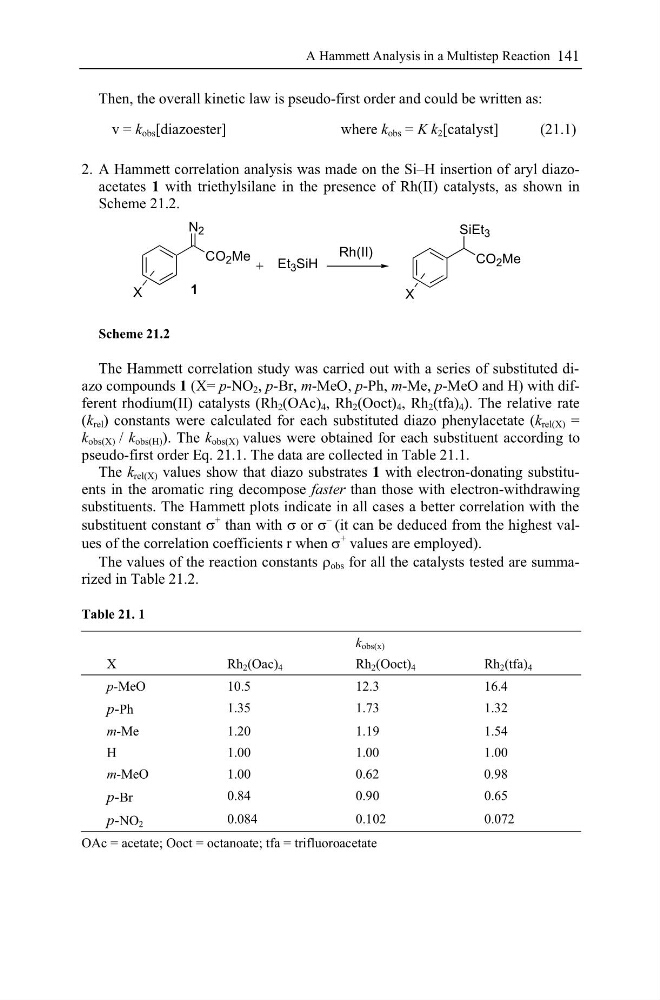
2. A Hammett correlation analysis was made on the Si–H insertion of aryl diazoacetates 1 with triethylsilane in the presence of Rh(II) catalysts, as shown in
Scheme 21.2.
CO 2 Me
N 2
X
1
Rh(II)
Et 3 SiH
CO 2 Me
SiEt 3
X
Scheme 21.2
The Hammett correlation study was carried out with a series of substituted diazo compounds 1 (X= p-NO 2 , p-Br, m-MeO, p-Ph, m-Me, p-MeO and H) with different rhodium(II) catalysts (Rh 2 (OAc) 4 , Rh 2 (Ooct) 4 , Rh 2 (tfa) 4 ). The relative rate
(k rel
k k ) constants were calculated for each substituted diazo phenylacetate (k rel(X)
k k
=
k obs(X)
k k
/ k obs(H)
k k
). The k obs(X)
k k
values were obtained for each substituent according to
pseudo-first order Eq. 21.1. The data are collected in Table 21.1.
The k rel(X)
k k
values show that diazo substrates 1 with electron-donating substituents in the aromatic ring decompose faster than those with electron-withdrawing
r
substituents. The Hammett plots indicate in all cases a better correlation with the
substituent constant V
+ than with V or V
– (it can be deduced from the highest values of the correlation coefficients r when V
+ values are employed).
The values of the reaction constants U obs for all the catalysts tested are summarized in Table 21.2.
Table 21. 1
k obs(x)
k k
X
R h 2 (Oac) 4
Rh 2 (Ooct) 4
Rh 2 (tfa) 4
p-MeO
10.5
12.3
16.4
p-Ph
1.35
1.73
1.32
m-Me
1.20
1.19
1.54
H
1 .00
1.00
1.00
m-MeO
1.00
0.62
0.98
p-Br
0.84
0.90
0.65
p-NO 2
0.084
0.102
0.072
OAc = acetate; Ooct = octanoate; tfa = trifluoroacetate
Then, the overall kinetic law is pseudo-first order and could be written as:
v = k obs
k k [diazoester]
where k obs
k k = K k 2
k k [catalyst]
(21.1)
2. A Hammett correlation analysis was made on the Si–H insertion of aryl diazoacetates 1 with triethylsilane in the presence of Rh(II) catalysts, as shown in
Scheme 21.2.
CO 2 Me
N 2
X
1
Rh(II)
Et 3 SiH
CO 2 Me
SiEt 3
X
Scheme 21.2
The Hammett correlation study was carried out with a series of substituted diazo compounds 1 (X= p-NO 2 , p-Br, m-MeO, p-Ph, m-Me, p-MeO and H) with different rhodium(II) catalysts (Rh 2 (OAc) 4 , Rh 2 (Ooct) 4 , Rh 2 (tfa) 4 ). The relative rate
(k rel
k k ) constants were calculated for each substituted diazo phenylacetate (k rel(X)
k k
=
k obs(X)
k k
/ k obs(H)
k k
). The k obs(X)
k k
values were obtained for each substituent according to
pseudo-first order Eq. 21.1. The data are collected in Table 21.1.
The k rel(X)
k k
values show that diazo substrates 1 with electron-donating substituents in the aromatic ring decompose faster than those with electron-withdrawing
r
substituents. The Hammett plots indicate in all cases a better correlation with the
substituent constant V
+ than with V or V
– (it can be deduced from the highest values of the correlation coefficients r when V
+ values are employed).
The values of the reaction constants U obs for all the catalysts tested are summarized in Table 21.2.
Table 21. 1
k obs(x)
k k
X
R h 2 (Oac) 4
Rh 2 (Ooct) 4
Rh 2 (tfa) 4
p-MeO
10.5
12.3
16.4
p-Ph
1.35
1.73
1.32
m-Me
1.20
1.19
1.54
H
1 .00
1.00
1.00
m-MeO
1.00
0.62
0.98
p-Br
0.84
0.90
0.65
p-NO 2
0.084
0.102
0.072
OAc = acetate; Ooct = octanoate; tfa = trifluoroacetate