

L Le ev ve el l 2 2 C Ca as se e 2 21 1
A A H Ha am mm me et tt t A An na al ly ys si is s i in n a a M Mu ul lt ti is st te ep p R Re ea ac ct ti io on n: :
R Rh ho od di iu um m( (I II I) )- -C Ca at ta al ly yz ze ed d D De ec co om mp po os si it ti io on n o of f
D D- -D Di ia az zo o E Es st te er rs s
K Ke ey y p po oi in nt t: : H Ha Ha H Ha H Ha Ha H Ham mm me et tt t t
tt c co on ns st ta ta t ta ta ta ta t tan nt ts ts t ts ts ts ts t t
A Ar
CO 2 Me
N 2
Rh Rh
CO 2 Me
N 2
Ar
Rh Rh
CO 2 Me
Ar
k 1
k -
k k 1
k 2
k k
products
A A H Ha am mm me et tt t A An na al ly ys si is s i in n a a M Mu ul lt ti is st te ep p R Re ea ac ct ti io on n: :
R
Rh ho od di iu um m( (I II I) )- -C Ca at ta al ly yz ze ed d D De ec co om mp po os si it ti io on n o of f D D- -D Di ia az zo o E Es st te er rs s
Hammett analysis in multistep reactions is not always a simple task. The ratedetermining step is not necessarily the first step of the reaction and in a reaction
sequence, substituents that favor a step could favor or disfavor the next one. This
situation sometimes complicates evaluation of the influence of electron-withdrawing or electron-donating groups on the overall reaction mechanism.
One of the parameters used to determine the influence of electronic effects in a
reaction is the Hammett reaction constant U. However, the experimentally observed Uvalues (U obs ) are the average of the contributions of the electronic effects
on the rate-determining step and all the steps preceeding, which generally means
that the magnitude of U obs is not as large as expected. This fact adds an extra difficulty to the analysis of the influence of the electronic effects in the elucidation of
multistep mechanisms, particularly when intermediates bearing charges of opposite signs are involved.
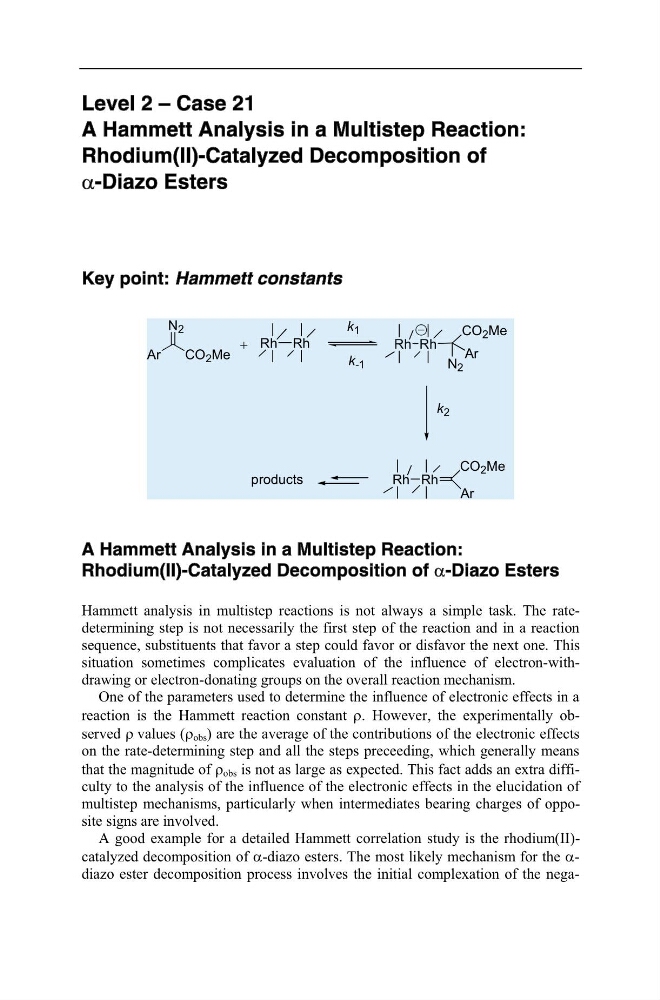
A good example for a detailed Hammett correlation study is the rhodium(II)catalyzed decomposition of D-diazo esters. The most likely mechanism for the Ddiazo ester decomposition process involves the initial complexation of the nega-
A A H Ha am mm me et tt t A An na al ly ys si is s i in n a a M Mu ul lt ti is st te ep p R Re ea ac ct ti io on n: :
R Rh ho od di iu um m( (I II I) )- -C Ca at ta al ly yz ze ed d D De ec co om mp po os si it ti io on n o of f
D D- -D Di ia az zo o E Es st te er rs s
K Ke ey y p po oi in nt t: : H Ha Ha H Ha H Ha Ha H Ham mm me et tt t t
tt c co on ns st ta ta t ta ta ta ta t tan nt ts ts t ts ts ts ts t t
A Ar
CO 2 Me
N 2
Rh Rh
CO 2 Me
N 2
Ar
Rh Rh
CO 2 Me
Ar
k 1
k -
k k 1
k 2
k k
products
A A H Ha am mm me et tt t A An na al ly ys si is s i in n a a M Mu ul lt ti is st te ep p R Re ea ac ct ti io on n: :
R
Rh ho od di iu um m( (I II I) )- -C Ca at ta al ly yz ze ed d D De ec co om mp po os si it ti io on n o of f D D- -D Di ia az zo o E Es st te er rs s
Hammett analysis in multistep reactions is not always a simple task. The ratedetermining step is not necessarily the first step of the reaction and in a reaction
sequence, substituents that favor a step could favor or disfavor the next one. This
situation sometimes complicates evaluation of the influence of electron-withdrawing or electron-donating groups on the overall reaction mechanism.
One of the parameters used to determine the influence of electronic effects in a
reaction is the Hammett reaction constant U. However, the experimentally observed Uvalues (U obs ) are the average of the contributions of the electronic effects
on the rate-determining step and all the steps preceeding, which generally means
that the magnitude of U obs is not as large as expected. This fact adds an extra difficulty to the analysis of the influence of the electronic effects in the elucidation of
multistep mechanisms, particularly when intermediates bearing charges of opposite signs are involved.
A good example for a detailed Hammett correlation study is the rhodium(II)catalyzed decomposition of D-diazo esters. The most likely mechanism for the Ddiazo ester decomposition process involves the initial complexation of the nega-