

Esterification of Carboxylic Acids with Dimethyl Carbonate and DBU 135
Scheme 20.11
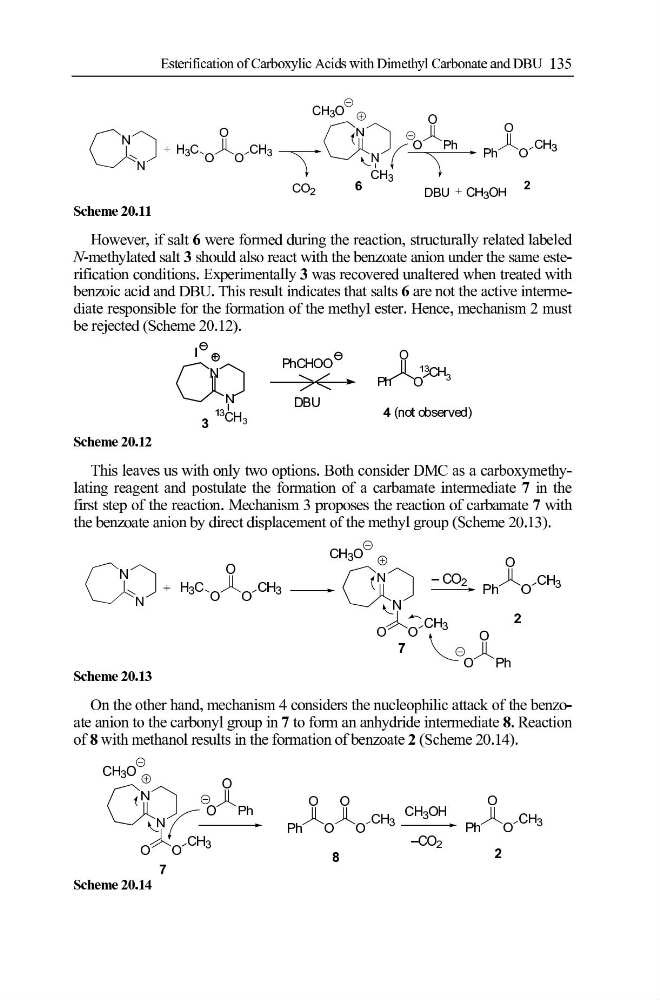
However, if salt 6 were formed during the reaction, structurally related labeled
N-methylated salt 3 should also react with the benzoate anion under the same esterification conditions. Experimentally 3 was recovered unaltered when treated with
benzoic acid and DBU. This result indicates that salts 6 are not the active intermedia te responsible for the formation of the methyl ester. Hence, mechanism 2 must
be rejected (Scheme 20.12).
le
d)
13CH
3
3
PhCH00
6
><.
~ ')GH
p~
3
DBU
4 (not observed)
Scheme 20.12
This leaves us with only two options. Both consider DMC as a carboxymethylating reagent and postulate the formation of a carbamate intermediate 7 in the
first step of the reaction. Mechanism 3 proposes the reaction of carbamate 7 with
the benzoate anion by direct displacement of the methyl group (Scheme 20.13).
e
CH30 C±l
O
O
~
~
0N~ -C02 )l_ ,CH3
~N) + H3C .... 0
,...;o..... 0 , C H 3 -
\ , .. )
-
Ph
O
~N
oAifcH3
o 2
7
\...._eO)l_Ph
Scheme 20.13
On the other hand, mechanism 4 considers the nucleophilic attack of the benzoate anion to the carbonyl group in 7 to form an anhydride intermediate 8. Reaction
of 8 with methanol results in the formation ofbenzoate 2 (Scheme 20.14).
e
CH30,....
'~;;
o
0
~ e)l
'·)/O Ph
'-._N { ~":
0
.;lt 0
,cH3
8
2
7
Scheme 20.14
Scheme 20.11
However, if salt 6 were formed during the reaction, structurally related labeled
N-methylated salt 3 should also react with the benzoate anion under the same esterification conditions. Experimentally 3 was recovered unaltered when treated with
benzoic acid and DBU. This result indicates that salts 6 are not the active intermedia te responsible for the formation of the methyl ester. Hence, mechanism 2 must
be rejected (Scheme 20.12).
le
d)
13CH
3
3
PhCH00
6
><.
~ ')GH
p~
3
DBU
4 (not observed)
Scheme 20.12
This leaves us with only two options. Both consider DMC as a carboxymethylating reagent and postulate the formation of a carbamate intermediate 7 in the
first step of the reaction. Mechanism 3 proposes the reaction of carbamate 7 with
the benzoate anion by direct displacement of the methyl group (Scheme 20.13).
e
CH30 C±l
O
O
~
~
0N~ -C02 )l_ ,CH3
~N) + H3C .... 0
,...;o..... 0 , C H 3 -
\ , .. )
-
Ph
O
~N
oAifcH3
o 2
7
\...._eO)l_Ph
Scheme 20.13
On the other hand, mechanism 4 considers the nucleophilic attack of the benzoate anion to the carbonyl group in 7 to form an anhydride intermediate 8. Reaction
of 8 with methanol results in the formation ofbenzoate 2 (Scheme 20.14).
e
CH30,....
'~;;
o
0
~ e)l
'·)/O Ph
'-._N { ~":
0
.;lt 0
,cH3
8
2
7
Scheme 20.14