

134 Level 2 - Case 20
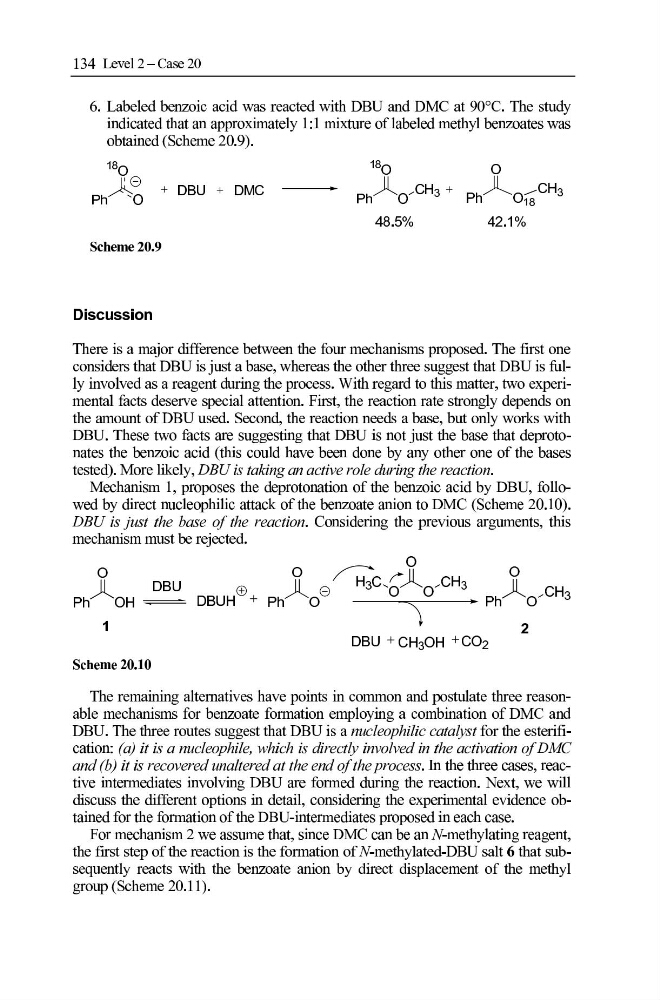
6. Labeled benzoic acid was reacted with DBU and DMC at 90°C. The study
indicated that an approximately 1: 1 mixture of labe led methyl benzoates was
obtained (Scheme 20.9).
180
i~G + DBU + DMC
Ph~O
Scheme20.9
Discussion
48.5%
42.1%
There is a major difference between the four mechanisms proposed. The first one
considers that DBU is just a base, whereas the other three suggest that DBU is fully involved as a reagent during the process. With regard to this matter, two experimental facts deserve special attention. First, the reaction rate strongly depends on
the amount of DBU used. Second, the reaction needs a base, but only works with
DBU. These two facts are suggesting that DBU is not just the base that deprotonates the benzoic acid (this could have been done by any other one of the bases
tested). More likely, DBU is taking an active role during the reaction.
Mechanism 1, proposes the deprotonation of the benzoic acid by DBU, followed by direct nucleophilic attack ofthe benzoate anion to DMC (Scheme 20.10).
DBU is just the base (l the reaction. Considering the previous argtm1ents, this
mechanism must be rejected.
DBU
2
Scheme 20.10
The remaining alternatives have points in common and postulate three reasonable mechanisms for benzoate formation employing a combination of DMC and
DBU. The three routes suggest that DBU is a nucleophilic catafyst for the esterification: (a) it is a nucleophile, which is directly involved in the activation of DMC
and (b) it is recovered unaltered at the end of the process. In the three cases, reactive intermediates involving DBU are fonned during the reaction. Next, we will
discuss the different options in detail, considering the experimental evidence obtained for the formation ofthe DBU-intermediates proposed in each case.
For mechanism 2 we assume that, since DMC can be an N-methylating reagent,
the first step of the reaction is the formation of N-methylated-DBU salt 6 that subsequently reacts with the benzoate anion by direct displacement of the methyl
group (Scheme 20.11).
6. Labeled benzoic acid was reacted with DBU and DMC at 90°C. The study
indicated that an approximately 1: 1 mixture of labe led methyl benzoates was
obtained (Scheme 20.9).
180
i~G + DBU + DMC
Ph~O
Scheme20.9
Discussion
48.5%
42.1%
There is a major difference between the four mechanisms proposed. The first one
considers that DBU is just a base, whereas the other three suggest that DBU is fully involved as a reagent during the process. With regard to this matter, two experimental facts deserve special attention. First, the reaction rate strongly depends on
the amount of DBU used. Second, the reaction needs a base, but only works with
DBU. These two facts are suggesting that DBU is not just the base that deprotonates the benzoic acid (this could have been done by any other one of the bases
tested). More likely, DBU is taking an active role during the reaction.
Mechanism 1, proposes the deprotonation of the benzoic acid by DBU, followed by direct nucleophilic attack ofthe benzoate anion to DMC (Scheme 20.10).
DBU is just the base (l the reaction. Considering the previous argtm1ents, this
mechanism must be rejected.
DBU
2
Scheme 20.10
The remaining alternatives have points in common and postulate three reasonable mechanisms for benzoate formation employing a combination of DMC and
DBU. The three routes suggest that DBU is a nucleophilic catafyst for the esterification: (a) it is a nucleophile, which is directly involved in the activation of DMC
and (b) it is recovered unaltered at the end of the process. In the three cases, reactive intermediates involving DBU are fonned during the reaction. Next, we will
discuss the different options in detail, considering the experimental evidence obtained for the formation ofthe DBU-intermediates proposed in each case.
For mechanism 2 we assume that, since DMC can be an N-methylating reagent,
the first step of the reaction is the formation of N-methylated-DBU salt 6 that subsequently reacts with the benzoate anion by direct displacement of the methyl
group (Scheme 20.11).