

136 Level 2 - Case 20
The formation of a carbamate like 7 as the active intermedia te of the reaction is
supported by the experimental data. In fact, when carbamate 5 (synthesized from
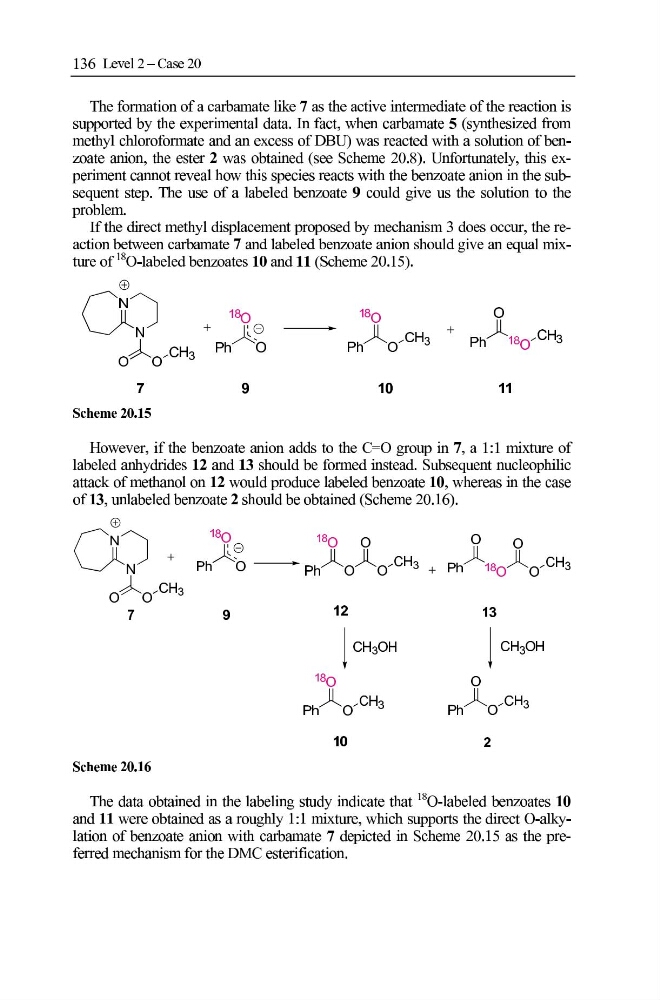
methyl chloroformate and an excess of DBU) was reacted with a solution of benzoate anion, the ester 2 was obtained (see Scheme 20.8). Unforttmately, this experiment cannot reveal how this species reacts with the benzoate anion in the subsequent step. The use of a labeled benzoate 9 could give us the solution to the
problem.
lf the direct methyl displacement proposed by mechanism 3 does occur, the reaction between carbamate 7 and labeled benzoate anion should give an equal mixture of
18 0-labeled benzoates 10 and 11 (Scheme 20.15).
+
7
9
10
11
Scheme 20.15
However, if the benzoate an ion adds to the C=O group in 7, a 1 : 1 mixture of
labeled anhydrides 12 and 13 should be fonned instead. Subsequent nucleophilic
attack of methanol on 12 would produce labeled benzoate 10, whereas in the case
of 13, unlabeled benzoate 2 should be obtained (Scheme 20.16).
ci)
1s 0
1s 0
o
o
o
+
..A.~
Ph)l.O)l_O_..CH3
Ph)l18o)l_O_..CH3
Ph
O
+
0
A 0
... cH3
7
9
12
13
! CH30H
l CH30H
1s 0
o
Ph)l.O_..CH3
Ph)l.O_..CH3
10
2
Scheme 20.16
The data obtained in the labeling study indicate that
18 0-labeled benzoates 10
and 11 were obtained as a roughly 1:1 rnixture, which supports the direct 0-alkylation of benzoate anion with carbamate 7 depicted in Scheme 20.15 as the preferred mechanism for the DMC esterification.
The formation of a carbamate like 7 as the active intermedia te of the reaction is
supported by the experimental data. In fact, when carbamate 5 (synthesized from
methyl chloroformate and an excess of DBU) was reacted with a solution of benzoate anion, the ester 2 was obtained (see Scheme 20.8). Unforttmately, this experiment cannot reveal how this species reacts with the benzoate anion in the subsequent step. The use of a labeled benzoate 9 could give us the solution to the
problem.
lf the direct methyl displacement proposed by mechanism 3 does occur, the reaction between carbamate 7 and labeled benzoate anion should give an equal mixture of
18 0-labeled benzoates 10 and 11 (Scheme 20.15).
+
7
9
10
11
Scheme 20.15
However, if the benzoate an ion adds to the C=O group in 7, a 1 : 1 mixture of
labeled anhydrides 12 and 13 should be fonned instead. Subsequent nucleophilic
attack of methanol on 12 would produce labeled benzoate 10, whereas in the case
of 13, unlabeled benzoate 2 should be obtained (Scheme 20.16).
ci)
1s 0
1s 0
o
o
o
+
..A.~
Ph)l.O)l_O_..CH3
Ph)l18o)l_O_..CH3
Ph
O
+
0
A 0
... cH3
7
9
12
13
! CH30H
l CH30H
1s 0
o
Ph)l.O_..CH3
Ph)l.O_..CH3
10
2
Scheme 20.16
The data obtained in the labeling study indicate that
18 0-labeled benzoates 10
and 11 were obtained as a roughly 1:1 rnixture, which supports the direct 0-alkylation of benzoate anion with carbamate 7 depicted in Scheme 20.15 as the preferred mechanism for the DMC esterification.