

Level 2 – Case 19
128
in Fig. 19.2, as only the Lewis acid has changed. Therefore, the Felkin product 3
should have been obtained as the major reaction product, which is not the case.
Furthermore, the configuration on the newly formed stereocenter in the sole reaction product 4 is exactly the opposite of that predicted by the Felkin-Anh’s model.
Compounds 4 are named anti-Felkin products. The conclusion is that, either the
Felkin-Anh’s model is not appropriate to predict the stereochemistry in this case
or the reaction follows a completely different pathway.
Although hard to believe, it can be thought that the anti-Felkin selectivity is not
due to the presence of an D-stereocenter (the one we have considered when discussing the Felkin-Anh’s model) but to the E-stereocenter present in 2. This possibility is easily discarded, simply by carrying out the analogous analysis in a substrate lacking the E-stereocenter as aldehyde 6. This compound reacts with pinacolone enolsilane 1 in the presence of Me 2 AlCl to yield the corresponding aldols 7
and 8 with stereoselectivities in the range of those obtained with aldehyde 2 under
the same conditions. Therefore some kind of “dominant effect emanating from the
E-stereocenter” should be ruled out (see Scheme 19.2).
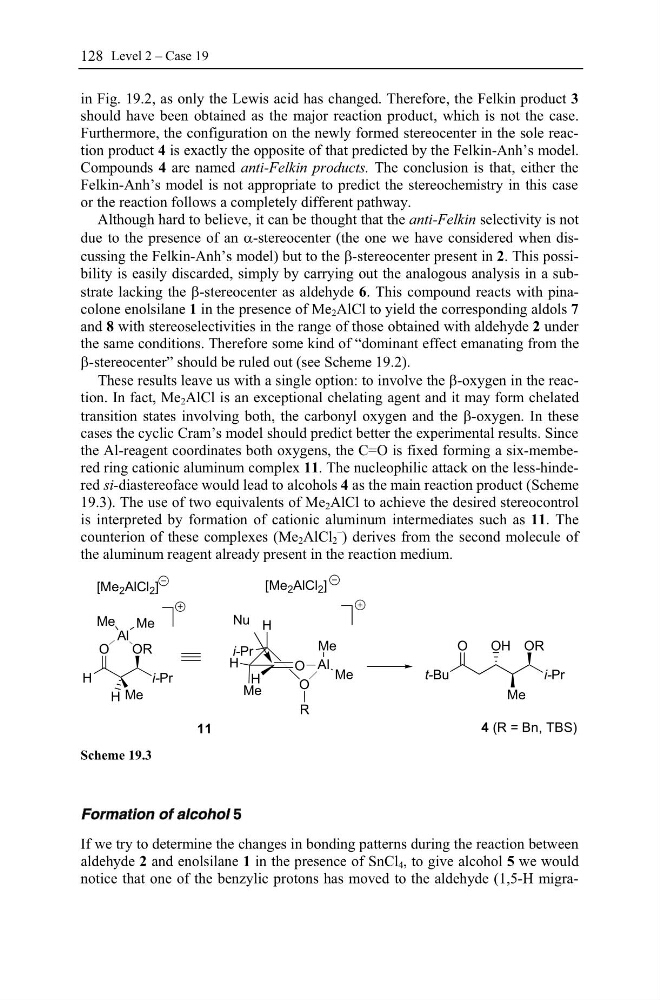
These results leave us with a single option: to involve the E-oxygen in the reaction. In fact, Me 2 AlCl is an exceptional chelating agent and it may form chelated
transition states involving both, the carbonyl oxygen and the E-oxygen. In these
cases the cyclic Cram’s model should predict better the experimental results. Since
the Al-reagent coordinates both oxygens, the C=O is fixed forming a six-membered ring cationic aluminum complex 11. The nucleophilic attack on the less-hindered si-diastereoface would lead to alcohols 4 as the main reaction product (Scheme
19.3). The use of two equivalents of Me 2 AlCl to achieve the desired stereocontrol
is interpreted by formation of cationic aluminum intermediates such as 11. The
counterion of these complexes (Me 2 AlCl 2
–
) derives from the second molecule of
the aluminum reagent already present in the reaction medium.
i-Pr
Me
OR
O
H
Al
Me
Me
H
[Me 2 AlCl 2 ]
H
Me
H
Al
O
R
Me
O
H
i-Pr
Me
[Me 2 AlCl 2 ]
i-Pr
OR
Me
OH
O
t-Bu
4 (R = Bn, TBS)
11
Nu
Scheme 19.3
F Fo Fo F Fo Fo Fo F For rm r rm rm rm rm r r a at ti ti ti t ti ti t tio io io io i ion n o of f a al lc lc lc lc l l o oh ho ol l 5 5
If we try to determine the changes in bonding patterns during the reaction between
aldehyde 2 and enolsilane 1 in the presence of SnCl 4 , to give alcohol 5 we would
notice that one of the benzylic protons has moved to the aldehyde (1,5-H migra-
128
in Fig. 19.2, as only the Lewis acid has changed. Therefore, the Felkin product 3
should have been obtained as the major reaction product, which is not the case.
Furthermore, the configuration on the newly formed stereocenter in the sole reaction product 4 is exactly the opposite of that predicted by the Felkin-Anh’s model.
Compounds 4 are named anti-Felkin products. The conclusion is that, either the
Felkin-Anh’s model is not appropriate to predict the stereochemistry in this case
or the reaction follows a completely different pathway.
Although hard to believe, it can be thought that the anti-Felkin selectivity is not
due to the presence of an D-stereocenter (the one we have considered when discussing the Felkin-Anh’s model) but to the E-stereocenter present in 2. This possibility is easily discarded, simply by carrying out the analogous analysis in a substrate lacking the E-stereocenter as aldehyde 6. This compound reacts with pinacolone enolsilane 1 in the presence of Me 2 AlCl to yield the corresponding aldols 7
and 8 with stereoselectivities in the range of those obtained with aldehyde 2 under
the same conditions. Therefore some kind of “dominant effect emanating from the
E-stereocenter” should be ruled out (see Scheme 19.2).
These results leave us with a single option: to involve the E-oxygen in the reaction. In fact, Me 2 AlCl is an exceptional chelating agent and it may form chelated
transition states involving both, the carbonyl oxygen and the E-oxygen. In these
cases the cyclic Cram’s model should predict better the experimental results. Since
the Al-reagent coordinates both oxygens, the C=O is fixed forming a six-membered ring cationic aluminum complex 11. The nucleophilic attack on the less-hindered si-diastereoface would lead to alcohols 4 as the main reaction product (Scheme
19.3). The use of two equivalents of Me 2 AlCl to achieve the desired stereocontrol
is interpreted by formation of cationic aluminum intermediates such as 11. The
counterion of these complexes (Me 2 AlCl 2
–
) derives from the second molecule of
the aluminum reagent already present in the reaction medium.
i-Pr
Me
OR
O
H
Al
Me
Me
H
[Me 2 AlCl 2 ]
H
Me
H
Al
O
R
Me
O
H
i-Pr
Me
[Me 2 AlCl 2 ]
i-Pr
OR
Me
OH
O
t-Bu
4 (R = Bn, TBS)
11
Nu
Scheme 19.3
F Fo Fo F Fo Fo Fo F For rm r rm rm rm rm r r a at ti ti ti t ti ti t tio io io io i ion n o of f a al lc lc lc lc l l o oh ho ol l 5 5
If we try to determine the changes in bonding patterns during the reaction between
aldehyde 2 and enolsilane 1 in the presence of SnCl 4 , to give alcohol 5 we would
notice that one of the benzylic protons has moved to the aldehyde (1,5-H migra-