

Chelate-Controlled Carbonyl Addition Reactions 127
dependence suggests that other factors different from the facial selectivity of the
aldehyde (the preferential attack of the nucleophile to one of the two faces of the
aldehyde) are involved in the stereodiscrimination of the reaction. If the facial selectivity were solely responsible for the stereochemistry of the process, changes in
the 3:4 diastereomeric ratio should be expected after changing the Lewis acid, but
not the complete inversion that is experimentally observed.
Aldehyde 2 has a nicely positioned E-oxygen that may be able to coordinate the
metal. Within this premise, the stereochemical outcome of the reaction would depend on the ability of the metal to coordinate both, the carbonyl oxygen and the Eoxygen, or just the carbonyl oxygen alone.
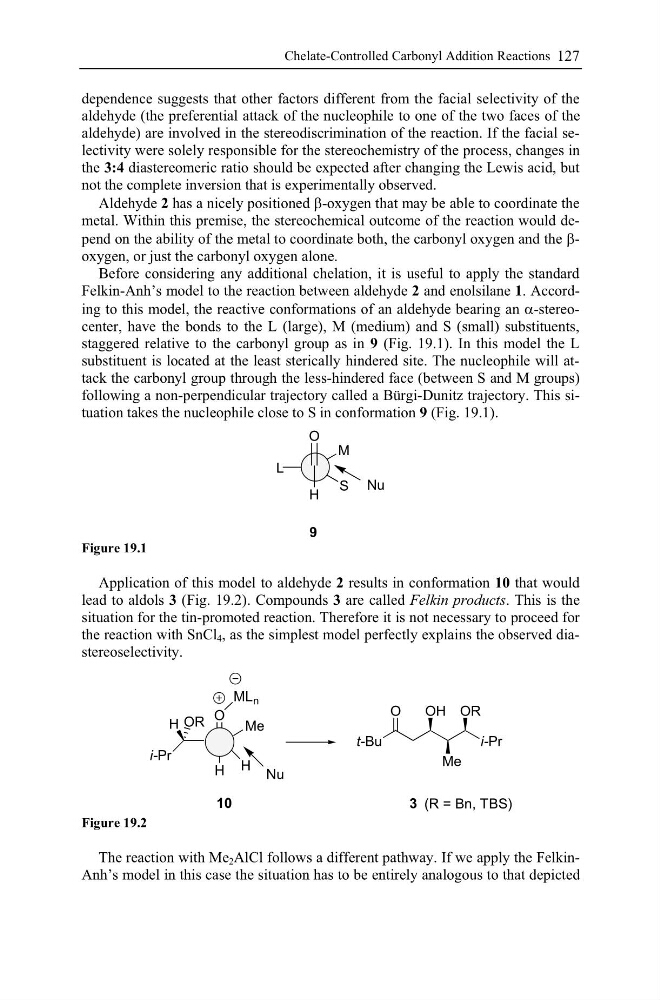
Before considering any additional chelation, it is useful to apply the standard
Felkin-Anh’s model to the reaction between aldehyde 2 and enolsilane 1. According to this model, the reactive conformations of an aldehyde bearing an D-stereocenter, have the bonds to the L (large), M (medium) and S (small) substituents,
staggered relative to the carbonyl group as in 9 (Fig. 19.1). In this model the L
substituent is located at the least sterically hindered site. The nucleophile will attack the carbonyl group through the less-hindered face (between S and M groups)
following a non-perpendicular trajectory called a Bürgi-Dunitz trajectory. This situation takes the nucleophile close to S in conformation 9 (Fig. 19.1).
S
M
L
Nu
9
O
H
Figure 19.1
Application of this model to aldehyde 2 results in conformation 10 that would
lead to aldols 3 (Fig. 19.2). Compounds 3 are called Felkin products. This is the
situation for the tin-promoted reaction. Therefore it is not necessary to proceed for
the reaction with SnCl 4 , as the simplest model perfectly explains the observed diastereoselectivity.
H OR
i-Pr
ML n
O
H
Me
H
O
t-Bu
OH OR
i-Pr
Me
10
3
Nu
(R = Bn, TBS)
Figure 19.2
The reaction with Me 2 AlCl follows a different pathway. If we apply the FelkinAnh’s model in this case the situation has to be entirely analogous to that depicted
dependence suggests that other factors different from the facial selectivity of the
aldehyde (the preferential attack of the nucleophile to one of the two faces of the
aldehyde) are involved in the stereodiscrimination of the reaction. If the facial selectivity were solely responsible for the stereochemistry of the process, changes in
the 3:4 diastereomeric ratio should be expected after changing the Lewis acid, but
not the complete inversion that is experimentally observed.
Aldehyde 2 has a nicely positioned E-oxygen that may be able to coordinate the
metal. Within this premise, the stereochemical outcome of the reaction would depend on the ability of the metal to coordinate both, the carbonyl oxygen and the Eoxygen, or just the carbonyl oxygen alone.
Before considering any additional chelation, it is useful to apply the standard
Felkin-Anh’s model to the reaction between aldehyde 2 and enolsilane 1. According to this model, the reactive conformations of an aldehyde bearing an D-stereocenter, have the bonds to the L (large), M (medium) and S (small) substituents,
staggered relative to the carbonyl group as in 9 (Fig. 19.1). In this model the L
substituent is located at the least sterically hindered site. The nucleophile will attack the carbonyl group through the less-hindered face (between S and M groups)
following a non-perpendicular trajectory called a Bürgi-Dunitz trajectory. This situation takes the nucleophile close to S in conformation 9 (Fig. 19.1).
S
M
L
Nu
9
O
H
Figure 19.1
Application of this model to aldehyde 2 results in conformation 10 that would
lead to aldols 3 (Fig. 19.2). Compounds 3 are called Felkin products. This is the
situation for the tin-promoted reaction. Therefore it is not necessary to proceed for
the reaction with SnCl 4 , as the simplest model perfectly explains the observed diastereoselectivity.
H OR
i-Pr
ML n
O
H
Me
H
O
t-Bu
OH OR
i-Pr
Me
10
3
Nu
(R = Bn, TBS)
Figure 19.2
The reaction with Me 2 AlCl follows a different pathway. If we apply the FelkinAnh’s model in this case the situation has to be entirely analogous to that depicted