

Chelate-Controlled Carbonyl Addition Reactions 129
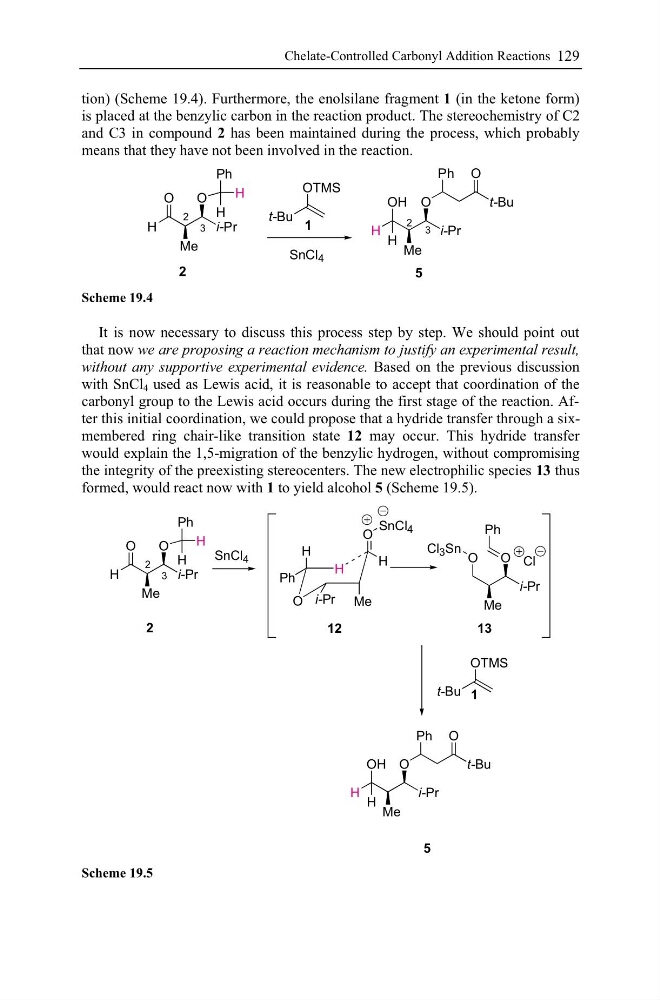
tion) (Scheme 19.4). Furthermore, the enolsilane fragment 1 (in the ketone form)
is placed at the benzylic carbon in the reaction product. The stereochemistry of C2
and C3 in compound 2 has been maintained during the process, which probably
means that they have not been involved in the reaction.
Ph
H
H
i-Pr
O
Me
O
H
OTMS
t-Bu
SnCl 4
OH
Me
O
i-Pr
Ph O
t-Bu
2
5
2
3
1
2 3
H
H
Scheme 19.4
It is now necessary to discuss this process step by step. We should point out
that now we are proposing a reaction mechanism to justify an experimental result,
without any supportive experimental evidence. Based on the previous discussion
with SnCl 4 used as Lewis acid, it is reasonable to accept that coordination of the
carbonyl group to the Lewis acid occurs during the first stage of the reaction. After this initial coordination, we could propose that a hydride transfer through a sixmembered ring chair-like transition state 12 may occur. This hydride transfer
would explain the 1,5-migration of the benzylic hydrogen, without compromising
the integrity of the preexisting stereocenters. The new electrophilic species 13 thus
formed, would react now with 1 to yield alcohol 5 (Scheme 19.5).
H
Ph
H
i-Pr
O
Me
O
H
SnCl 4
H
Me
H
Ph
i-Pr
O
O
H
SnCl 4
O
O
Ph
i-Pr
Cl 3 Sn
Me
t-Bu
OTMS
O
i-Pr
t-Bu
OH
Me
H
H
Ph O
5
12
13
1
2
3
2
Cl
Scheme 19.5
tion) (Scheme 19.4). Furthermore, the enolsilane fragment 1 (in the ketone form)
is placed at the benzylic carbon in the reaction product. The stereochemistry of C2
and C3 in compound 2 has been maintained during the process, which probably
means that they have not been involved in the reaction.
Ph
H
H
i-Pr
O
Me
O
H
OTMS
t-Bu
SnCl 4
OH
Me
O
i-Pr
Ph O
t-Bu
2
5
2
3
1
2 3
H
H
Scheme 19.4
It is now necessary to discuss this process step by step. We should point out
that now we are proposing a reaction mechanism to justify an experimental result,
without any supportive experimental evidence. Based on the previous discussion
with SnCl 4 used as Lewis acid, it is reasonable to accept that coordination of the
carbonyl group to the Lewis acid occurs during the first stage of the reaction. After this initial coordination, we could propose that a hydride transfer through a sixmembered ring chair-like transition state 12 may occur. This hydride transfer
would explain the 1,5-migration of the benzylic hydrogen, without compromising
the integrity of the preexisting stereocenters. The new electrophilic species 13 thus
formed, would react now with 1 to yield alcohol 5 (Scheme 19.5).
H
Ph
H
i-Pr
O
Me
O
H
SnCl 4
H
Me
H
Ph
i-Pr
O
O
H
SnCl 4
O
O
Ph
i-Pr
Cl 3 Sn
Me
t-Bu
OTMS
O
i-Pr
t-Bu
OH
Me
H
H
Ph O
5
12
13
1
2
3
2
Cl
Scheme 19.5