

Level 2 – Case 18
122
N
HOMO
N
CO 2 Me
Ph
0.46 eV
9.78 eV
0.27 eV
0.61 eV
9.44 eV
9.35 eV
LUMO
1
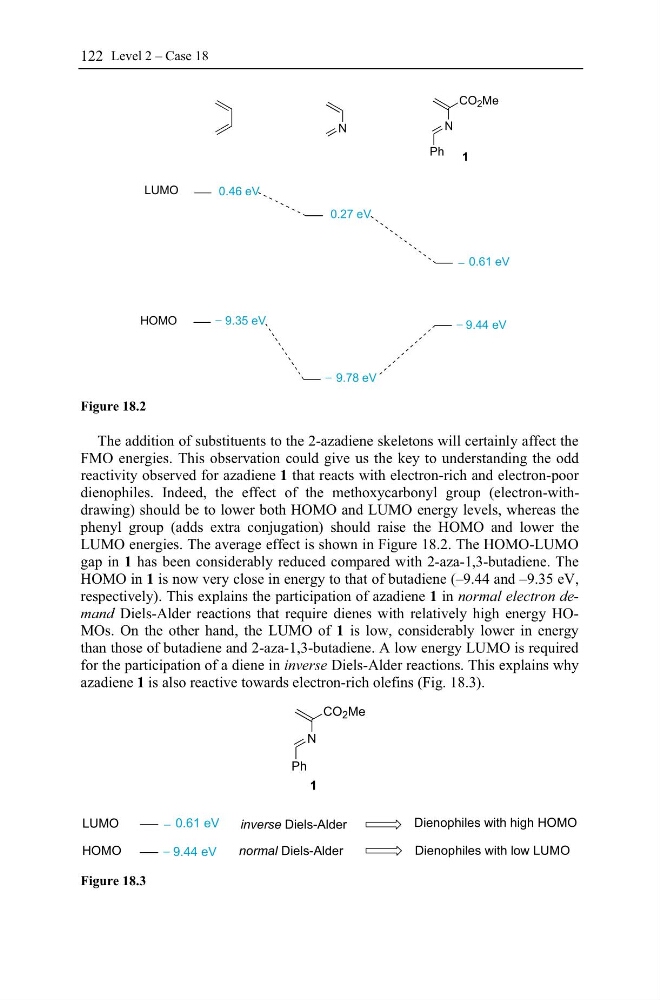
Figure 18.2
The addition of substituents to the 2-azadiene skeletons will certainly affect the
FMO energies. This observation could give us the key to understanding the odd
reactivity observed for azadiene 1 that reacts with electron-rich and electron-poor
dienophiles. Indeed, the effect of the methoxycarbonyl group (electron-withdrawing) should be to lower both HOMO and LUMO energy levels, whereas the
phenyl group (adds extra conjugation) should raise the HOMO and lower the
LUMO energies. The average effect is shown in Figure 18.2. The HOMO-LUMO
gap in 1 has been considerably reduced compared with 2-aza-1,3-butadiene. The
HOMO in 1 is now very close in energy to that of butadiene (–9.44 and –9.35 eV,
respectively). This explains the participation of azadiene 1 in normal electron demand Diels-Alder reactions that require di
d
enes with relatively high energy HOMOs. On the other hand, the LUMO of 1 is low, considerably lower in energy
than those of butadiene and 2-aza-1,3-butadiene. A low energy LUMO is required
for the participation of a diene in inverse Diels-Alder reactions. This explains why
azadiene 1 is also reactive towards electron-rich olefins (Fig. 18.3).
HOMO
N
CO 2 Me
Ph
normal Diels-Alder
l
inverse Diels-Alder
1
0.61 eV
9.44 eV
LUMO
Dienophiles with high HOMO
Dienophiles with low LUMO
Figure 18.3
122
N
HOMO
N
CO 2 Me
Ph
0.46 eV
9.78 eV
0.27 eV
0.61 eV
9.44 eV
9.35 eV
LUMO
1
Figure 18.2
The addition of substituents to the 2-azadiene skeletons will certainly affect the
FMO energies. This observation could give us the key to understanding the odd
reactivity observed for azadiene 1 that reacts with electron-rich and electron-poor
dienophiles. Indeed, the effect of the methoxycarbonyl group (electron-withdrawing) should be to lower both HOMO and LUMO energy levels, whereas the
phenyl group (adds extra conjugation) should raise the HOMO and lower the
LUMO energies. The average effect is shown in Figure 18.2. The HOMO-LUMO
gap in 1 has been considerably reduced compared with 2-aza-1,3-butadiene. The
HOMO in 1 is now very close in energy to that of butadiene (–9.44 and –9.35 eV,
respectively). This explains the participation of azadiene 1 in normal electron demand Diels-Alder reactions that require di
d
enes with relatively high energy HOMOs. On the other hand, the LUMO of 1 is low, considerably lower in energy
than those of butadiene and 2-aza-1,3-butadiene. A low energy LUMO is required
for the participation of a diene in inverse Diels-Alder reactions. This explains why
azadiene 1 is also reactive towards electron-rich olefins (Fig. 18.3).
HOMO
N
CO 2 Me
Ph
normal Diels-Alder
l
inverse Diels-Alder
1
0.61 eV
9.44 eV
LUMO
Dienophiles with high HOMO
Dienophiles with low LUMO
Figure 18.3