

Unusual Diels-Alder Reactivity of Acyclic 2-Azadienes 121
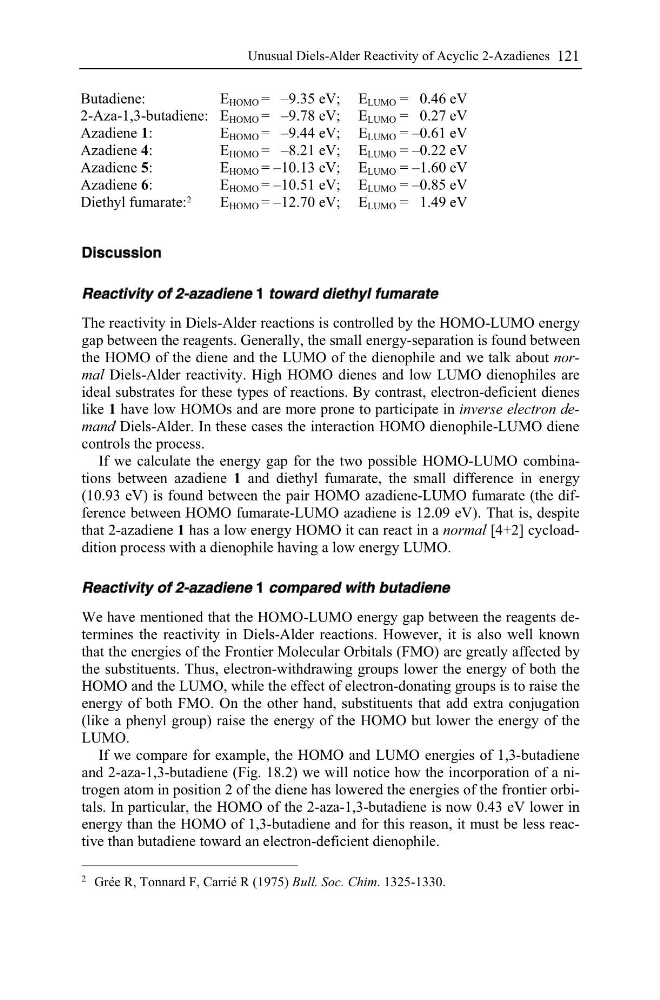
Butadiene:
E HOMO = –9.35 eV; E LUMO = 0.46 eV
2-Aza-1,3-butadiene: E HOMO = –9.78 eV; E LUMO = 0.27 eV
Azadiene 1:
E HOMO = –9.44 eV; E LUMO = –0.61 eV
Azadiene 4:
E HOMO = –8.21 eV; E LUMO = –0.22 eV
Azadiene 5:
E HOMO = –10.13 eV; E LUMO = –1.60 eV
Azadiene 6:
E HOMO = –10.51 eV; E LUMO = –0.85 eV
Diethyl fumarate:
2
E HOMO = –12.70 eV; E LUMO = 1.49 eV
D Di is sc cu us ss si io on n
R Re e e ea ac ct ti ti ti t ti ti t tiv vi vi vi v vi vi v vit ity ty ty y o of f 2 2- 2-a a a az az a az a a a
za z za za za za z zad di di di d di di d die ie i ie ie ie i ien ne e 1 1 t to to to to to t tow wa wa w wa wa wa wa w war rd rd r rd rd r rd r rd d di di di d di di d die ie i ie ie ie i iet th t th th th th t t y yl y yl yl y yl y y f fu fu f fu f f fu f f m ma ar ra ra r ra ra ra ra r rat te te t te te te te t te
The reactivity in Diels-Alder reactions is controlled by the HOMO-LUMO energy
gap between the reagents. Generally, the small energy-separation is found between
the HOMO of the diene and the LUMO of the dienophile and we talk about
f
normal Diels-Alder reactivity. High HOMO di
l
enes and low LUMO dienophiles are
ideal substrates for these types of reactions. By contrast, electron-deficient dienes
like 1 have low HOMOs and are more prone to participate in inverse electron demand Diels-Alder. In these cases the interaction HOMO dienophile-LUMO diene
d
controls the process.
If we calculate the energy gap for the two possible HOMO-LUMO combinations between azadiene 1 and diethyl fumarate, the small difference in energy
(10.93 eV) is found between the pair HOMO azadiene-LUMO fumarate (the difference between HOMO fumarate-LUMO azadiene is 12.09 eV). That is, despite
that 2-azadiene 1 has a low energy HOMO it can react in a normal [4+2] cycloadl
dition process with a dienophile having a low energy LUMO.
R Re e e
Rea ac ct ti ti ti t ti ti t tiv vi vi vi v vi vi v vit ty ty ty y o of f 2 2- 2-a a a az az a az a a a
za z za za za za z zad di di di d di di d die ie i ie ie ie i ien ne e 1 1 c co om mp mp mp pa ar re re r re re re re r red d w wi wi wi w wi wi w wit ith t th th th th t t b bu ut ta ta t ta ta ta ta t tad di di di d di di d die ie i ie ie ie i ien ne e
We have mentioned that the HOMO-LUMO energy gap between the reagents determines the reactivity in Diels-Alder reactions. However, it is also well known
that the energies of the Frontier Molecular Orbitals (FMO) are greatly affected by
the substituents. Thus, electron-withdrawing groups lower the energy of both the
HOMO and the LUMO, while the effect of electron-donating groups is to raise the
energy of both FMO. On the other hand, substituents that add extra conjugation
(like a phenyl group) raise the energy of the HOMO but lower the energy of the
LUMO.
If we compare for example, the HOMO and LUMO energies of 1,3-butadiene
and 2-aza-1,3-butadiene (Fig. 18.2) we will notice how the incorporation of a nitrogen atom in position 2 of the diene has lowered the energies of the frontier orbitals. In particular, the HOMO of the 2-aza-1,3-butadiene is now 0.43 eV lower in
energy than the HOMO of 1,3-butadiene and for this reason, it must be less reactive than butadiene toward an electron-deficient dienophile.
2 Grée R, Tonnard F, Carrié R (1975) Bull. Soc. Chim. 1325-1330.
Butadiene:
E HOMO = –9.35 eV; E LUMO = 0.46 eV
2-Aza-1,3-butadiene: E HOMO = –9.78 eV; E LUMO = 0.27 eV
Azadiene 1:
E HOMO = –9.44 eV; E LUMO = –0.61 eV
Azadiene 4:
E HOMO = –8.21 eV; E LUMO = –0.22 eV
Azadiene 5:
E HOMO = –10.13 eV; E LUMO = –1.60 eV
Azadiene 6:
E HOMO = –10.51 eV; E LUMO = –0.85 eV
Diethyl fumarate:
2
E HOMO = –12.70 eV; E LUMO = 1.49 eV
D Di is sc cu us ss si io on n
R Re e e ea ac ct ti ti ti t ti ti t tiv vi vi vi v vi vi v vit ity ty ty y o of f 2 2- 2-a a a az az a az a a a
za z za za za za z zad di di di d di di d die ie i ie ie ie i ien ne e 1 1 t to to to to to t tow wa wa w wa wa wa wa w war rd rd r rd rd r rd r rd d di di di d di di d die ie i ie ie ie i iet th t th th th th t t y yl y yl yl y yl y y f fu fu f fu f f fu f f m ma ar ra ra r ra ra ra ra r rat te te t te te te te t te
The reactivity in Diels-Alder reactions is controlled by the HOMO-LUMO energy
gap between the reagents. Generally, the small energy-separation is found between
the HOMO of the diene and the LUMO of the dienophile and we talk about
f
normal Diels-Alder reactivity. High HOMO di
l
enes and low LUMO dienophiles are
ideal substrates for these types of reactions. By contrast, electron-deficient dienes
like 1 have low HOMOs and are more prone to participate in inverse electron demand Diels-Alder. In these cases the interaction HOMO dienophile-LUMO diene
d
controls the process.
If we calculate the energy gap for the two possible HOMO-LUMO combinations between azadiene 1 and diethyl fumarate, the small difference in energy
(10.93 eV) is found between the pair HOMO azadiene-LUMO fumarate (the difference between HOMO fumarate-LUMO azadiene is 12.09 eV). That is, despite
that 2-azadiene 1 has a low energy HOMO it can react in a normal [4+2] cycloadl
dition process with a dienophile having a low energy LUMO.
R Re e e
Rea ac ct ti ti ti t ti ti t tiv vi vi vi v vi vi v vit ty ty ty y o of f 2 2- 2-a a a az az a az a a a
za z za za za za z zad di di di d di di d die ie i ie ie ie i ien ne e 1 1 c co om mp mp mp pa ar re re r re re re re r red d w wi wi wi w wi wi w wit ith t th th th th t t b bu ut ta ta t ta ta ta ta t tad di di di d di di d die ie i ie ie ie i ien ne e
We have mentioned that the HOMO-LUMO energy gap between the reagents determines the reactivity in Diels-Alder reactions. However, it is also well known
that the energies of the Frontier Molecular Orbitals (FMO) are greatly affected by
the substituents. Thus, electron-withdrawing groups lower the energy of both the
HOMO and the LUMO, while the effect of electron-donating groups is to raise the
energy of both FMO. On the other hand, substituents that add extra conjugation
(like a phenyl group) raise the energy of the HOMO but lower the energy of the
LUMO.
If we compare for example, the HOMO and LUMO energies of 1,3-butadiene
and 2-aza-1,3-butadiene (Fig. 18.2) we will notice how the incorporation of a nitrogen atom in position 2 of the diene has lowered the energies of the frontier orbitals. In particular, the HOMO of the 2-aza-1,3-butadiene is now 0.43 eV lower in
energy than the HOMO of 1,3-butadiene and for this reason, it must be less reactive than butadiene toward an electron-deficient dienophile.
2 Grée R, Tonnard F, Carrié R (1975) Bull. Soc. Chim. 1325-1330.