

Unusual Diels-Alder Reactivity of Acyclic 2-Azadienes 123
R Re ea ac ct ti ti ti t ti ti t tiv vi vi vi v vi vi v vit ty ty ty y o of f s su ub b b
ubs st ti ti ti t ti ti t tit tu u
tut te te t te te te te t ted d 2 2- 2-a a a az az a az a a a
za z za za za za z zad di di di d di di d die ie i ie ie ie i ien ne es s 1 1, , 4 4, , 5 5 a an nd d 6 6
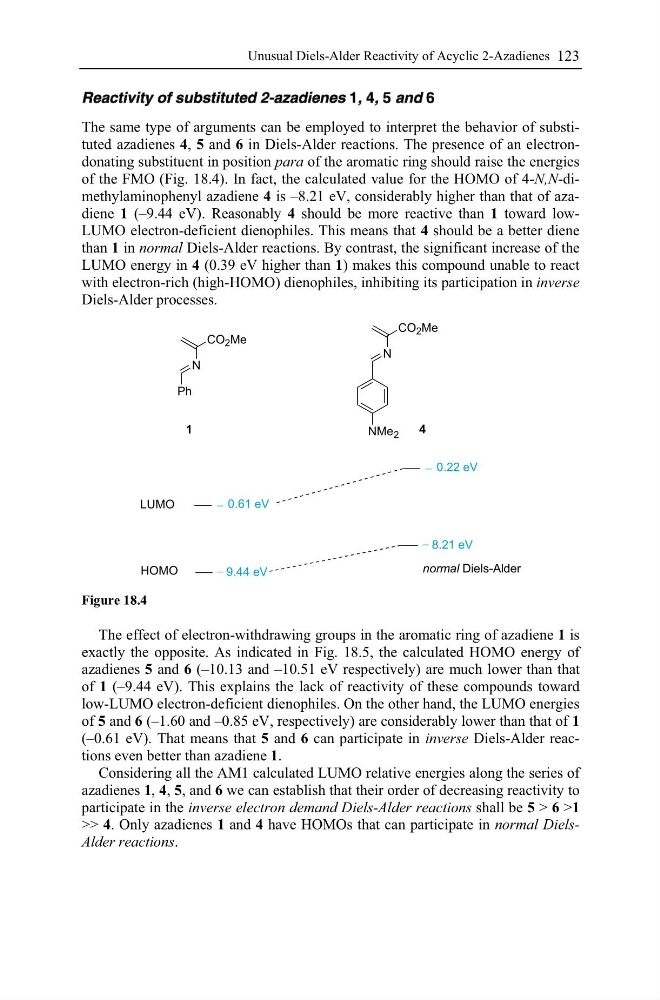
The same type of arguments can be employed to interpret the behavior of substituted azadienes 4, 5 and 6 in Diels-Alder reactions. The presence of an electrondonating substituent in position para of the aromatic ring should raise the energies
of the FMO (Fig. 18.4). In fact, the calculated value for the HOMO of 4-N,N -
-diN N
methylaminophenyl azadiene 4 is –8.21 eV, considerably higher than that of azadiene 1 (–9.44 eV). Reasonably 4 should be more reactive than 1 toward lowLUMO electron-deficient dienophiles. This means that 4 should be a better diene
than 1 in normal Diels-Alder reactions. By contrast
l
, the significant increase of the
LUMO energy in 4 (0.39 eV higher than 1) makes this compound unable to react
with electron-rich (high-HOMO) dienophiles, inhibiting its participation in inverse
Diels-Alder processes.
N
CO 2 Me
NMe 2
N
CO 2 Me
Ph
HOMO
4
1
0.61 eV
9.44 eV
LUMO
8.21 eV
0.22 eV
normal Diels-Alder
l
Figure 18.4
The effect of electron-withdrawing groups in the aromatic ring of azadiene 1 is
exactly the opposite. As indicated in Fig. 18.5, the calculated HOMO energy of
azadienes 5 and 6 (–10.13 and –10.51 eV respectively) are much lower than that
of 1 (–9.44 eV). This explains the lack of reactivity of these compounds toward
low-LUMO electron-deficient dienophiles. On the other hand, the LUMO energies
of 5 and 6 (–1.60 and –0.85 eV, respectively) are considerably lower than that of 1
(–0.61 eV). That means that 5 and 6 can participate in inverse Diels-Alder reactions even better than azadiene 1.
Considering all the AM1 calculated LUMO relative energies along the series of
azadienes 1, 4, 5, and 6 we can establish that their order of decreasing reactivity to
participate in the inverse electron demand Diels-Alder reactions shall be 5 > 6 >1
>> 4. Only azadienes 1 and 4 have HOMOs that can participate in normal DielsAlder reactions.
R Re ea ac ct ti ti ti t ti ti t tiv vi vi vi v vi vi v vit ty ty ty y o of f s su ub b b
ubs st ti ti ti t ti ti t tit tu u
tut te te t te te te te t ted d 2 2- 2-a a a az az a az a a a
za z za za za za z zad di di di d di di d die ie i ie ie ie i ien ne es s 1 1, , 4 4, , 5 5 a an nd d 6 6
The same type of arguments can be employed to interpret the behavior of substituted azadienes 4, 5 and 6 in Diels-Alder reactions. The presence of an electrondonating substituent in position para of the aromatic ring should raise the energies
of the FMO (Fig. 18.4). In fact, the calculated value for the HOMO of 4-N,N -
-diN N
methylaminophenyl azadiene 4 is –8.21 eV, considerably higher than that of azadiene 1 (–9.44 eV). Reasonably 4 should be more reactive than 1 toward lowLUMO electron-deficient dienophiles. This means that 4 should be a better diene
than 1 in normal Diels-Alder reactions. By contrast
l
, the significant increase of the
LUMO energy in 4 (0.39 eV higher than 1) makes this compound unable to react
with electron-rich (high-HOMO) dienophiles, inhibiting its participation in inverse
Diels-Alder processes.
N
CO 2 Me
NMe 2
N
CO 2 Me
Ph
HOMO
4
1
0.61 eV
9.44 eV
LUMO
8.21 eV
0.22 eV
normal Diels-Alder
l
Figure 18.4
The effect of electron-withdrawing groups in the aromatic ring of azadiene 1 is
exactly the opposite. As indicated in Fig. 18.5, the calculated HOMO energy of
azadienes 5 and 6 (–10.13 and –10.51 eV respectively) are much lower than that
of 1 (–9.44 eV). This explains the lack of reactivity of these compounds toward
low-LUMO electron-deficient dienophiles. On the other hand, the LUMO energies
of 5 and 6 (–1.60 and –0.85 eV, respectively) are considerably lower than that of 1
(–0.61 eV). That means that 5 and 6 can participate in inverse Diels-Alder reactions even better than azadiene 1.
Considering all the AM1 calculated LUMO relative energies along the series of
azadienes 1, 4, 5, and 6 we can establish that their order of decreasing reactivity to
participate in the inverse electron demand Diels-Alder reactions shall be 5 > 6 >1
>> 4. Only azadienes 1 and 4 have HOMOs that can participate in normal DielsAlder reactions.