

Level 2 – Case 17
Change in Rate-Determining Step in an E1cB
Mechanism: Aminolysis of Sulfamate Esters
Key point: Activation Parameters. Brønsted Plots
NR
1 R
2
SO 2
PhCH 2 NH
NO 2
O
O
SO 2
NO 2
PhCH 2 NH
R
1 R
2
NH
R
1
R
2
NH 2
Change in Rate-Determining Step in an E1cB Mechanism:
Aminolysis of Sulfamate Esters
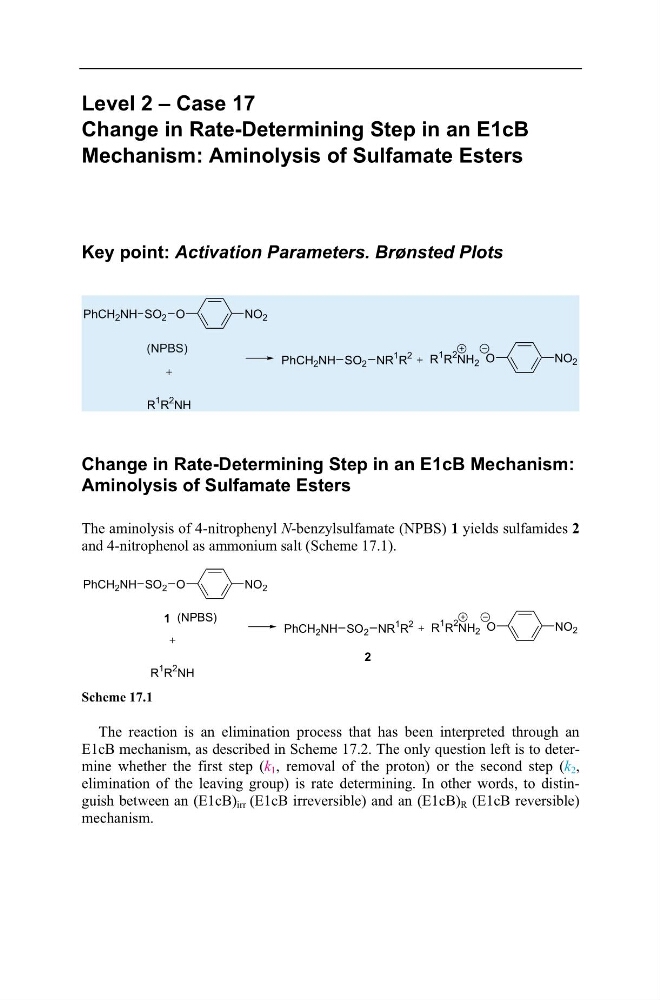
The aminolysis of 4-nitrophenyl N-benzylsulfamate (NPBS)
N N
1 yields sulfamides 2
and 4-nitrophenol as ammonium salt (Scheme 17.1).
NO 2
O
SO 2
PhCH 2 NH
(NPBS)
NR
1 R
2
SO 2
PhCH 2 NH
NO 2
O
2
1
R
1 R
2
NH
R
1 R
2
NH 2
Scheme 17.1
The reaction is an elimination process that has been interpreted through an
E1cB mechanism, as described in Scheme 17.2. The only question left is to determine whether the first step (k 1 , removal of the proton) or the second step (k 2 ,
elimination of the leaving group) is rate determining. In other words, to distinguish between an (E1cB) irr (E1cB irreversible) and an (E1cB) R (E1cB reversible)
R
mechanism.
Change in Rate-Determining Step in an E1cB
Mechanism: Aminolysis of Sulfamate Esters
Key point: Activation Parameters. Brønsted Plots
NR
1 R
2
SO 2
PhCH 2 NH
NO 2
O
O
SO 2
NO 2
PhCH 2 NH
R
1 R
2
NH
R
1
R
2
NH 2
Change in Rate-Determining Step in an E1cB Mechanism:
Aminolysis of Sulfamate Esters
The aminolysis of 4-nitrophenyl N-benzylsulfamate (NPBS)
N N
1 yields sulfamides 2
and 4-nitrophenol as ammonium salt (Scheme 17.1).
NO 2
O
SO 2
PhCH 2 NH
(NPBS)
NR
1 R
2
SO 2
PhCH 2 NH
NO 2
O
2
1
R
1 R
2
NH
R
1 R
2
NH 2
Scheme 17.1
The reaction is an elimination process that has been interpreted through an
E1cB mechanism, as described in Scheme 17.2. The only question left is to determine whether the first step (k 1 , removal of the proton) or the second step (k 2 ,
elimination of the leaving group) is rate determining. In other words, to distinguish between an (E1cB) irr (E1cB irreversible) and an (E1cB) R (E1cB reversible)
R
mechanism.