

Level 2 – Case 17
114
NO 2
O
2
PhCH 2 N
O
N O
SO 2
2
PhCH 2 N SO 2
1 (NPBS)
NR
1 R
2
SO 2
PhCH 2 NH
O
N O 2
SO 2
PhCH 2 NH
R
1 R
2
NH
k 1
k -1
k k
R
1 R
2
NH 2
k 2
R
1 R
2
NH
2
Scheme 17.2
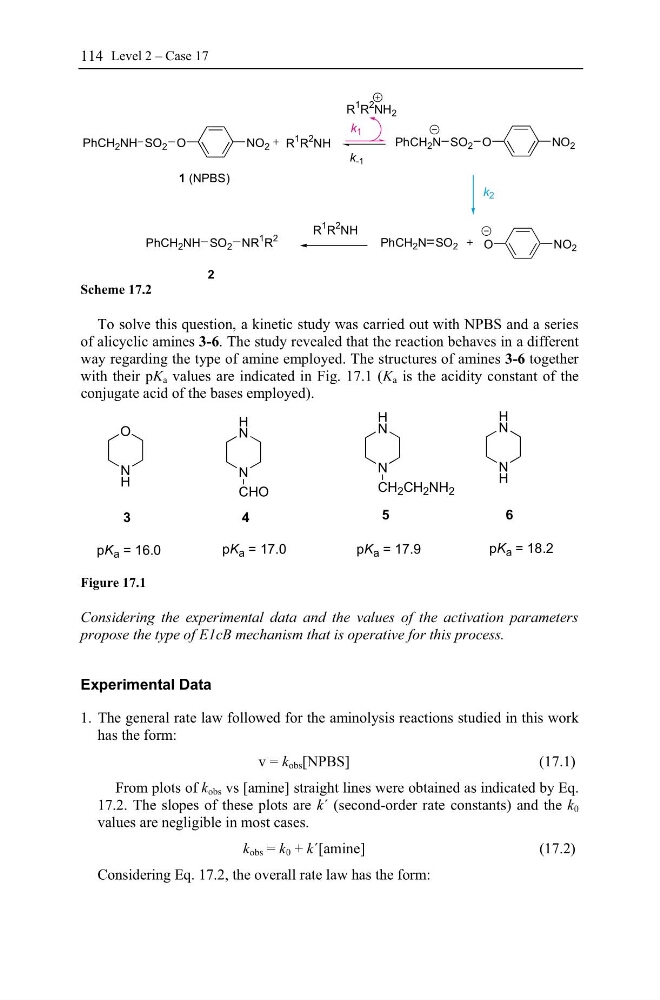
To solve this question, a kinetic study was carried out with NPBS and a series
of alicyclic amines 3-6. The study revealed that the reaction behaves in a different
way regarding the type of amine employed. The structures of amines
m
3-6 together
with their pK a
K K values are indicated in Fig. 17.1 (K ( ( a
K K is the acidity constant of the
conjugate acid of the bases employed).
N
H
O
N
H
N
CHO
N
H
N
CH 2 CH 2 NH 2
N
H
H
N
pK a
K K = 16.0
pK a
K K = 17.0
pK a
K K = 17.9
pK a
K K = 18.2
3
4
5
6
Figure 17.1
Considering the experimental data and the values of the activation parameters
propose the type of E1cB mechanism that is operative for this process.
([SHULPHQWDOO'DWD
1. The general rate law followed for the aminolysis reactions studied in this work
has the form:
v = k obs
k k [NPBS]
(17.1)
From plots of k obs
k k vs [amine] straight lines were obtained as indicated by Eq.
17.2. The slopes of these plots are k´ (second-order rate constants) and the k 0
k k
values are negligible in most cases.
k obs
k k = k 0
k k + k´[amine]
(17.2)
Considering Eq. 17.2, the overall rate law has the form:
114
NO 2
O
2
PhCH 2 N
O
N O
SO 2
2
PhCH 2 N SO 2
1 (NPBS)
NR
1 R
2
SO 2
PhCH 2 NH
O
N O 2
SO 2
PhCH 2 NH
R
1 R
2
NH
k 1
k -1
k k
R
1 R
2
NH 2
k 2
R
1 R
2
NH
2
Scheme 17.2
To solve this question, a kinetic study was carried out with NPBS and a series
of alicyclic amines 3-6. The study revealed that the reaction behaves in a different
way regarding the type of amine employed. The structures of amines
m
3-6 together
with their pK a
K K values are indicated in Fig. 17.1 (K ( ( a
K K is the acidity constant of the
conjugate acid of the bases employed).
N
H
O
N
H
N
CHO
N
H
N
CH 2 CH 2 NH 2
N
H
H
N
pK a
K K = 16.0
pK a
K K = 17.0
pK a
K K = 17.9
pK a
K K = 18.2
3
4
5
6
Figure 17.1
Considering the experimental data and the values of the activation parameters
propose the type of E1cB mechanism that is operative for this process.
([SHULPHQWDOO'DWD
1. The general rate law followed for the aminolysis reactions studied in this work
has the form:
v = k obs
k k [NPBS]
(17.1)
From plots of k obs
k k vs [amine] straight lines were obtained as indicated by Eq.
17.2. The slopes of these plots are k´ (second-order rate constants) and the k 0
k k
values are negligible in most cases.
k obs
k k = k 0
k k + k´[amine]
(17.2)
Considering Eq. 17.2, the overall rate law has the form: