

Light-Induced Cycloadditions of N-Phthaloyl N N
D-Amino Acids 111
Q Qu ue es st ti io on ns s
Irradiation of N-(trimethylsilyl)methylphthalimide N N
11 in MeCN with methyl acrylate produces benzopyrrolizidine 12 exclusively (Scheme 16.8). Explain this experimental result.
N CH 2 SiMe 3
O
O
CO 2 Me
N
Me 3 SiO
CO 2 Me
O
11
hQ MeCN
12
Scheme 16.8
A An ns sw we er r t to o t th he e Q Qu ue es st ti io on n
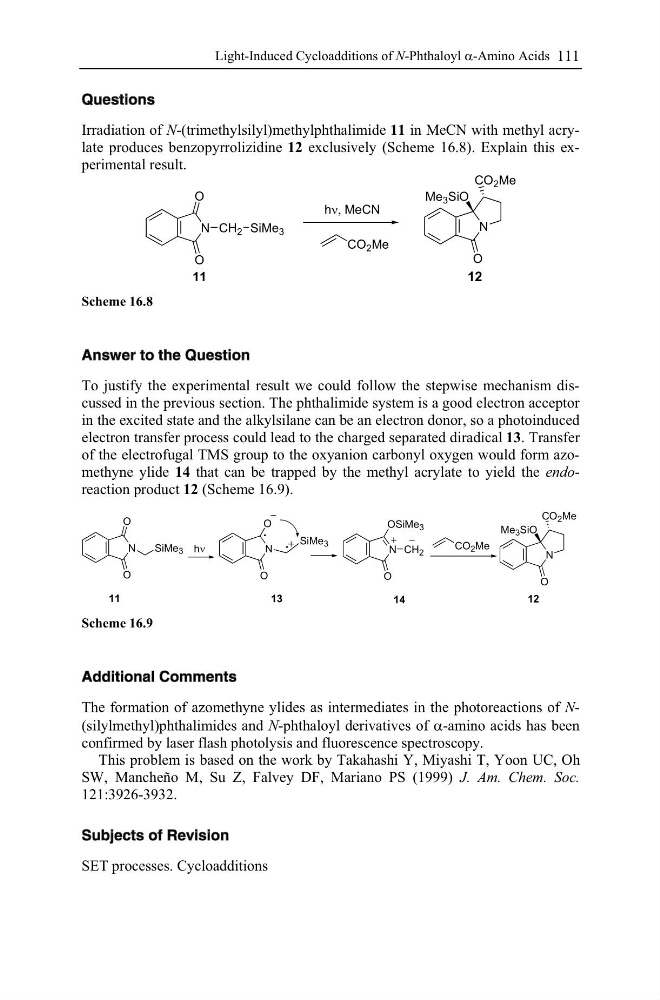
To justify the experimental result we could follow the stepwise mechanism discussed in the previous section. The phthalimide system is a good electron acceptor
in the excited state and the alkylsilane can be an electron donor, so a photoinduced
n
electron transfer process could lead to the charged separated diradical 13. Transfer
of the electrofugal TMS group to the oxyanion carbonyl oxygen would form azomethyne ylide 14 that can be trapped by the methyl acrylate to yield the endoreaction product 12 (Scheme 16.9).
N
SiMe 3
N
O
SiMe 3
N
OSiMe 3
CH 2
CO 2 Me
N
Me 3 SiO
CO 2 Me
11
hQ
13
14
12
O
O
O
O
O
Scheme 16.9
A Ad dd di it ti io on na al l C Co om mm me en nt ts s
The formation of azomethyne ylides as intermediates in the photoreactions of N- N N
(silylmethyl)phthalimides and N-phthaloyl derivatives of
N N
D-amino acids has been
confirmed by laser flash photolysis and fluorescence spectroscopy.
This problem is based on the work by Takahashi Y, Miyashi T, Yoon UC, Oh
SW, Mancheño M, Su Z, Falvey DF, Mariano PS (1999) J. Am. Chem. Soc.
121:3926-3932.
S Su ub bj je ec ct ts s o of f R Re ev vi is si io on n
SET processes. Cycloadditions
D-Amino Acids 111
Q Qu ue es st ti io on ns s
Irradiation of N-(trimethylsilyl)methylphthalimide N N
11 in MeCN with methyl acrylate produces benzopyrrolizidine 12 exclusively (Scheme 16.8). Explain this experimental result.
N CH 2 SiMe 3
O
O
CO 2 Me
N
Me 3 SiO
CO 2 Me
O
11
hQ MeCN
12
Scheme 16.8
A An ns sw we er r t to o t th he e Q Qu ue es st ti io on n
To justify the experimental result we could follow the stepwise mechanism discussed in the previous section. The phthalimide system is a good electron acceptor
in the excited state and the alkylsilane can be an electron donor, so a photoinduced
n
electron transfer process could lead to the charged separated diradical 13. Transfer
of the electrofugal TMS group to the oxyanion carbonyl oxygen would form azomethyne ylide 14 that can be trapped by the methyl acrylate to yield the endoreaction product 12 (Scheme 16.9).
N
SiMe 3
N
O
SiMe 3
N
OSiMe 3
CH 2
CO 2 Me
N
Me 3 SiO
CO 2 Me
11
hQ
13
14
12
O
O
O
O
O
Scheme 16.9
A Ad dd di it ti io on na al l C Co om mm me en nt ts s
The formation of azomethyne ylides as intermediates in the photoreactions of N- N N
(silylmethyl)phthalimides and N-phthaloyl derivatives of
N N
D-amino acids has been
confirmed by laser flash photolysis and fluorescence spectroscopy.
This problem is based on the work by Takahashi Y, Miyashi T, Yoon UC, Oh
SW, Mancheño M, Su Z, Falvey DF, Mariano PS (1999) J. Am. Chem. Soc.
121:3926-3932.
S Su ub bj je ec ct ts s o of f R Re ev vi is si io on n
SET processes. Cycloadditions