

Level 1 – Case 16
110
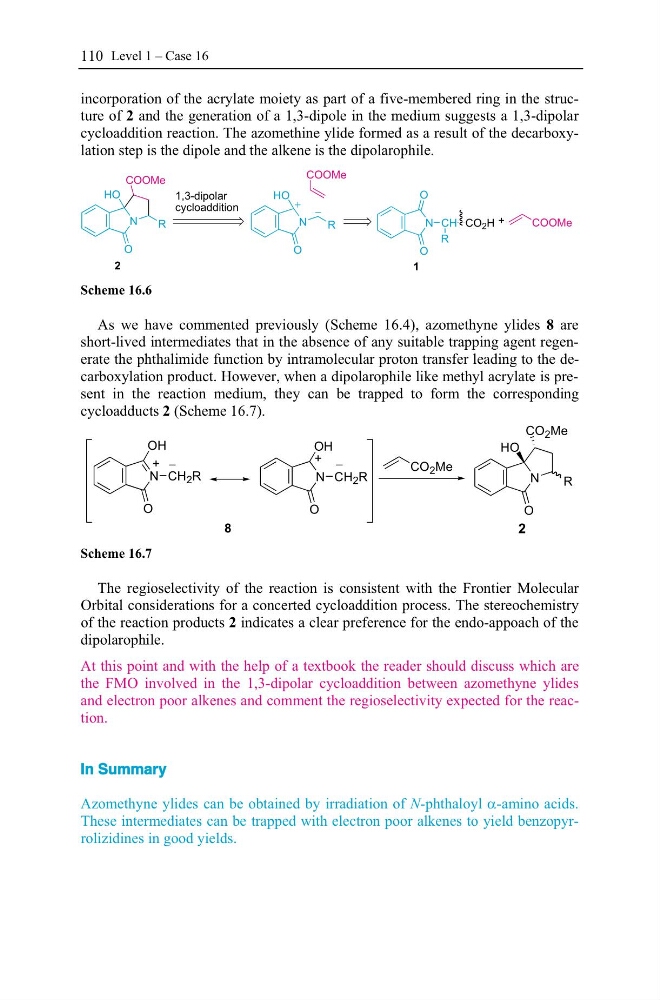
incorporation of the acrylate moiety as part of a five-membered ring in the structure of 2 and the generation of a 1,3-dipole in the medium suggests a 1,3-dipolar
cycloaddition reaction. The azomethine ylide formed as a result of the decarboxylation step is the dipole and the alkene is the dipolarophile.
N
HO
R
COOMe
N
HO
R
COOMe
N CH
R
CO 2 H +
COOMe
1
2
1,3-dipolar
cycloaddition
O
O
O
O
Scheme 16.6
As we have commented previously (Scheme 16.4), azomethyne ylides 8 are
short-lived intermediates that in the absence of any suitable trapping agent regenerate the phthalimide function by intramolecular proton transfer leading to the decarboxylation product. However, when a dipolarophile like methyl acrylate is present in the reaction medium, they can be trapped to form the corresponding
cycloadducts 2 (Scheme 16.7).
N
OH
CH 2 R
+
N
OH
CH 2 R
+
CO 2 Me
N
HO
CO 2 Me
R
2
8
O
O
O
Scheme 16.7
The regioselectivity of the reaction is consistent with the Frontier Molecular
Orbital considerations for a concerted cycloaddition process. The stereochemistry
of the reaction products 2 indicates a clear preference for the endo-appoach of the
dipolarophile.
At this point and with the help of a textbook the reader should discuss which are
the FMO involved in the 1,3-dipolar cycloaddition between azomethyne ylides
and electron poor alkenes and comment the regioselectivity expected for the reaction.
In Summary
Azomethyne ylides can be obtained by irradiation of N-phthaloyl D-amino acids.
These intermediates can be trapped with electron poor alkenes to yield benzopyrrolizidines in good yields.
110
incorporation of the acrylate moiety as part of a five-membered ring in the structure of 2 and the generation of a 1,3-dipole in the medium suggests a 1,3-dipolar
cycloaddition reaction. The azomethine ylide formed as a result of the decarboxylation step is the dipole and the alkene is the dipolarophile.
N
HO
R
COOMe
N
HO
R
COOMe
N CH
R
CO 2 H +
COOMe
1
2
1,3-dipolar
cycloaddition
O
O
O
O
Scheme 16.6
As we have commented previously (Scheme 16.4), azomethyne ylides 8 are
short-lived intermediates that in the absence of any suitable trapping agent regenerate the phthalimide function by intramolecular proton transfer leading to the decarboxylation product. However, when a dipolarophile like methyl acrylate is present in the reaction medium, they can be trapped to form the corresponding
cycloadducts 2 (Scheme 16.7).
N
OH
CH 2 R
+
N
OH
CH 2 R
+
CO 2 Me
N
HO
CO 2 Me
R
2
8
O
O
O
Scheme 16.7
The regioselectivity of the reaction is consistent with the Frontier Molecular
Orbital considerations for a concerted cycloaddition process. The stereochemistry
of the reaction products 2 indicates a clear preference for the endo-appoach of the
dipolarophile.
At this point and with the help of a textbook the reader should discuss which are
the FMO involved in the 1,3-dipolar cycloaddition between azomethyne ylides
and electron poor alkenes and comment the regioselectivity expected for the reaction.
In Summary
Azomethyne ylides can be obtained by irradiation of N-phthaloyl D-amino acids.
These intermediates can be trapped with electron poor alkenes to yield benzopyrrolizidines in good yields.