

Light-Induced Cycloadditions of N-Phthaloyl N N
D-Amino Acids 109
N
O
O
R
OH
O
N
O
O
R
O
O
H
N
O
O
CH 2 R
N
OH
O
CHR
N
OH
O R
O
O
-CO 2
1
hQ
6
7
8
SET
3
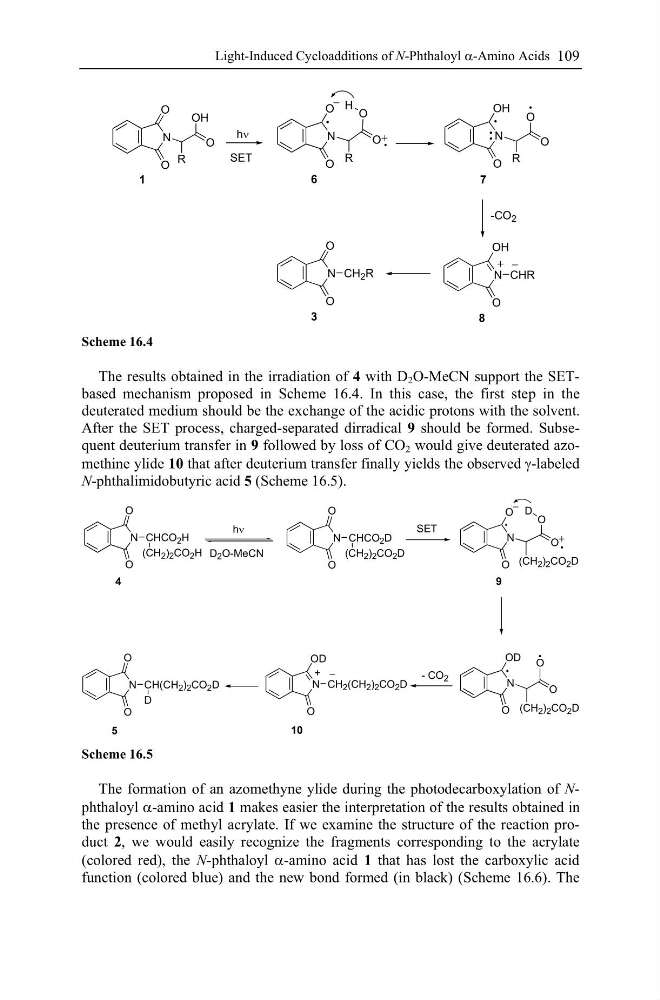
Scheme 16.4
The results obtained in the irradiation of 4 with D 2 O-MeCN support the SETbased mechanism proposed in Scheme 16.4. In this case, the first step in the
deuterated medium should be the exchange of the acidic protons with the solvent.
After the SET process, charged-separated dirradical 9 should be formed. Subsequent deuterium transfer in 9 followed by loss of CO 2 would give deuterated azomethine ylide 10 that after deuterium transfer finally yields the observed J-labeled
N-phthalimidobutyric acid
N N
5 (Scheme 16.5).
N CHCO 2 H
(CH 2 ) 2 CO 2 H
D
N CH(CH 2 ) 2 CO 2 D
D 2 O-MeCN
N
OD
CH 2 (CH 2 ) 2 CO 2 D
+
N CHCO 2 D
(CH 2 ) 2 CO 2 D
- CO 2
N
OD O
O
(CH 2 ) 2 CO 2 D
N
O
O
D
O
(CH 2 ) 2 CO 2 D
10
5
9
SET
4
hQ
O
O
O
O
O
O
O
O
O
Scheme 16.5
The formation of an azomethyne ylide during the photodecarboxylation of N- N N
phthaloyl D-amino acid 1 makes easier the interpretation of the results obtained in
the presence of methyl acrylate. If we examine the structure of the reaction product 2, we would easily recognize the fragments corresponding to the acrylate
(colored red), the N-phthaloyl N N
D-amino acid 1 that has lost the carboxylic acid
function (colored blue) and the new bond formed (in black) (Scheme 16.6). The
D-Amino Acids 109
N
O
O
R
OH
O
N
O
O
R
O
O
H
N
O
O
CH 2 R
N
OH
O
CHR
N
OH
O R
O
O
-CO 2
1
hQ
6
7
8
SET
3
Scheme 16.4
The results obtained in the irradiation of 4 with D 2 O-MeCN support the SETbased mechanism proposed in Scheme 16.4. In this case, the first step in the
deuterated medium should be the exchange of the acidic protons with the solvent.
After the SET process, charged-separated dirradical 9 should be formed. Subsequent deuterium transfer in 9 followed by loss of CO 2 would give deuterated azomethine ylide 10 that after deuterium transfer finally yields the observed J-labeled
N-phthalimidobutyric acid
N N
5 (Scheme 16.5).
N CHCO 2 H
(CH 2 ) 2 CO 2 H
D
N CH(CH 2 ) 2 CO 2 D
D 2 O-MeCN
N
OD
CH 2 (CH 2 ) 2 CO 2 D
+
N CHCO 2 D
(CH 2 ) 2 CO 2 D
- CO 2
N
OD O
O
(CH 2 ) 2 CO 2 D
N
O
O
D
O
(CH 2 ) 2 CO 2 D
10
5
9
SET
4
hQ
O
O
O
O
O
O
O
O
O
Scheme 16.5
The formation of an azomethyne ylide during the photodecarboxylation of N- N N
phthaloyl D-amino acid 1 makes easier the interpretation of the results obtained in
the presence of methyl acrylate. If we examine the structure of the reaction product 2, we would easily recognize the fragments corresponding to the acrylate
(colored red), the N-phthaloyl N N
D-amino acid 1 that has lost the carboxylic acid
function (colored blue) and the new bond formed (in black) (Scheme 16.6). The