

Level 1 – Case 16
108
E Ex xp pe er ri im me en nt ta al l D Da at ta a
N-Phthaloyl N N
D-amino acids 1 undergo photodecarboxylation to generate the corresponding N-alkylphthalimides N N
3. It is believed that the photodecarboxylation occurs by photoinduced single electron transfer (SET) involving the electronically
excited phthalimide as electron acceptor and the carboxylic acid as electron donor
a
(Scheme 16.2).
N CH
R
COOH
O
O
MeCN
N CH 2 R
O
O
3
1
hQ
Scheme 16.2
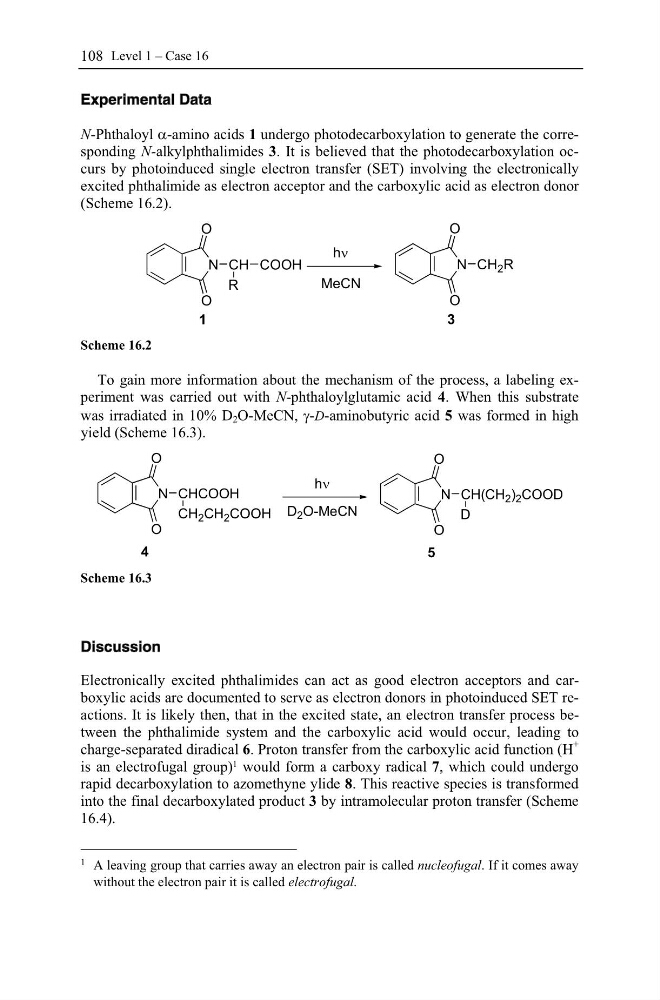
To gain more information about the mechanism of the process, a labeling experiment was carried out with N-phthaloylglutamic acid
N N
4. When this substrate
was irradiated in 10% D 2 O-MeCN, J-D-aminobutyric acid 5 was formed in high
yield (Scheme 16.3).
N CHCOOH
CH 2 CH 2 COOH
O
O
D 2 O-MeCN
CH(CH 2 ) 2 COOD
D
N
O
O
5
4
hQ
Scheme 16.3
D Di is sc cu us ss si io on n
Electronically excited phthalimides can act as good electron acceptors and carboxylic acids are documented to serve as electron donors in photoinduced SET reactions. It is likely then, that in the excited state, an electron transfer process between the phthalimide system and the carboxylic acid would occur, leading to
charge-separated diradical 6. Proton transfer from the carboxylic acid function (H
+
is an electrofugal group)
1 would form a carboxy radical 7, which could undergo
rapid decarboxylation to azomethyne ylide 8. This reactive species is transformed
into the final decarboxylated product
r
3 by intramolecular proton transfer (Scheme
16.4).
1 A leaving group that carries away an electron pair is called nucleofugal. If it comes away
without the electron pair it is called electrofugal.
108
E Ex xp pe er ri im me en nt ta al l D Da at ta a
N-Phthaloyl N N
D-amino acids 1 undergo photodecarboxylation to generate the corresponding N-alkylphthalimides N N
3. It is believed that the photodecarboxylation occurs by photoinduced single electron transfer (SET) involving the electronically
excited phthalimide as electron acceptor and the carboxylic acid as electron donor
a
(Scheme 16.2).
N CH
R
COOH
O
O
MeCN
N CH 2 R
O
O
3
1
hQ
Scheme 16.2
To gain more information about the mechanism of the process, a labeling experiment was carried out with N-phthaloylglutamic acid
N N
4. When this substrate
was irradiated in 10% D 2 O-MeCN, J-D-aminobutyric acid 5 was formed in high
yield (Scheme 16.3).
N CHCOOH
CH 2 CH 2 COOH
O
O
D 2 O-MeCN
CH(CH 2 ) 2 COOD
D
N
O
O
5
4
hQ
Scheme 16.3
D Di is sc cu us ss si io on n
Electronically excited phthalimides can act as good electron acceptors and carboxylic acids are documented to serve as electron donors in photoinduced SET reactions. It is likely then, that in the excited state, an electron transfer process between the phthalimide system and the carboxylic acid would occur, leading to
charge-separated diradical 6. Proton transfer from the carboxylic acid function (H
+
is an electrofugal group)
1 would form a carboxy radical 7, which could undergo
rapid decarboxylation to azomethyne ylide 8. This reactive species is transformed
into the final decarboxylated product
r
3 by intramolecular proton transfer (Scheme
16.4).
1 A leaving group that carries away an electron pair is called nucleofugal. If it comes away
without the electron pair it is called electrofugal.