

Level 1 – Case 15
104
tals involved in the reaction. It is true that the greatest bonding interaction is
achieved by pairing the two centers with the large coefficients rather than pairing
large with small positions (principle of maximum overlap). However, the first
condition for two lobes to overlap is to have the same sign. Two lobes with opposite signs could never overlap, even if they have similar sizes. Therefore, size is
always a secondary factor to consider after sign.
S St te te t te te te te t ter re re r re re re re r reo os se el le le l le le le
l lec ct ti ti ti t ti ti t tiv vi vi vi v vi vi v vit ty ty ty y
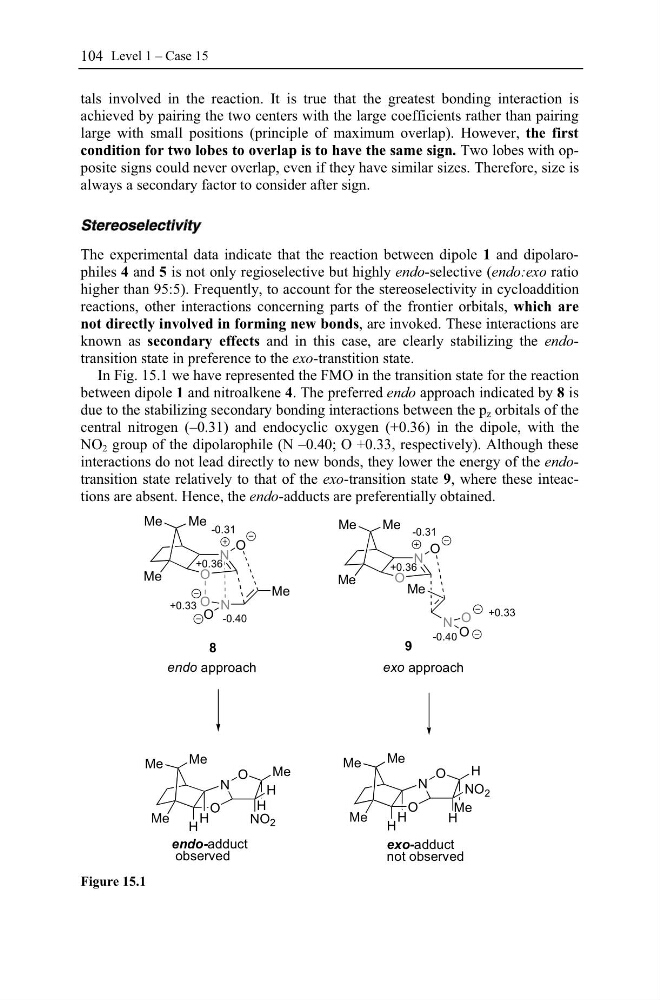
The experimental data indicate that the reaction between dipole 1 and dipolarophiles 4 and 5 is not only regioselective but highly endo-selective (endo:exo ratio
higher than 95:5). Frequently, to account for the stereoselectivity in cycloaddition
reactions, other interactions concerning parts of the frontier orbitals, which are
not directly involved in forming new bonds, are invoked. These interactions are
known as secondary effects and in this case, are clearly stabilizing the endotransition state in preference to the exo-transtition state.
In Fig. 15.1 we have represented the FMO in the transition state for the reaction
between dipole 1 and nitroalkene 4. The preferred endo approach indicated by 8 is
due to the stabilizing secondary bonding interactions between the p z orbitals of the
central nitrogen (–0.31) and endocyclic oxygen (+0.36) in the dipole, with the
NO 2 group of the dipolarophile (N –0.40; O +0.33, respectively). Although these
interactions do not lead directly to new bonds, they lower the energy of the endotransition state relatively to that of the exo-transition state 9, where these inteactions are absent. Hence, the endo-adducts are preferentially obtained.
Me
Me
O
Me
Me
N
O
O
N
O
Me
N
Me
N
Me
O
O
Me
O
O
N
Me
Me
Me
O
H
H
O
H
H
Me
NO 2
Me
H
H
N
Me
Me
O
H
Me
NO 2
H
O
+0.36
8
-0.31
+0.33
-0.40
+0.36
-0.31
exo-adduct
not observed
endo approach
9
exo approach
endo-adduct
observed
+0.33
-0.40
Figure 15.1
104
tals involved in the reaction. It is true that the greatest bonding interaction is
achieved by pairing the two centers with the large coefficients rather than pairing
large with small positions (principle of maximum overlap). However, the first
condition for two lobes to overlap is to have the same sign. Two lobes with opposite signs could never overlap, even if they have similar sizes. Therefore, size is
always a secondary factor to consider after sign.
S St te te t te te te te t ter re re r re re re re r reo os se el le le l le le le
l lec ct ti ti ti t ti ti t tiv vi vi vi v vi vi v vit ty ty ty y
The experimental data indicate that the reaction between dipole 1 and dipolarophiles 4 and 5 is not only regioselective but highly endo-selective (endo:exo ratio
higher than 95:5). Frequently, to account for the stereoselectivity in cycloaddition
reactions, other interactions concerning parts of the frontier orbitals, which are
not directly involved in forming new bonds, are invoked. These interactions are
known as secondary effects and in this case, are clearly stabilizing the endotransition state in preference to the exo-transtition state.
In Fig. 15.1 we have represented the FMO in the transition state for the reaction
between dipole 1 and nitroalkene 4. The preferred endo approach indicated by 8 is
due to the stabilizing secondary bonding interactions between the p z orbitals of the
central nitrogen (–0.31) and endocyclic oxygen (+0.36) in the dipole, with the
NO 2 group of the dipolarophile (N –0.40; O +0.33, respectively). Although these
interactions do not lead directly to new bonds, they lower the energy of the endotransition state relatively to that of the exo-transition state 9, where these inteactions are absent. Hence, the endo-adducts are preferentially obtained.
Me
Me
O
Me
Me
N
O
O
N
O
Me
N
Me
N
Me
O
O
Me
O
O
N
Me
Me
Me
O
H
H
O
H
H
Me
NO 2
Me
H
H
N
Me
Me
O
H
Me
NO 2
H
O
+0.36
8
-0.31
+0.33
-0.40
+0.36
-0.31
exo-adduct
not observed
endo approach
9
exo approach
endo-adduct
observed
+0.33
-0.40
Figure 15.1