

Oxazoline N-Oxides as Dipoles in [3+2] Cycloadditions
N N
105
Exercise: Represent the endo- and exo-transition states for the reaction between
dipole 1 and ester 5. In this case, the endo-transition state is favored by the secondary bonding interactions between the nitrogen and endocyclic oxygen in the dipole and the CO 2 group of the dipolarophile.
In Summary
The reactivity, regioselectivity and stereoselectivity of [3+2] cycloadditions of
oxazoline N-oxides and DE-unsaturated esters or nitroalkenes can be rationalized
in terms of the FMO theory. The reactions are HOMO-dipole controlled and the
preferred endo-selectivity in those cycloadditions can be rationalized by stabilizing secondary orbital interactions only present in the endo-approach.
Q Qu ue es st ti io on ns s
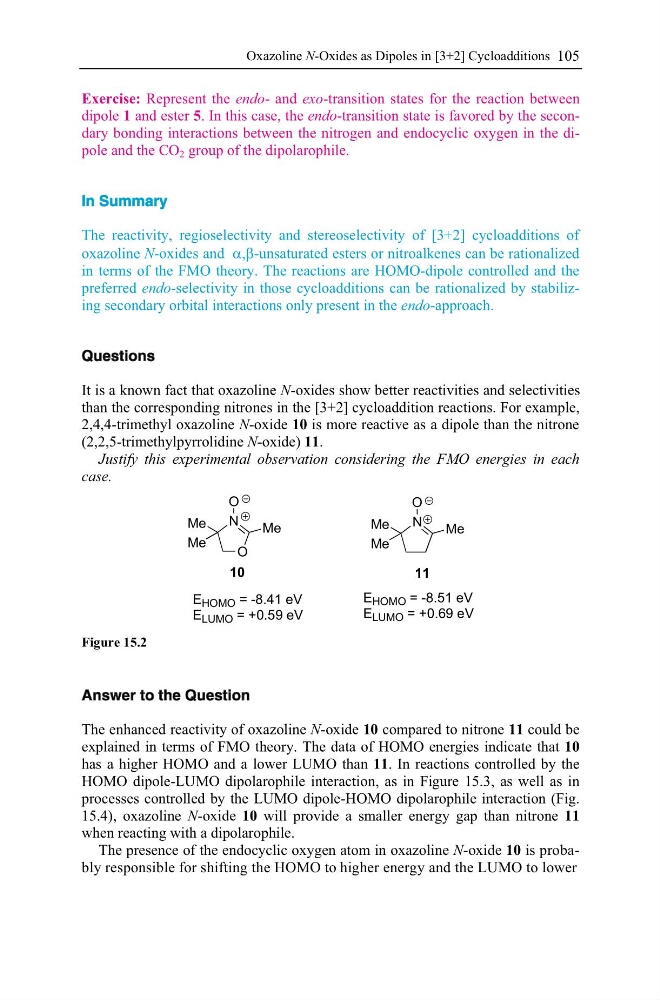
It is a known fact that oxazoline N-oxides show better reactivities and selectivities
N N
than the corresponding nitrones in the [3+2] cycloaddition reactions. For example,
2,4,4-trimethyl oxazoline N-oxide N N
10 is more reactive as a dipole than the nitrone
(2,2,5-trimethylpyrrolidine N-oxide) N N
11.
Justify this experimental observation considering the FMO energies in each
case.
O
N
Me
Me
O
Me
N
Me
Me
O
Me
E HOMO = -8.41 eV
E LUMO = +0.59 eV
E HOMO = -8.51 eV
E LUMO = +0.69 eV
10
11
Figure 15.2
A An ns sw we er r t to o t th he e Q Qu ue es st ti io on n
The enhanced reactivity of oxazoline N-oxide N N
10 compared to nitrone 11 could be
explained in terms of FMO theory. The data of HOMO energies indicate that 10
has a higher HOMO and a lower LUMO than 11. In reactions controlled by the
HOMO dipole-LUMO dipolarophile interaction, as in Figure 15.3, as well as in
processes controlled by the LUMO dipole-HOMO dipolarophile interaction (Fig.
15.4), oxazoline N-oxide N N
10 will provide a smaller energy gap than nitrone 11
when reacting with a dipolarophile.
The presence of the endocyclic oxygen atom in oxazoline N-oxide N N
10 is probably responsible for shifting the HOMO to higher energy and the LUMO to lower
N N
105
Exercise: Represent the endo- and exo-transition states for the reaction between
dipole 1 and ester 5. In this case, the endo-transition state is favored by the secondary bonding interactions between the nitrogen and endocyclic oxygen in the dipole and the CO 2 group of the dipolarophile.
In Summary
The reactivity, regioselectivity and stereoselectivity of [3+2] cycloadditions of
oxazoline N-oxides and DE-unsaturated esters or nitroalkenes can be rationalized
in terms of the FMO theory. The reactions are HOMO-dipole controlled and the
preferred endo-selectivity in those cycloadditions can be rationalized by stabilizing secondary orbital interactions only present in the endo-approach.
Q Qu ue es st ti io on ns s
It is a known fact that oxazoline N-oxides show better reactivities and selectivities
N N
than the corresponding nitrones in the [3+2] cycloaddition reactions. For example,
2,4,4-trimethyl oxazoline N-oxide N N
10 is more reactive as a dipole than the nitrone
(2,2,5-trimethylpyrrolidine N-oxide) N N
11.
Justify this experimental observation considering the FMO energies in each
case.
O
N
Me
Me
O
Me
N
Me
Me
O
Me
E HOMO = -8.41 eV
E LUMO = +0.59 eV
E HOMO = -8.51 eV
E LUMO = +0.69 eV
10
11
Figure 15.2
A An ns sw we er r t to o t th he e Q Qu ue es st ti io on n
The enhanced reactivity of oxazoline N-oxide N N
10 compared to nitrone 11 could be
explained in terms of FMO theory. The data of HOMO energies indicate that 10
has a higher HOMO and a lower LUMO than 11. In reactions controlled by the
HOMO dipole-LUMO dipolarophile interaction, as in Figure 15.3, as well as in
processes controlled by the LUMO dipole-HOMO dipolarophile interaction (Fig.
15.4), oxazoline N-oxide N N
10 will provide a smaller energy gap than nitrone 11
when reacting with a dipolarophile.
The presence of the endocyclic oxygen atom in oxazoline N-oxide N N
10 is probably responsible for shifting the HOMO to higher energy and the LUMO to lower