

Oxazoline N-Oxides as Dipoles in [3+2] Cycloadditions
N N
103
suggests that in both cases the narrower HOMO-LUMO gap involves the HOMO
of 1 (dipole) and the LUMO of the alkene (dipolarophile). Therefore, the reactions
are HOMO dipole-controlled.
To decide which alkene (4 or 5) is more reactive towards dipole 1 we have to
calculate the HOMO dipole-LUMO alkene energy difference in each case. That is,
the smaller difference in energy will lead to a faster reaction. The HOMO-LUMO
d
gaps are 7.71 eV in the case of nitroalkene 4 and 8.57 eV in the case of ester 5.
Hence, the cycloaddition between oxazoline N-oxide N N
1 and nitroalkene 4 is faster
than the reaction with ester 5.
R Re e e
Reg g g gi i i
gio io io io i ios se el le le l le le le l lec ct ti ti ti t ti ti t tiv vi vi vi v vi vi v vit ity ty ty y
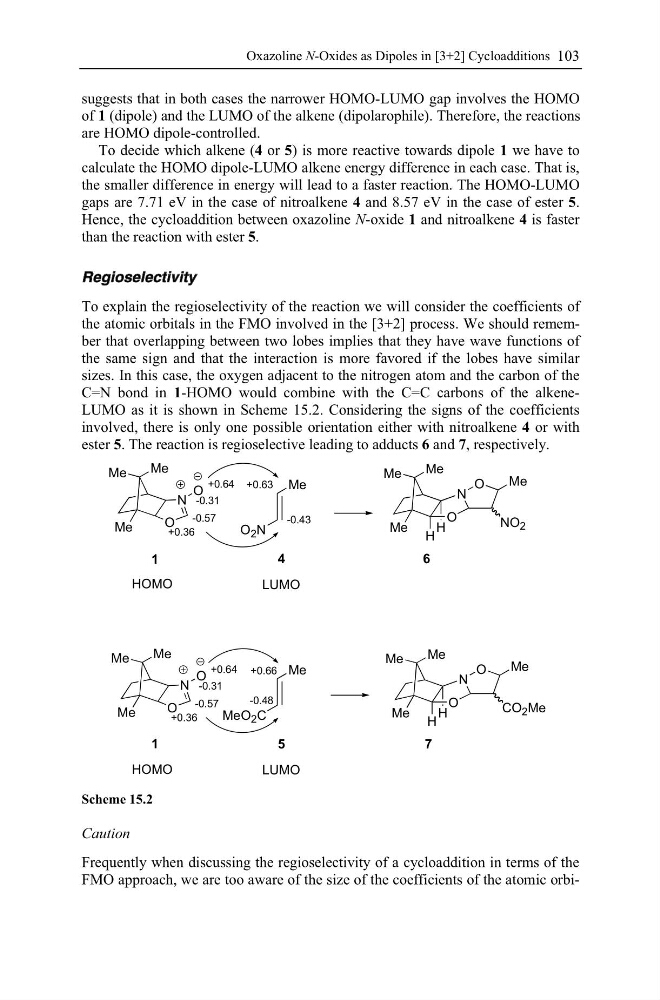
To explain the regioselectivity of the reaction we will consider the coefficients of
the atomic orbitals in the FMO involved in the [3+2] process. We should remember that overlapping between two lobes implies that they have wave functions of
the same sign and that the interaction is more favored if the lobes have similar
sizes. In this case, the oxygen adjacent to the nitrogen atom and the carbon of the
C=N bond in 1-HOMO would combine with the C=C carbons of the alkeneLUMO as it is shown in Scheme 15.2. Considering the signs of the coefficients
involved, there is only one possible orientation either with nitroalkene 4 or with
ester 5. The reaction is regioselective leading to adducts 6 and 7, respectively.
1
-0.48
+0.66
HOMO
-0.43
+0.63
LUMO
4
Me
O 2 N
1
HOMO
LUMO
5
Me
MeO 2 C
N
Me
Me
Me
O
H
H
O
Me
O
N
O
Me
Me
Me
+0.64
-0.31
-0.57
+0.36
NO 2
6
Me
Me
Me
O
H
H
O
Me
CO 2 Me
7
N
O
Me
Me
Me
+0.64
-0.31
-0.57
+0.36
Scheme 15.2
Caution
Frequently when discussing the regioselectivity of a cycloaddition in terms of the
FMO approach, we are too aware of the size of the coefficients of the atomic orbi-
N N
103
suggests that in both cases the narrower HOMO-LUMO gap involves the HOMO
of 1 (dipole) and the LUMO of the alkene (dipolarophile). Therefore, the reactions
are HOMO dipole-controlled.
To decide which alkene (4 or 5) is more reactive towards dipole 1 we have to
calculate the HOMO dipole-LUMO alkene energy difference in each case. That is,
the smaller difference in energy will lead to a faster reaction. The HOMO-LUMO
d
gaps are 7.71 eV in the case of nitroalkene 4 and 8.57 eV in the case of ester 5.
Hence, the cycloaddition between oxazoline N-oxide N N
1 and nitroalkene 4 is faster
than the reaction with ester 5.
R Re e e
Reg g g gi i i
gio io io io i ios se el le le l le le le l lec ct ti ti ti t ti ti t tiv vi vi vi v vi vi v vit ity ty ty y
To explain the regioselectivity of the reaction we will consider the coefficients of
the atomic orbitals in the FMO involved in the [3+2] process. We should remember that overlapping between two lobes implies that they have wave functions of
the same sign and that the interaction is more favored if the lobes have similar
sizes. In this case, the oxygen adjacent to the nitrogen atom and the carbon of the
C=N bond in 1-HOMO would combine with the C=C carbons of the alkeneLUMO as it is shown in Scheme 15.2. Considering the signs of the coefficients
involved, there is only one possible orientation either with nitroalkene 4 or with
ester 5. The reaction is regioselective leading to adducts 6 and 7, respectively.
1
-0.48
+0.66
HOMO
-0.43
+0.63
LUMO
4
Me
O 2 N
1
HOMO
LUMO
5
Me
MeO 2 C
N
Me
Me
Me
O
H
H
O
Me
O
N
O
Me
Me
Me
+0.64
-0.31
-0.57
+0.36
NO 2
6
Me
Me
Me
O
H
H
O
Me
CO 2 Me
7
N
O
Me
Me
Me
+0.64
-0.31
-0.57
+0.36
Scheme 15.2
Caution
Frequently when discussing the regioselectivity of a cycloaddition in terms of the
FMO approach, we are too aware of the size of the coefficients of the atomic orbi-