

Level 1 – Case 14
100
the expense of the dihydronaphthalene 3, when harsher reaction conditions (excess
of triflic acid, prolonged heating) are used. Then, it is reasonable to think that 4
was obtained by dearylation of 3 in the acidic medium.
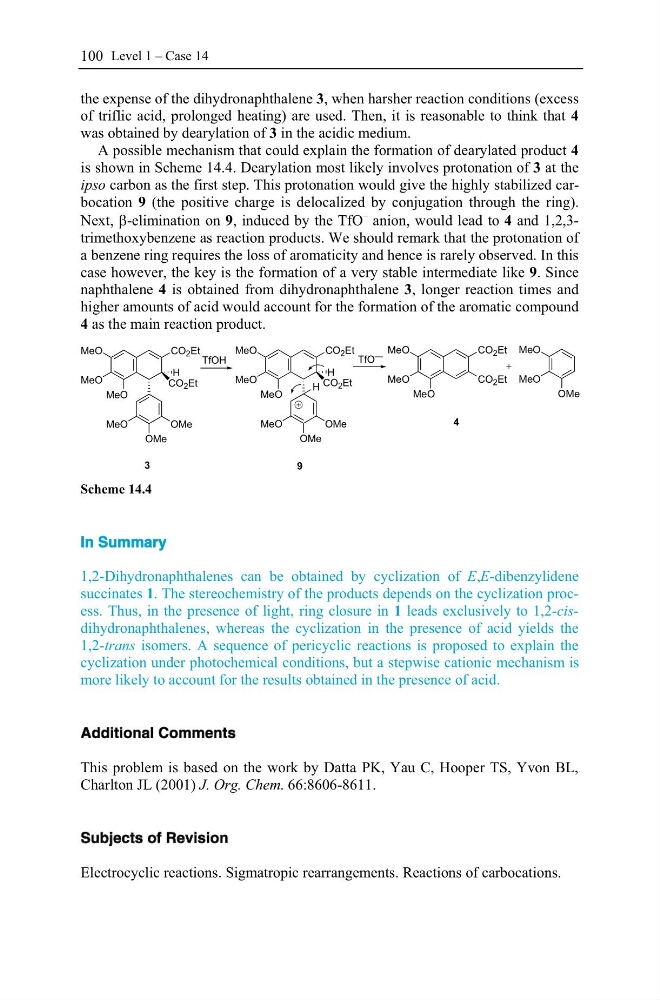
A possible mechanism that could explain the formation of dearylated product 4
is shown in Scheme 14.4. Dearylation most likely involves protonation of 3 at the
ipso carbon as the first step. This protonation would give the highly stabilized carbocation 9 (the positive charge is delocalized by conjugation through the ring).
Next, E-elimination on 9, induced by the TfO
– anion, would lead to
–
4 and 1,2,3trimethoxybenzene as reaction products. We should remark that the protonation of
a benzene ring requires the loss of aromaticity and hence is rarely observed. In this
case however, the key is the formation of a very stable intermediate like 9. Since
naphthalene 4 is obtained from dihydronaphthalene 3, longer reaction times and
higher amounts of acid would account for the formation of the aromatic compound
f
4 as the main reaction product.
CO 2 Et
CO 2 Et
H
MeO
MeO
MeO
OMe
OMe
MeO
TfOH
CO 2 Et
CO 2 Et
H
H
MeO
MeO
MeO
OMe
OMe
MeO
TfO —
CO 2 Et
CO 2 Et
MeO
MeO
MeO
3
9
4
MeO
OMe
MeO
Scheme 14.4
In Summary
1,2-Dihydronaphthalenes can be obtained by cyclization of E,E-dibenzylidene
succinates 1. The stereochemistry of the products depends on the cyclization process. Thus, in the presence of light, ring closure in 1 leads exclusively to 1,2-cisdihydronaphthalenes, whereas the cyclization in the presence of acid yields the
1,2-trans isomers. A sequence of pericyclic reactions is proposed to explain the
cyclization under photochemical conditions, but a stepwise cationic mechanism is
more likely to account for the results obtained in the presence of acid.
A Ad dd di it ti io on na al l C Co om mm me en nt ts s
This problem is based on the work by Datta PK, Yau C, Hooper TS, Yvon BL,
Charlton JL (2001) J. Org. Chem. 66:8606-8611.
S Su ub bj je ec ct ts s o of f R Re ev vi is si io on n
Electrocyclic reactions. Sigmatropic rearrangements. Reactions of carbocations.
100
the expense of the dihydronaphthalene 3, when harsher reaction conditions (excess
of triflic acid, prolonged heating) are used. Then, it is reasonable to think that 4
was obtained by dearylation of 3 in the acidic medium.
A possible mechanism that could explain the formation of dearylated product 4
is shown in Scheme 14.4. Dearylation most likely involves protonation of 3 at the
ipso carbon as the first step. This protonation would give the highly stabilized carbocation 9 (the positive charge is delocalized by conjugation through the ring).
Next, E-elimination on 9, induced by the TfO
– anion, would lead to
–
4 and 1,2,3trimethoxybenzene as reaction products. We should remark that the protonation of
a benzene ring requires the loss of aromaticity and hence is rarely observed. In this
case however, the key is the formation of a very stable intermediate like 9. Since
naphthalene 4 is obtained from dihydronaphthalene 3, longer reaction times and
higher amounts of acid would account for the formation of the aromatic compound
f
4 as the main reaction product.
CO 2 Et
CO 2 Et
H
MeO
MeO
MeO
OMe
OMe
MeO
TfOH
CO 2 Et
CO 2 Et
H
H
MeO
MeO
MeO
OMe
OMe
MeO
TfO —
CO 2 Et
CO 2 Et
MeO
MeO
MeO
3
9
4
MeO
OMe
MeO
Scheme 14.4
In Summary
1,2-Dihydronaphthalenes can be obtained by cyclization of E,E-dibenzylidene
succinates 1. The stereochemistry of the products depends on the cyclization process. Thus, in the presence of light, ring closure in 1 leads exclusively to 1,2-cisdihydronaphthalenes, whereas the cyclization in the presence of acid yields the
1,2-trans isomers. A sequence of pericyclic reactions is proposed to explain the
cyclization under photochemical conditions, but a stepwise cationic mechanism is
more likely to account for the results obtained in the presence of acid.
A Ad dd di it ti io on na al l C Co om mm me en nt ts s
This problem is based on the work by Datta PK, Yau C, Hooper TS, Yvon BL,
Charlton JL (2001) J. Org. Chem. 66:8606-8611.
S Su ub bj je ec ct ts s o of f R Re ev vi is si io on n
Electrocyclic reactions. Sigmatropic rearrangements. Reactions of carbocations.